Department of Emergency Medicine, Emergency Medical Laboratory, West China Hospital, Sichuan University, Chengdu, Sichuan, China.
Disaster Medical Center, Sichuan University, Chengdu, Sichuan, China.
PLoS One. 2020 May 18;15(5):e0233328. doi: 10.1371/journal.pone.0233328. eCollection 2020.
Since December 2019, coronavirus disease 2019 (COVID-19) emerged in Wuhan and spread across the globe. The objective of this study is to build and validate a practical nomogram for estimating the risk of severe COVID-19.
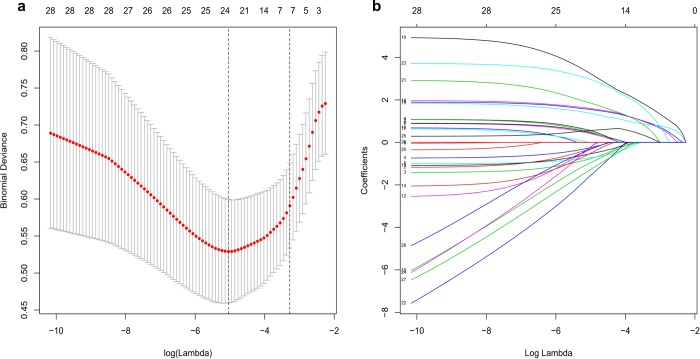
A cohort of 366 patients with laboratory-confirmed COVID-19 was used to develop a prediction model using data collected from 47 locations in Sichuan province from January 2020 to February 2020. The primary outcome was the development of severe COVID-19 during hospitalization. The least absolute shrinkage and selection operator (LASSO) regression model was used to reduce data size and select relevant features. Multivariable logistic regression analysis was applied to build a prediction model incorporating the selected features. The performance of the nomogram regarding the C-index, calibration, discrimination, and clinical usefulness was assessed. Internal validation was assessed by bootstrapping.
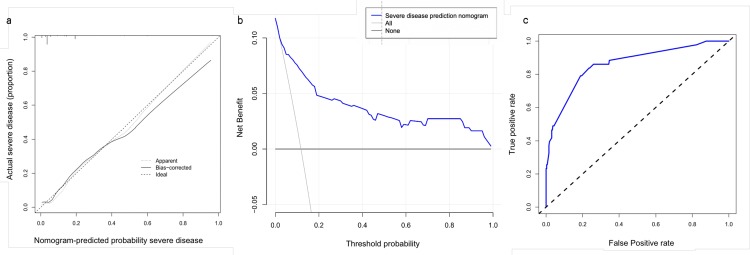
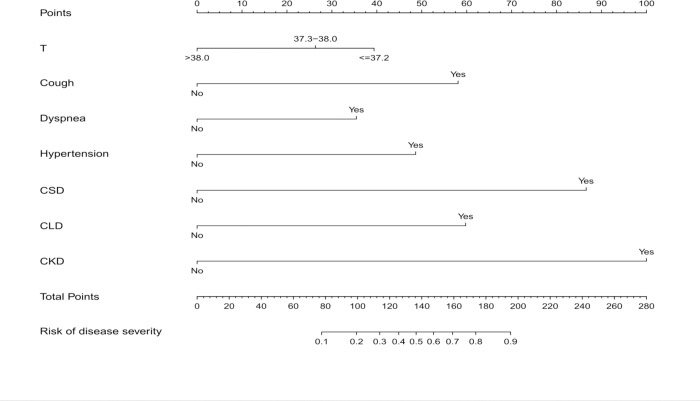
The median age of the cohort was 43 years. Severe patients were older than mild patients by a median of 6 years. Fever, cough, and dyspnea were more common in severe patients. The individualized prediction nomogram included seven predictors: body temperature at admission, cough, dyspnea, hypertension, cardiovascular disease, chronic liver disease, and chronic kidney disease. The model had good discrimination with an area under the curve of 0.862, C-index of 0.863 (95% confidence interval, 0.801-0.925), and good calibration. A high C-index value of 0.839 was reached in the interval validation. Decision curve analysis showed that the prediction nomogram was clinically useful.
We established an early warning model incorporating clinical characteristics that could be quickly obtained on admission. This model can be used to help predict severe COVID-19 and identify patients at risk of developing severe disease.
自 2019 年 12 月以来,新型冠状病毒病 2019(COVID-19)在武汉出现并在全球范围内传播。本研究的目的是建立并验证一种实用的列线图,以估计 COVID-19 重症的风险。
我们使用了 2020 年 1 月至 2 月期间从四川省 47 个地点收集的实验室确诊 COVID-19 患者的队列来建立预测模型。主要结局是住院期间发生严重 COVID-19。最小绝对收缩和选择算子(LASSO)回归模型用于减少数据量并选择相关特征。应用多变量逻辑回归分析来构建包含选定特征的预测模型。通过自举法评估列线图的 C 指数、校准、区分度和临床实用性。
队列的中位年龄为 43 岁。严重组患者比轻症组患者的年龄中位数大 6 岁。发热、咳嗽和呼吸困难在严重组患者中更为常见。个体化预测列线图包括七个预测因子:入院时体温、咳嗽、呼吸困难、高血压、心血管疾病、慢性肝病和慢性肾脏病。该模型具有良好的区分度,曲线下面积为 0.862,C 指数为 0.863(95%置信区间,0.801-0.925),校准度良好。间隔验证中 C 指数值高达 0.839。决策曲线分析表明该预测列线图具有临床实用性。
我们建立了一个纳入入院时可快速获得的临床特征的预警模型。该模型可用于帮助预测严重 COVID-19 并识别发生严重疾病风险较高的患者。