Department of Medical Laboratory Science, School of Laboratory Medicine and Life Science, Wenzhou Medical University, Wenzhou, Zhejiang Province, China.
Department of Clinical Laboratory, The First Affiliated Hospital of Wenzhou Medical University, Wenzhou, Zhejiang Province, China.
Antimicrob Resist Infect Control. 2020 Oct 2;9(1):161. doi: 10.1186/s13756-020-00823-5.
The widespread application of triclosan contributes to its residual deposition in urine, which provides an environment of long-term exposure to triclosan for the intestinal Escherichia coli. We determined the triclosan and antibiotic resistance characteristics of E. coli strains isolated from urine samples and further investigated the resistance mechanism and molecular epidemic characteristics of triclosan-resistant E. coli isolates.
A total of 200 non-repetitive E. coli strains were isolated from urine samples and then identified. The minimum inhibitory concentrations (MICs) of triclosan and antibiotics, fabI mutation, efflux pump activity, the expression of 14 efflux pump encoding genes, and epidemiological characteristics were determined by the agar dilution method, polymerase chain reaction (PCR), carbonyl cyanide 3-chlorophenylhydrazone (CCCP) inhibition test, quantitative real-time polymerase chain reaction (RT-qPCR), multilocus sequence typing (MLST), and pulse-field gel electrophoresis (PFGE) for all triclosan-resistant isolates. Furthermore, we also investigated the effect of triclosan exposure in vitro on antibiotic susceptibility and the efflux pump encoding gene expressions of triclosan-susceptible strains via serial passage experiments.
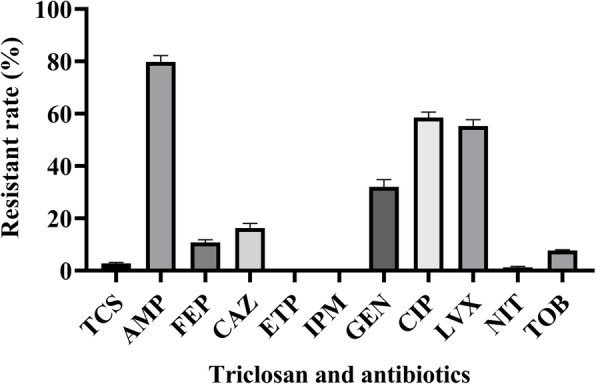
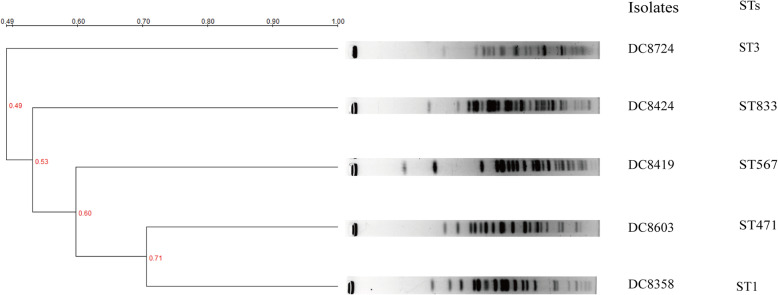
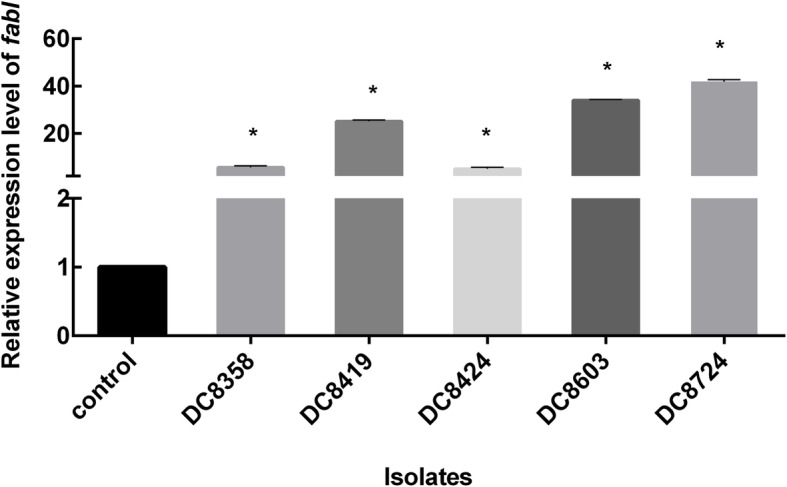
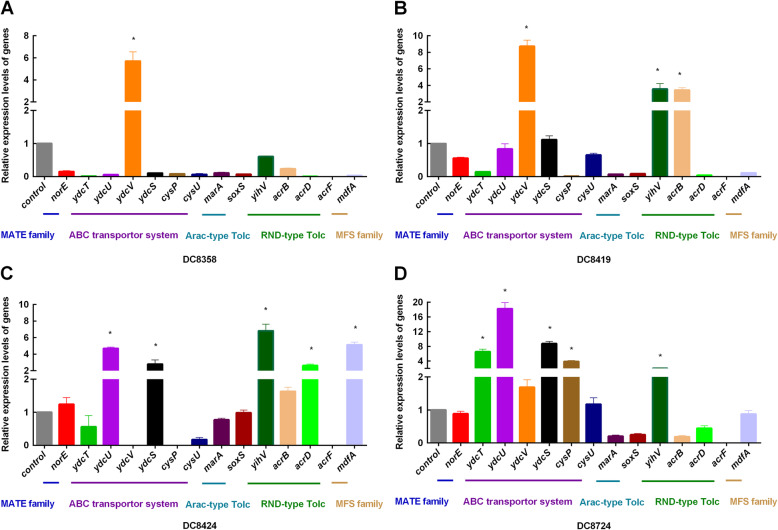
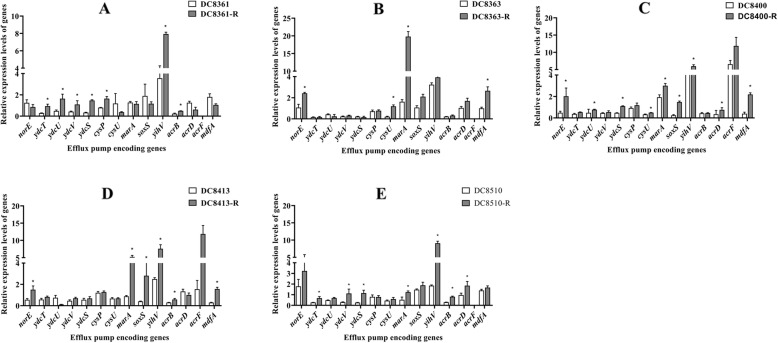
Of the 200 E. coli isolates, 2.5% (n = 5) were found to be resistant to triclosan, and multidrug resistance (MDR) and cross-resistance phenotypes were noted for these triclosan-resistant strains. The triclosan-sensitive strains also exhibited MDR phenotypes, probably because of the high resistance rate to AMP, CIP, LVX, and GEN. Gly79Ala and Ala69Thr amino acid changes were observed in the triclosan-resistant strains, but these changes may not mediate resistance of E. coli to triclosan, because mutations of these two amino acids has also been detected in triclosan-susceptible strains. Moreover, except for DC8603, all other strains enhanced the efflux pumps activity. As compared with ATCC 25922, except for fabI, increased expressions were noted for all efflux pump encoding genes such as ydcV, ydcU, ydcS, ydcT, cysP, yihV, acrB, acrD, and mdfA among the studied strains with varying PFGE patterns and STs types. Unexpectedly, 5 susceptible E. coli isolates showed rapidly increasing triclosan resistance after exposure to triclosan in vitro for only 12 days, while MDR or cross-resistance phenotypes and the overexpression of efflux pump genes were recorded among these triclosan-induced resistant isolates.
This is the first study to report that short-term triclosan exposure in vitro increases triclosan resistance in susceptible E. coli isolates. After acquiring resistance, these strains may present MDR or cross-resistance phenotypes. Moreover, triclosan resistance mainly involves the overexpression of fabI and efflux pumps in E. coli isolates.
三氯生的广泛应用导致其在尿液中残留沉积,为肠道大肠杆菌(Escherichia coli)提供了长期接触三氯生的环境。我们从尿液样本中分离出大肠杆菌菌株,测定了三氯生和抗生素的最小抑菌浓度(MIC),并进一步研究了三氯生耐药大肠杆菌分离株的耐药机制和分子流行特征。
从尿液样本中分离出 200 株非重复大肠杆菌菌株,然后进行鉴定。采用琼脂稀释法、聚合酶链反应(PCR)、碳酰氰基-3-氯苯腙(CCCP)抑制试验、定量实时 PCR(RT-qPCR)、多位点序列分型(MLST)和脉冲场凝胶电泳(PFGE)测定三氯生和抗生素的最小抑菌浓度(MIC)、fabI 突变、外排泵活性、14 个外排泵编码基因的表达及所有三氯生耐药分离株的流行特征。此外,我们还通过连续传代实验,研究了体外暴露于三氯生对三氯生敏感株抗生素敏感性和外排泵编码基因表达的影响。
200 株大肠杆菌分离株中,有 2.5%(n=5)对三氯生耐药,且这些三氯生耐药株表现出多药耐药(MDR)和交叉耐药表型。三氯生敏感株也表现出 MDR 表型,可能是因为对 AMP、CIP、LVX 和 GEN 的耐药率较高。三氯生耐药株中观察到 Gly79Ala 和 Ala69Thr 氨基酸改变,但这些改变可能不是大肠杆菌对三氯生耐药的原因,因为在三氯生敏感株中也检测到这两种氨基酸的突变。此外,除 DC8603 外,所有其他菌株均增强了外排泵的活性。与 ATCC 25922 相比,在所研究的菌株中,除 fabI 外,所有其他菌株的外排泵编码基因如 ydcV、ydcU、ydcS、ydcT、cysP、yihV、acrB、acrD 和 mdfA 的表达均增加,且具有不同的 PFGE 模式和 ST 类型。出乎意料的是,5 株敏感大肠杆菌在体外仅接触 12 天三氯生后,其对三氯生的耐药性迅速增加,而这些三氯生诱导的耐药分离株则表现出 MDR 或交叉耐药表型和外排泵基因的过度表达。
这是第一项研究报告表明,体外短期接触三氯生会增加敏感大肠杆菌对三氯生的耐药性。获得耐药性后,这些菌株可能表现出 MDR 或交叉耐药表型。此外,三氯生耐药主要涉及大肠杆菌中 fabI 和外排泵的过度表达。