Institute for Research in Operative Medicine, Witten/Herdecke University, Ostmerheimer Str. 200, 51109, Cologne, Germany.
Hospital Gummersbach, Klinikum Oberberg GmbH, Wilhelm-Breckow-Allee 20, 51643, Gummersbach, Germany.
Syst Rev. 2020 Oct 2;9(1):225. doi: 10.1186/s13643-020-01488-2.
Osteosynthesis is the internal fixation of fractures or osteotomy by mechanical devices (also called hardware). After bone healing, there are two options: one is to remove the hardware, the other is to leave it in place. The removal of the hardware in patients without medical indication (elective) is controversially discussed. We performed a scoping review to identify evidence on the elective removal of hardware in asymptomatic patients compared to retaining of the hardware to check feasibility of performing a health technology assessment. In addition, we wanted to find out which type of evidence is available.
A systematic literature search was performed in PubMed, Embase, EconLit, and CINAHL (November 2019). We included studies comparing asymptomatic patients with an internal fixation in the lower or upper extremities whose internal fixation was electively (without medical indication) removed or retained. We did not restrict inclusion to any effectiveness/safety outcome and considered any comparative study design as eligible. Study selection and data extraction was performed by two reviewers.
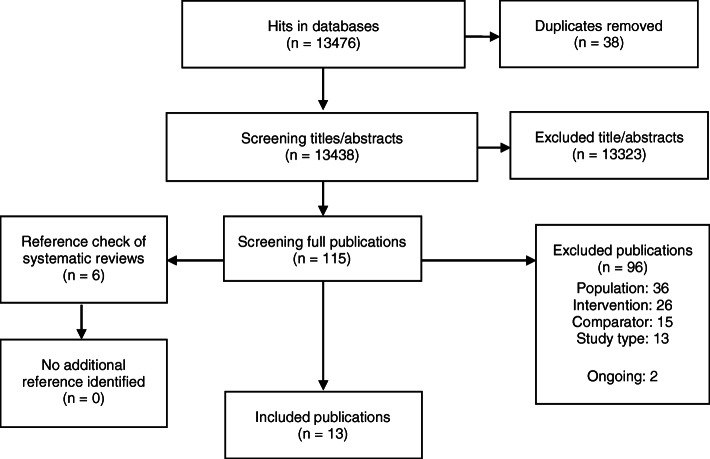
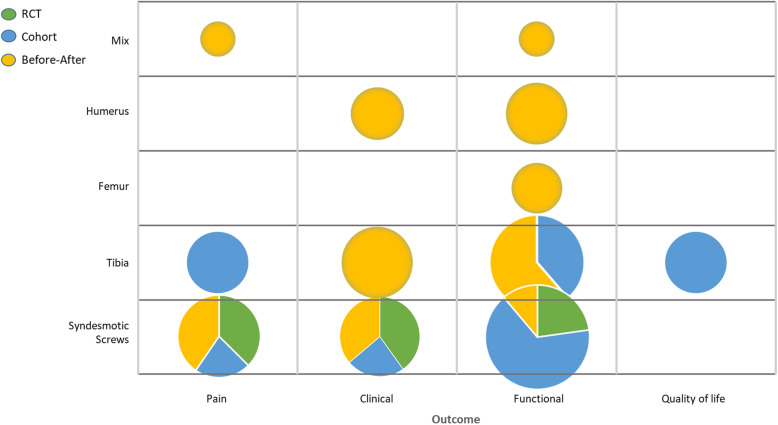
We identified 13476 titles/abstracts. Of these, we obtained 115 full-text publications which were assessed in detail against the inclusion criteria. We included 13 studies (1 RCT, 4 cohort studies, 8 before-after studies) and identified two ongoing RCTs. Nine assessed the removal of the internal fixation in the lower extremities (six of these syndesmotic screws in ankle fractures only) and two in the upper extremities. One study analysed the effectiveness of hardware removal in children in all types of extremity fractures. Outcomes reported included various scales measuring functionality, pain and clinical assessments (e.g. range of motion) and health-related quality of life.
We identified 13 studies that evaluated the effectiveness/safety of hardware removal in the extremities. The follow up times were short, the patient groups small and the ways of measurement differed. In general, clinical heterogeneity was high. Evidence on selected topics, e.g. syndesmotic screw removal is available nevertheless not sufficient to allow a meaningful assessment of effectiveness.
骨接合术是通过机械装置(也称为硬件)对内固定骨折或截骨的方法。在骨愈合后,有两种选择:一种是去除硬件,另一种是将其留在原处。对于没有医疗指征的患者(选择性)去除硬件存在争议。我们进行了范围综述,以确定与保留硬件相比,在无症状患者中选择性去除硬件的证据,以检查进行卫生技术评估的可行性。此外,我们还想找出可用的证据类型。
我们在 PubMed、Embase、EconLit 和 CINAHL 中进行了系统文献检索(2019 年 11 月)。我们纳入了比较下肢或上肢内固定无症状患者的研究,其内固定是选择性(无医疗指征)去除还是保留。我们没有将纳入范围限制在任何有效性/安全性结果上,并认为任何比较性研究设计都是合格的。研究选择和数据提取由两名评审员进行。
我们确定了 13476 个标题/摘要。其中,我们获得了 115 篇全文出版物,并根据纳入标准进行了详细评估。我们纳入了 13 项研究(1 项 RCT、4 项队列研究、8 项前后研究),并确定了两项正在进行的 RCT。9 项评估了下肢内固定的去除(其中 6 项仅评估了踝关节骨折的内固定),2 项评估了上肢内固定的去除。一项研究分析了所有类型肢体骨折中儿童硬件去除的有效性。报告的结果包括各种测量功能、疼痛和临床评估(如活动范围)和健康相关生活质量的量表。
我们确定了 13 项评估四肢硬件去除有效性/安全性的研究。随访时间短,患者群体小,测量方法不同。总体而言,临床异质性很高。关于某些主题(例如,联合螺钉去除)的证据是可用的,但不足以对有效性进行有意义的评估。