Department of Gynecologic Oncology, Sun Yat-sen University Cancer Centre, State Key Laboratory of Oncology in South China, Collaborative Innovation Center for Cancer Medicine, 651 Dongfeng Road East, Guangzhou, 510060, Guangdong, China.
Department of Cancer Prevention, Sun Yat-sen University Cancer Centre, State Key Laboratory of Oncology in South China, Collaborative Innovation Center for Cancer Medicine, Guangzhou, China.
BMC Med. 2020 Oct 5;18(1):267. doi: 10.1186/s12916-020-01733-4.
Vascular endothelial growth factor (VEGF)-targeted therapy is effective in patients with ovarian cancer. Whether adipose tissue (AT) could predict the efficacy of VEGF receptor (VEGFR) inhibitors in ovarian cancer is unknown. We aimed to evaluate the ability of distinct AT depots to predict the efficacy of apatinib, a VEGFR inhibitor, in recurrent ovarian cancers included in the AEROC trial.
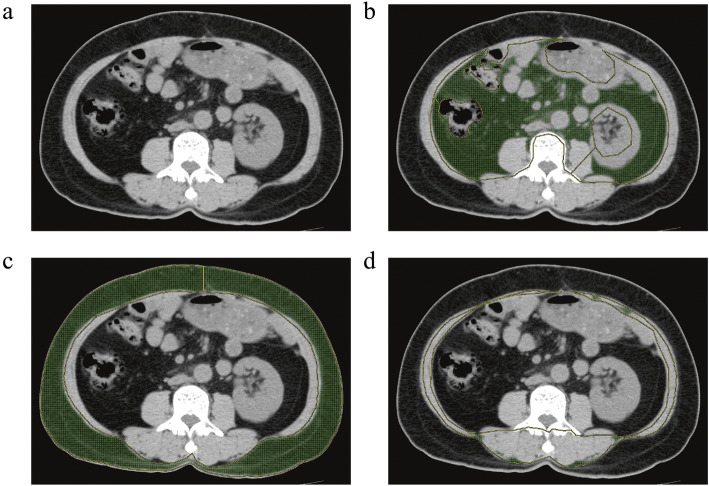
The AEROC was a single-arm phase 2 trial of apatinib and oral etoposide in patients with platinum-resistant or platinum-refractory ovarian cancer. Apatinib was administered continuously, and oral etoposide was administered every 21 days for a maximum of six cycles. This was a post hoc study based on the AEROC trial. Areas of visceral AT (VAT), subcutaneous AT (SAT), and intermuscular AT (IMAT) were measured using computed tomography scan at baseline to assess their association with the objective response rate, progression-free survival, and overall survival.
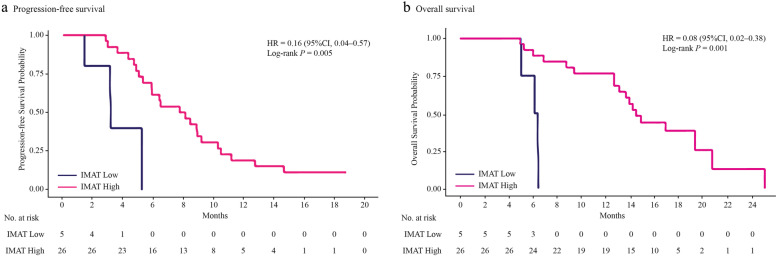
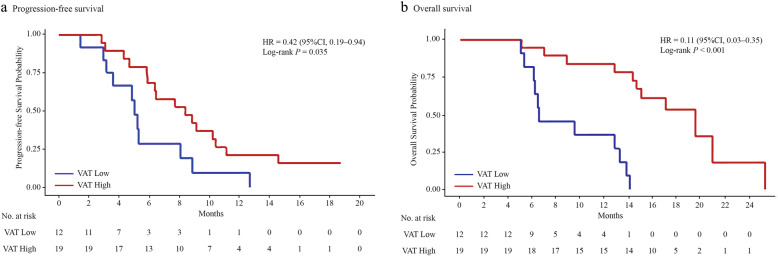
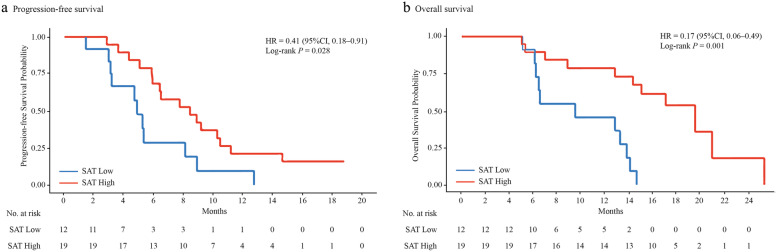
Of the 35 treated patients, 31 patients with at least one post-baseline efficacy assessment by computed tomography scan were included in this study. After adjusting for apatinib exposure, high VAT (odds ratio [OR], 0.16; 95% confidence interval [CI], 0.03-0.90, P = 0.037) and SAT (OR, 0.16; 95% CI, 0.03-0.87, P = 0.034) were significantly associated with a higher objective response rate. Further, decreased risks of disease progression and death were associated with high VAT (hazard ratio [HR], 0.39; 95% CI, 0.17-0.92, P = 0.031, and HR, 0.12; 95% CI, 0.04-0.40, P < 0.001, respectively), SAT (HR, 0.35; 95% CI, 0.15-0.83, P = 0.027, and HR, 0.24; 95% CI, 0.08-0.67, P = 0.007, respectively), and IMAT (HR, 0.20; 95% CI, 0.06-0.74, P = 0.016, and HR, 0.13; 95% CI, 0.03-0.62, P = 0.011, respectively).
High areas of VAT, SAT, and IMAT were significantly associated with better outcomes in patients with platinum-resistant or platinum-refractory ovarian cancer who received VEGFR inhibitors. AT assessments may be valuable as patient-specific imaging biomarkers for predicting response to VEGFR inhibitors.
ClinicalTrials.gov identifier: NCT02867956 .
血管内皮生长因子(VEGF)靶向治疗对卵巢癌患者有效。脂肪组织(AT)是否能预测卵巢癌患者接受 VEGF 受体(VEGFR)抑制剂的疗效尚不清楚。我们旨在评估不同的 AT 储存库预测阿帕替尼疗效的能力,阿帕替尼是一种 VEGFR 抑制剂,纳入 AEROC 试验的复发性卵巢癌患者。
AEROC 是一项单臂、阿帕替尼联合口服依托泊苷治疗铂耐药或铂难治性卵巢癌的 2 期临床试验。阿帕替尼连续给药,口服依托泊苷每 21 天给药一次,最多 6 个周期。这是基于 AEROC 试验的事后研究。基线时使用计算机断层扫描测量内脏 AT(VAT)、皮下 AT(SAT)和肌间 AT(IMAT)的面积,以评估它们与客观缓解率、无进展生存期和总生存期的相关性。
在 35 名接受治疗的患者中,有 31 名患者在计算机断层扫描评估后至少有一次基线后疗效评估,包括在本研究中。在调整阿帕替尼暴露后,高 VAT(比值比 [OR],0.16;95%置信区间 [CI],0.03-0.90,P=0.037)和 SAT(OR,0.16;95%CI,0.03-0.87,P=0.034)与更高的客观缓解率显著相关。此外,高 VAT(风险比 [HR],0.39;95%CI,0.17-0.92,P=0.031,和 HR,0.12;95%CI,0.04-0.40,P<0.001,分别)和 SAT(HR,0.35;95%CI,0.15-0.83,P=0.027,和 HR,0.24;95%CI,0.08-0.67,P=0.007,分别)和 IMAT(HR,0.20;95%CI,0.06-0.74,P=0.016,和 HR,0.13;95%CI,0.03-0.62,P=0.011,分别)降低疾病进展和死亡的风险。
VAT、SAT 和 IMAT 的面积较高与接受 VEGFR 抑制剂的铂耐药或铂难治性卵巢癌患者的更好结局显著相关。AT 评估可能作为预测 VEGFR 抑制剂反应的患者特异性影像学生物标志物具有价值。
ClinicalTrials.gov 标识符:NCT02867956。