Zelinkova Zuzana, Wenzl Thomas
Joint Research Centre, European Commission, Geel, Belgium.
Tob Induc Dis. 2020 Sep 14;18:77. doi: 10.18332/tid/126406. eCollection 2020.
Although e-cigarettes share common features such as power units, heating elements and e-liquids, the variability in design and possibility for customization represent potential risks for consumers. A main health concern is the exposure to carbonyl compounds, which are formed from the main components of e-liquids, propylene glycol and glycerol, through thermal decomposition. Levels of carbonyl emissions in e-cigarette aerosols depend, amongst others, on the power supplied to the coil. Thus, e-cigarettes with adjustable power outputs might lead to high exposures to carbonyls if the users increase the power output excessively. The aim of this work was to elucidate the generation of carbonyls in relation to undue battery power setting.
Carbonyl emissions were generated by two modular e-cigarettes equipped with two atomizers containing coils of different resistance following the ISO 20768:2018 method. The battery power output was increased from the lower wattage level to above the power range recommended by the producer. Carbonyls were trapped by a 2,4-dinitrophenylhydrazine (DNPH) solution and analysed by LC-MS/MS.
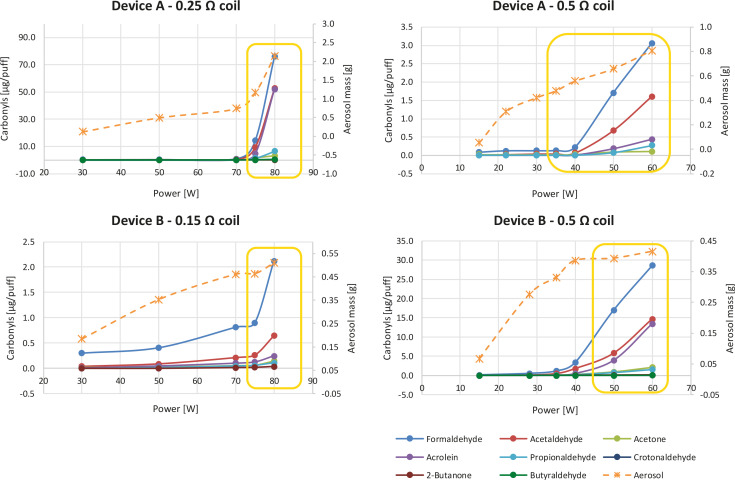
The amount of carbonyl emissions increased with increasing power setting. An exponential incline was observed when the applied power level exceeded the recommended power range. Exceeding the recommended power range by just 5 watts resulted in up to twenty times the amount of carbonyls emitted at the recommended upper power level. Generation of acetaldehyde and acrolein next to other carbonyls was prominent at high power outputs.
E-cigarettes with customisable power setting might generate high amounts of carbonyls if the battery power output is set by the consumer to levels above the recommended range. This represents a high risk of exposure to carbonyls and thus should be avoided by integrating safety features in e-cigarette devices to limit the possible power settings to the range specified by the manufacturer.
尽管电子烟具有诸如电源装置、加热元件和电子烟液等共同特征,但设计的多样性和定制的可能性给消费者带来了潜在风险。一个主要的健康问题是接触羰基化合物,这些化合物是由电子烟液的主要成分丙二醇和甘油通过热分解形成的。电子烟烟雾中羰基排放水平尤其取决于供给线圈的功率。因此,如果使用者过度增加功率输出,功率可调节的电子烟可能导致高剂量的羰基暴露。这项工作的目的是阐明与不当电池功率设置相关的羰基生成情况。
按照ISO 20768:2018方法,通过两台配备两个雾化器的模块化电子烟产生羰基排放,这两个雾化器包含不同电阻的线圈。电池功率输出从较低瓦数水平增加到高于生产商推荐的功率范围。羰基由2,4-二硝基苯肼(DNPH)溶液捕集,并通过液相色谱-串联质谱法进行分析。
羰基排放量随着功率设置的增加而增加。当施加的功率水平超过推荐功率范围时,观察到呈指数上升。仅超过推荐功率范围5瓦,就导致羰基排放量高达推荐最高功率水平下排放量的20倍。在高功率输出时,除其他羰基外,乙醛和丙烯醛的生成尤为显著。
如果消费者将电池功率输出设置到高于推荐范围的水平,功率可定制的电子烟可能会产生大量羰基。这代表着高剂量羰基暴露的风险,因此应通过在电子烟设备中集成安全功能,将可能的功率设置限制在制造商规定的范围内,以避免这种情况。