Lucas Joseph H, Muthumalage Thivanka, Wang Qixin, Friedman Michelle R, Friedman Alan E, Rahman Irfan
Department of Environmental Medicine, University of Rochester Medical Center, Rochester, NY, United States.
Department of Chemistry & Biochemistry, The College of Brockport, The State University of New York, New York, NY, United States.
Front Physiol. 2020 Sep 4;11:924. doi: 10.3389/fphys.2020.00924. eCollection 2020.
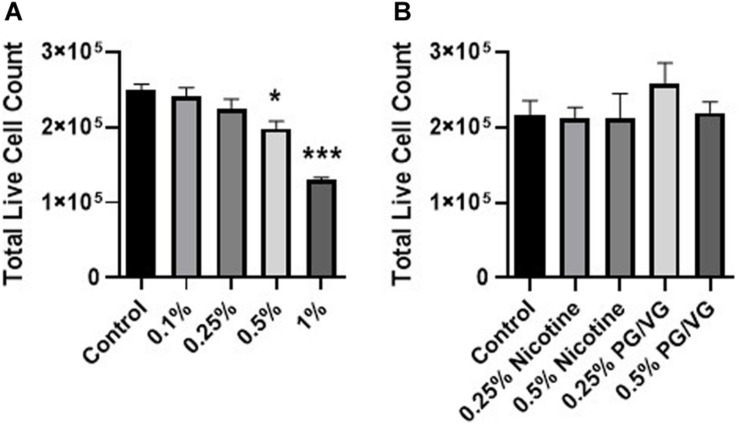
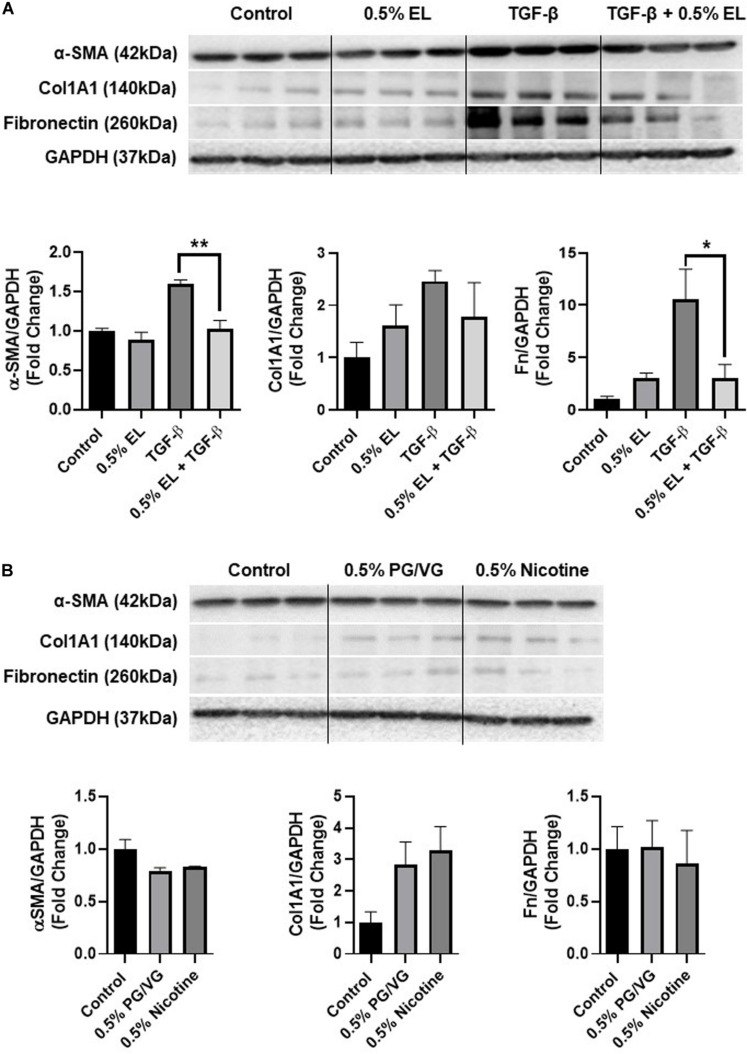
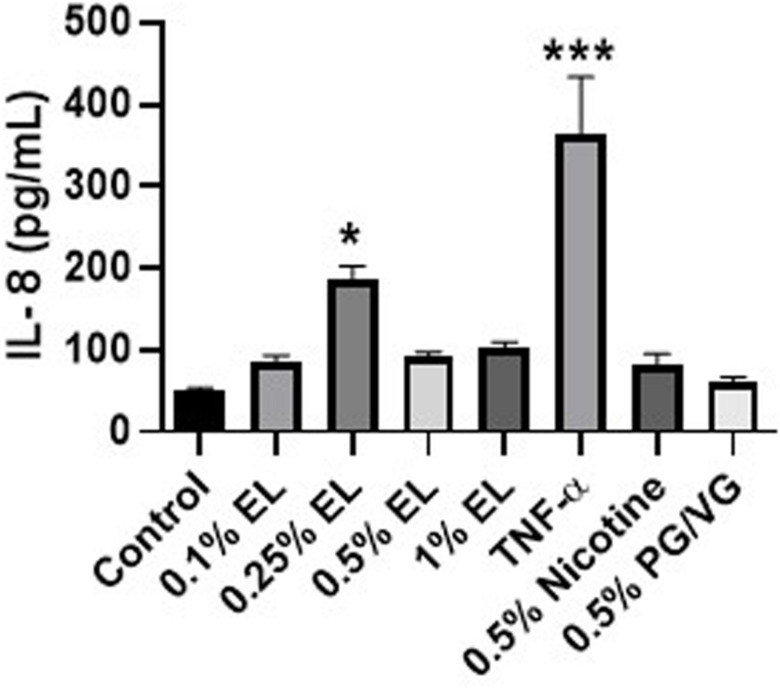
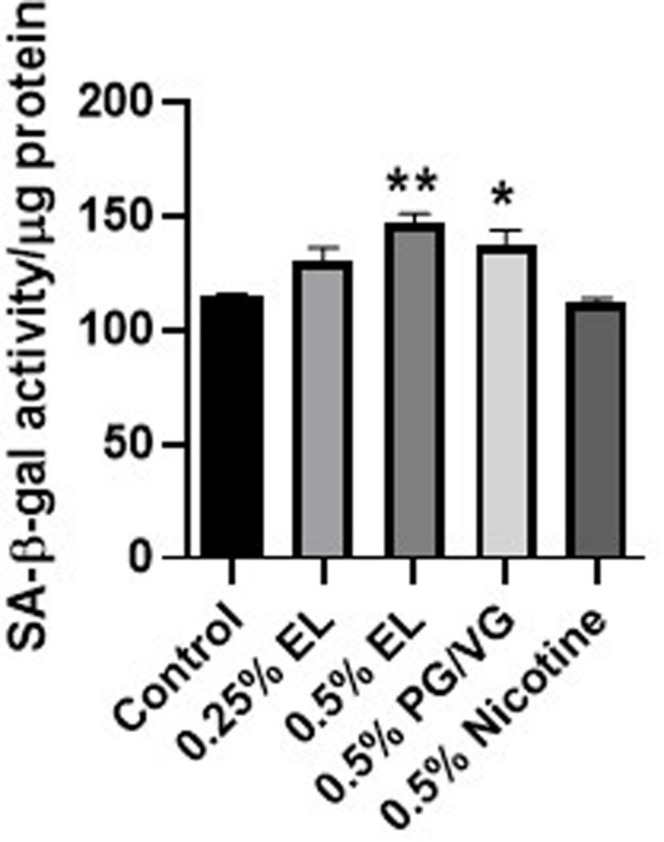
Electronic cigarette (e-cig) usage has risen dramatically worldwide over the past decade. While they are touted as a safe alternative to cigarettes, recent studies indicate that high levels of nicotine and flavoring chemicals present in e-cigs may still cause adverse health effects. We hypothesized that an e-liquid containing a mixture of tobacco, coconut, vanilla, and cookie flavors would induce senescence and disrupt wound healing processes in pulmonary fibroblasts. To test this hypothesis, we exposed pulmonary fibroblasts (HFL-1) to e-liquid at varying doses and assessed cytotoxicity, inflammation, senescence, and myofibroblast differentiation. We found that e-liquid exposure caused cytotoxicity, which was accompanied by an increase in IL-8 release in the conditioned media. E-liquid exposure resulted in elevated senescence-associated beta-galactosidase (SA-β-gal) activity. Transforming growth factor-β1 (TGF-β1) induced myofibroblast differentiation was inhibited by e-liquid exposure, resulting in decreased α-smooth muscle actin and fibronectin protein levels. Together, our data suggest that an e-liquid containing a mixture of flavors induces inflammation, senescence and dysregulated wound healing responses.
在过去十年中,电子烟的使用在全球范围内急剧增加。尽管电子烟被吹捧为香烟的安全替代品,但最近的研究表明,电子烟中存在的高浓度尼古丁和调味化学物质仍可能对健康产生不利影响。我们假设,一种含有烟草、椰子、香草和曲奇口味混合物的电子烟液体会诱导肺成纤维细胞衰老并扰乱伤口愈合过程。为了验证这一假设,我们将肺成纤维细胞(HFL-1)暴露于不同剂量的电子烟液中,并评估细胞毒性、炎症、衰老和肌成纤维细胞分化情况。我们发现,暴露于电子烟液会导致细胞毒性,同时条件培养基中白细胞介素-8的释放增加。暴露于电子烟液会导致衰老相关β-半乳糖苷酶(SA-β-gal)活性升高。电子烟液暴露抑制了转化生长因子-β1(TGF-β1)诱导的肌成纤维细胞分化,导致α-平滑肌肌动蛋白和纤连蛋白蛋白水平降低。总之,我们的数据表明,一种含有多种口味混合物的电子烟液体会诱导炎症、衰老和伤口愈合反应失调。