Mohammaden Mahmoud H, Stapleton Christopher J, Brunozzi Denise, Hussein Ahmad E, Khedr Eman M, Atwal Gursant, Alaraj Ali
Department of Neurology, South Valley University Qena Faculty of Medicine, Qena, Egypt.
Department of Neurology, Marcus Stroke and Neuroscience Center, Emory University School of Medicine, Grady Memorial Hospital, Atlanta, GA, United States.
Front Neurol. 2020 Sep 4;11:907. doi: 10.3389/fneur.2020.00907. eCollection 2020.
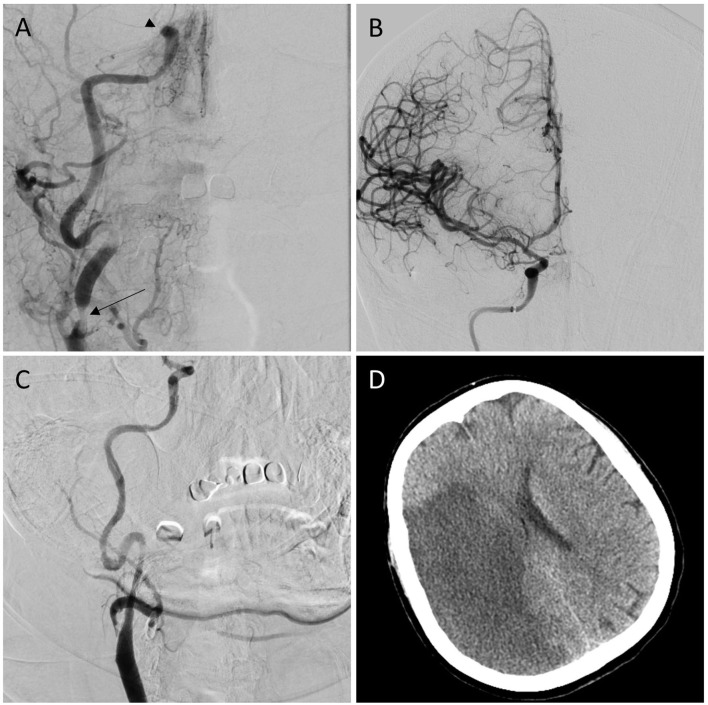
Successful reperfusion is a significant predictor of a good clinical outcome after mechanical thrombectomy (MT). However, some patients have a poor clinical outcome even with successful reperfusion. We aimed to study factors that predict a poor clinical outcome (90-day modified Rankin Scale ≥ 3) in patients with anterior circulation large vessel occlusion (LVO) treated by successful MT within 6 h of symptom onset. We performed a retrospective review of a prospectively maintained MT database of all patients who underwent MT within 6 h of symptom onset for an anterior circulation LVO at our institution from May 2016 to June 2018. Uni- and multivariable analyses were performed to identify predictors of poor outcome. A total of 56 patients met the criteria for inclusion in this study. A poor outcome occurred in 31 (55.4%) patients. On univariate analysis, compared to patients with good clinical outcome, patients with poor outcome had higher mean baseline NIHSS scores (23.3 vs. 13.8, < 0.001), were more likely to have internal carotid artery (ICA) occlusions (38.7 vs. 8%, = 0.008), and had a higher incidence of distal clot migration (DCM) (48.4 vs. 8%, = 0.028). Age, gender, other baseline clinical characteristics, MT technique, and incidence of hemorrhagic transformation did not differ between the two cohorts. On multivariable regression analysis, baseline NIHSS score [OR; 1.3, 95%CI [1.11-1.52], = 0.001], site of occlusion (ICA) [OR; 8.9, 95%CI [1.3-60.9], = 0.026], and DCM [OR; 5.77, 95%CI [1.09-30.69], = 0.04] were independent predictors of poor outcome at 90-days. Baseline NIHSS score, ICA occlusion, and DCM are independent predictors of a poor outcome after MT for anterior circulation LVO performed within 6 h of symptoms onset.
成功再灌注是机械取栓(MT)后良好临床结局的重要预测指标。然而,即使成功再灌注,一些患者的临床结局仍较差。我们旨在研究在症状发作6小时内接受成功MT治疗的前循环大血管闭塞(LVO)患者中,预测不良临床结局(90天改良Rankin量表评分≥3)的因素。我们对2016年5月至2018年6月在我院因前循环LVO在症状发作6小时内接受MT治疗的所有患者的前瞻性维护的MT数据库进行了回顾性分析。进行单变量和多变量分析以确定不良结局的预测因素。共有56例患者符合本研究的纳入标准。31例(55.4%)患者出现不良结局。单变量分析显示,与临床结局良好的患者相比,结局不良的患者基线NIHSS评分均值更高(23.3对13.8,<0.001),更有可能发生颈内动脉(ICA)闭塞(38.7%对8%,=0.008),远端血栓迁移(DCM)发生率更高(48.4%对8%,=0.028)。两个队列在年龄、性别、其他基线临床特征、MT技术和出血转化发生率方面无差异。多变量回归分析显示,基线NIHSS评分[比值比(OR);1.3,95%置信区间(CI)[1.11 - 1.52],=0.001]、闭塞部位(ICA)[OR;8.9,95%CI[1.3 - 60.9],=0.026]和DCM[OR;5.77,95%CI[1.09 - 30.69],=0.04]是90天时不良结局的独立预测因素。基线NIHSS评分、ICA闭塞和DCM是症状发作6小时内进行的前循环LVO的MT术后不良结局的独立预测因素。