Bleakley Lauren E, Soh Ming S, Bagnall Richard D, Sadleir Lynette G, Gooley Samuel, Semsarian Christopher, Scheffer Ingrid E, Berkovic Samuel F, Reid Christopher A
Florey Institute of Neuroscience and Mental Health, University of Melbourne, Parkville, VIC, Australia.
Agnes Ginges Centre for Molecular Cardiology Centenary Institute, The University of Sydney, Sydney, NSW, Australia.
Front Neurol. 2020 Sep 8;11:925. doi: 10.3389/fneur.2020.00925. eCollection 2020.
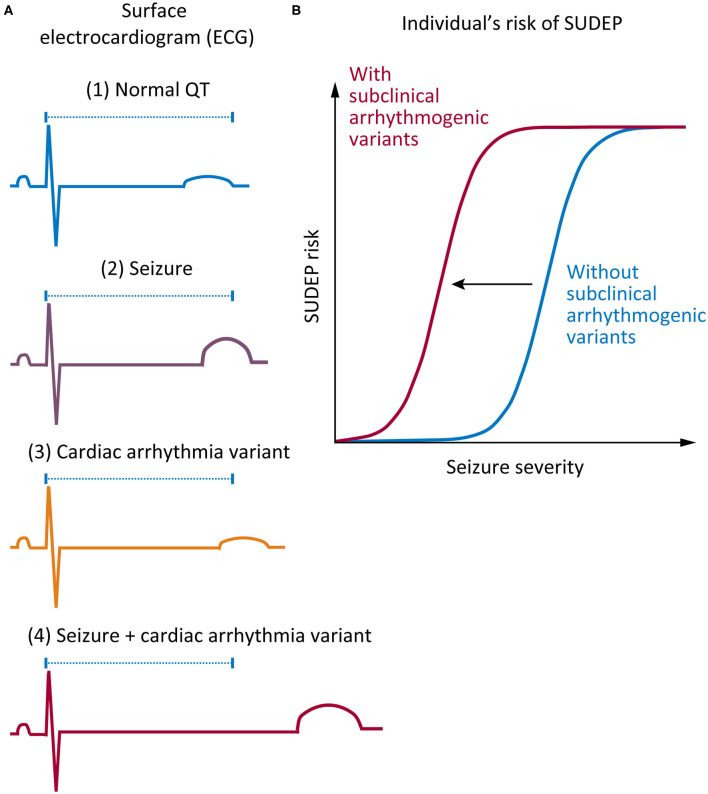
Sudden unexpected death in epilepsy (SUDEP) is the most common cause of premature mortality in individuals with epilepsy. Acute and adaptive changes in heart rhythm in epilepsy implicate cardiac dysfunction as a potential pathogenic mechanism in SUDEP. Furthermore, variants in genes associated with Long QT syndrome (LQTS) have been identified in patients with SUDEP. LQTS is a cardiac arrhythmia condition that causes sudden cardiac death with strong similarities to SUDEP. Here, we discuss the possibility of an additive risk of death due to the functional consequences of a pathogenic variant in an LQTS gene interacting with seizure-mediated changes in cardiac function. Extending this general concept, we propose a hypothesis that common variants in LQTS genes, which cause a subtle impact on channel function and would not normally be considered risk factors for cardiac disease, may increase the risk of sudden death when combined with epilepsy. A greater understanding of the interaction between epilepsy, cardiac arrhythmia, and SUDEP will inform our understanding of SUDEP risk and subsequent potential prophylactic treatment.
癫痫性猝死(SUDEP)是癫痫患者过早死亡的最常见原因。癫痫患者心律的急性和适应性变化表明心脏功能障碍是SUDEP潜在的致病机制。此外,在SUDEP患者中已鉴定出与长QT综合征(LQTS)相关的基因变异。LQTS是一种心律失常疾病,可导致心源性猝死,与SUDEP有很强的相似性。在此,我们讨论由于LQTS基因中的致病变异与癫痫发作介导的心脏功能变化相互作用的功能后果而导致死亡的附加风险的可能性。扩展这一总体概念,我们提出一个假设,即LQTS基因中的常见变异对通道功能有微妙影响,通常不被视为心脏病的危险因素,但与癫痫合并时可能会增加猝死风险。对癫痫、心律失常和SUDEP之间相互作用的更深入理解将有助于我们理解SUDEP风险及后续潜在的预防性治疗。