Taube Friedhelm, Vogeler Iris, Kluß Christof, Herrmann Antje, Hasler Mario, Rath Jürgen, Loges Ralf, Malisch Carsten S
Kiel University, Grass Forage Science/Organic Agriculture, Christian Albrechts University, Kiel, Germany.
Grass Based Dairy Systems, Animal Production Systems Group, Wageningen University (WUR), Wageningen, Netherlands.
Front Plant Sci. 2020 Aug 18;11:1214. doi: 10.3389/fpls.2020.01214. eCollection 2020.
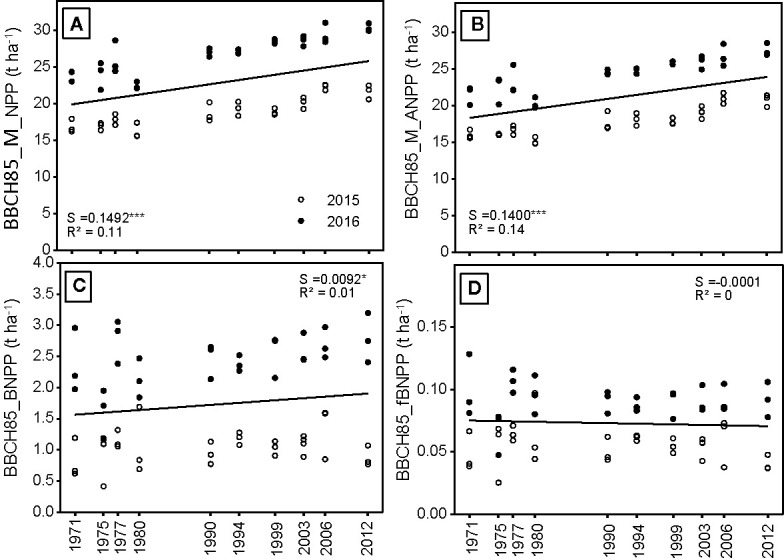
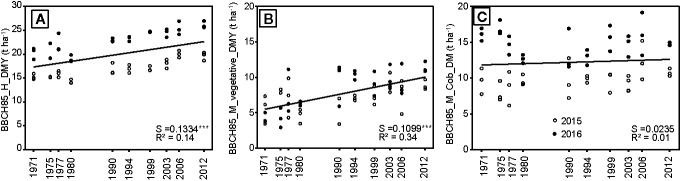
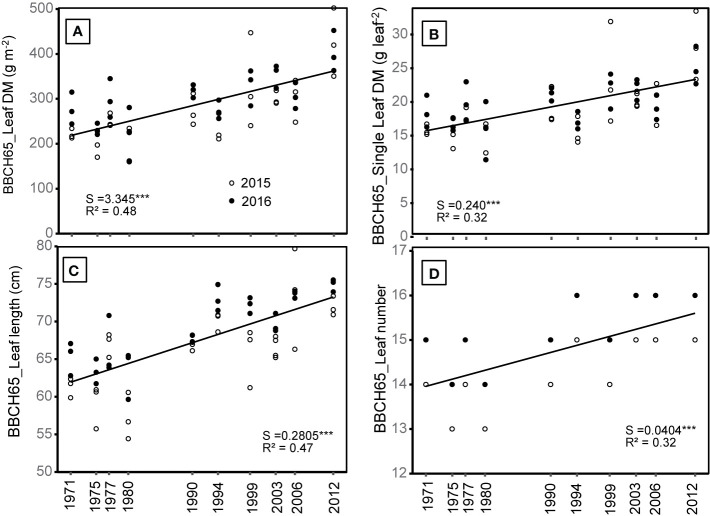
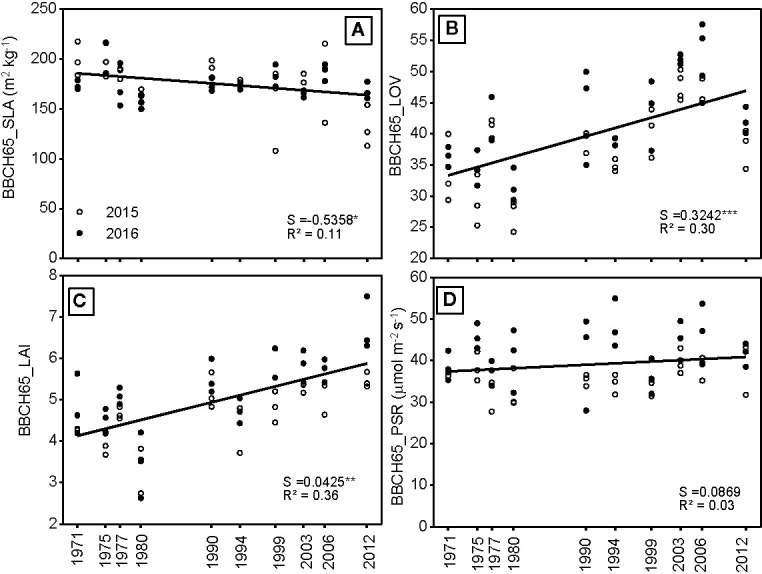
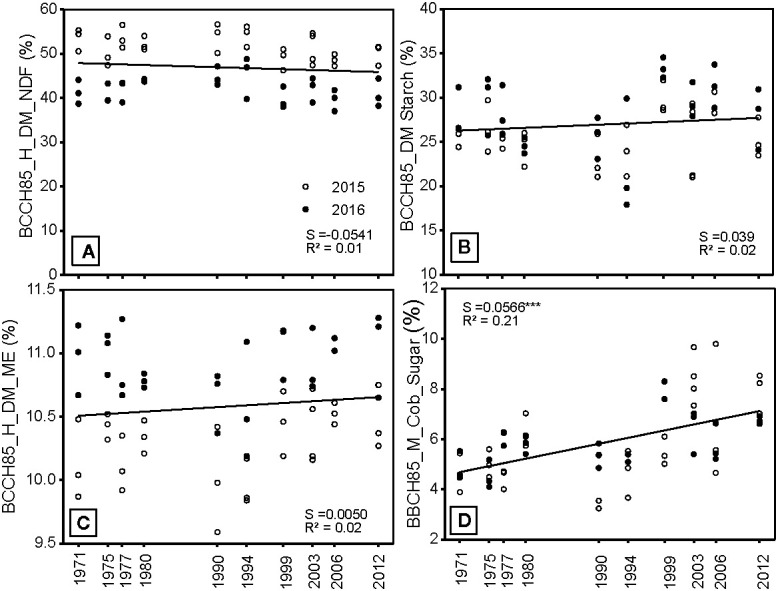
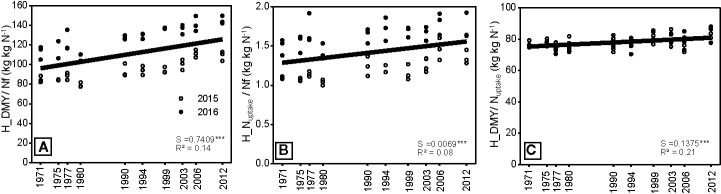
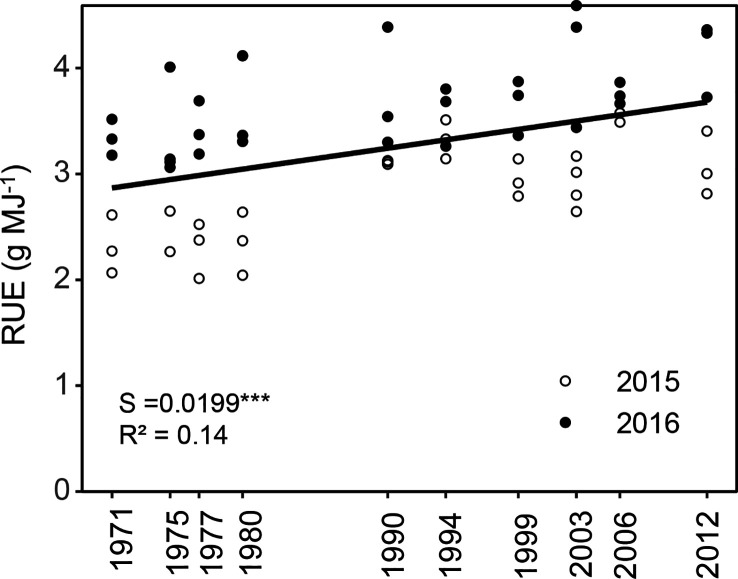
Yield increases in forage maize (Zea mays L.) in NW Europe over time are well documented. The driving causes for these, however, remain unclear as there is little information available regarding the role of plant traits triggering this yield progress. Ten different hybrids from the same maturity group, which have typically been cultivated in Northwest Germany from 1970 to recent and are thus representing breeding progress over four decades, were selected for a 2-year field study in northern Germany. Traits that were investigated included leaf area index, leaf architecture, photosynthesis, radiation use efficiency, root mass, root length density, and turnover. Based on a mixed model analysis with these traits as co-variates, parameters related to leaf characteristics, in particular the number and length of leaves, the radiation use efficiency, and the leaf orientation, were identified as most influential on the yield progress (0.13 tons ha year). In contrast to our hypothesis, root biomass only increased negligibly in newer hybrids compared to older ones, confirming the 'functional equilibrium' theory for high input production systems. Due to an abundance of nutrients and water in such high input systems, there is no incentive for breeders to select for carbon partitioning toward the rooting system. Breeding evidence to increase forage quality were also negligible, with no change in cob starch concentration, forage digestibility, nor NDF content and NDF digestibility. The observed increase in yield over the last four decades is due to a combination of increased temperature sums (~240 GDD within 40 years), and a higher radiation interception and radiation use efficiency. This higher radiation interception was driven by an increased leaf area index, with a higher number of leaves (16 instead of 14 leaves within 40 years) and longer leaves of newer compared to older hybrids. Future selection and adaptation of maize hybrids to changing environmental conditions are likely to be the key for high productivity and quality and for the economic viability of maize growing and expansion in Northern Europe.
随着时间的推移,西北欧地区饲用玉米(Zea mays L.)产量增加的情况已有充分记录。然而,其驱动原因仍不明确,因为关于触发这种产量增长的植物性状的作用,几乎没有可用信息。从同一成熟组中选取了10个不同的杂交种,这些杂交种自1970年至近期通常在德国西北部种植,因此代表了四十年来的育种进展,在德国北部进行了为期两年的田间研究。所研究的性状包括叶面积指数、叶片结构、光合作用、辐射利用效率、根质量、根长密度和周转率。基于以这些性状作为协变量的混合模型分析,与叶片特征相关的参数,特别是叶片数量和长度、辐射利用效率以及叶片方向,被确定为对产量增长(每年0.13吨/公顷)影响最大。与我们的假设相反,与较老的杂交种相比,新杂交种的根生物量仅略有增加,这证实了高投入生产系统的“功能平衡”理论。在这种高投入系统中,由于养分和水分充足,育种者没有动力选择向根系进行碳分配。提高饲用品质的育种证据也微不足道,穗轴淀粉浓度、饲草消化率、中性洗涤纤维含量和中性洗涤纤维消化率均无变化。过去四十年来观察到的产量增加是温度总和增加(40年内约240生长度日)以及辐射截获和辐射利用效率提高共同作用的结果。这种更高的辐射截获是由叶面积指数增加驱动的,与较老的杂交种相比,新杂交种的叶片数量更多(40年内从14片增加到16片)且叶片更长。未来玉米杂交种对不断变化的环境条件的选择和适应可能是北欧玉米高产、优质以及玉米种植和扩张的经济可行性的关键。