Elkhuizen Sylvia G, Vissers Jan M H, Mahdavi Mahdi, van de Klundert Joris J
Erasmus School of Health Policy and Management, Erasmus University Rotterdam, Rotterdam, Netherlands.
National Institute for Health Research/Tehran University of Medical Sciences, Tehran, Iran.
Front Public Health. 2020 Aug 28;8:428. doi: 10.3389/fpubh.2020.00428. eCollection 2020.
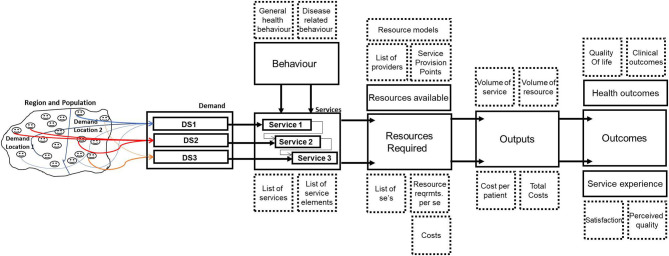
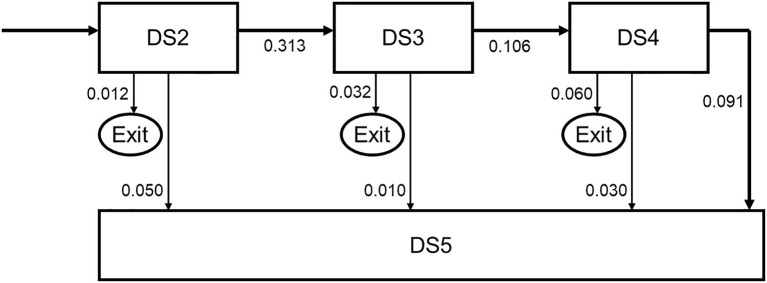
Chronic care is an important area for cost-effective and efficient health service delivery. Matching demand and services for chronic care is not easy as patients may have different needs in different stages of the disease. More insight is needed into the complete patient journey to do justice to the services required in each stage of the disease, to the different experiences of patients in each part of the journey, and to outcomes in each stage. With patient journey we refer to the "journey" of the patient along the services received within a demand segment of chronic care. We developed a generic framework for describing patient journeys and provider networks, based on an extension of the well-known model of Donabedian, to relate demand, services, resources, behavior, and outcomes. We also developed a generic operational model for the detailed modeling of services and resources, allowing for insight into costs. The generic operational model can be tailored to the specific characteristics of patient groups. We applied this modeling approach to type 2 diabetes (T2D) patients. Diabetes care is a form of chronic care for patients suffering diabetes mellitus. We studied the performance of T2D networks, using a descriptive model template. To identify and describe demand we made use of the following demand segments within the diabetes type 2 population: patients targeted for prevention; patients with stage 1 diabetes treated by their GP with lifestyle advice; patients with diabetes stage 2 treated by their GP with lifestyle advice and oral medication; patients with stage 3 diabetes treated by their GP with lifestyle advice, oral medication, and insulin injections; patients with stage 4 diabetes with complications (treated by internal medicine specialists). We used a Markov model to describe the transitions between the different health states. The model enables the patient journey through the health care system for cohorts of newly diagnosed T2D patients to be described, and to make a projection of the resource requirements of the different demand segments over the years. We illustrate our approach with a case study on a T2D care network in The Netherlands and reflect on the role of demand segmentation to analyse the case study results, with the objective of improving the T2D service delivery.
慢性病护理是实现具有成本效益和高效的医疗服务提供的重要领域。使慢性病护理的需求与服务相匹配并非易事,因为患者在疾病的不同阶段可能有不同的需求。需要更深入地了解患者的整个就医过程,以便公正地对待疾病每个阶段所需的服务、患者在就医过程每个部分的不同经历以及每个阶段的结果。我们所说的患者就医过程是指患者在慢性病护理需求领域内接受服务的“过程”。我们基于著名的唐纳贝迪安模型的扩展,开发了一个用于描述患者就医过程和提供者网络的通用框架,以关联需求、服务、资源、行为和结果。我们还开发了一个用于详细建模服务和资源的通用运营模型,以便洞察成本。该通用运营模型可以根据患者群体的特定特征进行定制。我们将这种建模方法应用于2型糖尿病(T2D)患者。糖尿病护理是为糖尿病患者提供的一种慢性病护理形式。我们使用描述性模型模板研究了T2D网络的绩效。为了识别和描述需求,我们利用了2型糖尿病人群中的以下需求细分:目标为预防的患者;由全科医生提供生活方式建议治疗的1期糖尿病患者;由全科医生提供生活方式建议和口服药物治疗的2期糖尿病患者;由全科医生提供生活方式建议、口服药物和胰岛素注射治疗的3期糖尿病患者;患有并发症的4期糖尿病患者(由内科专家治疗)。我们使用马尔可夫模型来描述不同健康状态之间的转变。该模型能够描述新诊断的T2D患者群体在医疗保健系统中的就医过程,并预测不同需求细分在多年内的资源需求。我们通过对荷兰一个T2D护理网络的案例研究来说明我们的方法,并反思需求细分在分析案例研究结果中的作用,目的是改善T2D服务的提供。