Cavaco Marco, Pérez-Peinado Clara, Valle Javier, Silva Rúben D M, Correia João D G, Andreu David, Castanho Miguel A R B, Neves Vera
Instituto de Medicina Molecular, Faculdade de Medicina, Universidade de Lisboa, Lisbon, Portugal.
Proteomics and Protein Chemistry Unit, Department of Experimental and Health Sciences, Pompeu Fabra University, Barcelona, Spain.
Front Bioeng Biotechnol. 2020 Sep 9;8:552035. doi: 10.3389/fbioe.2020.552035. eCollection 2020.
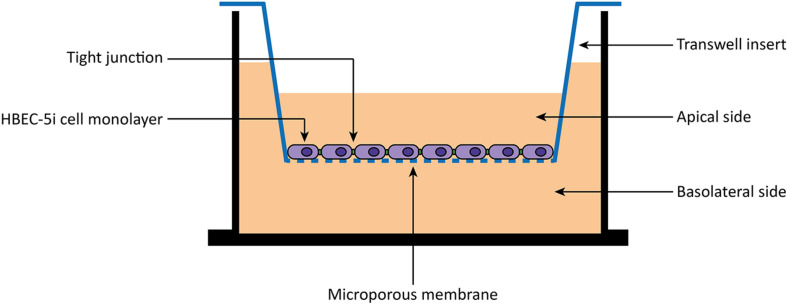
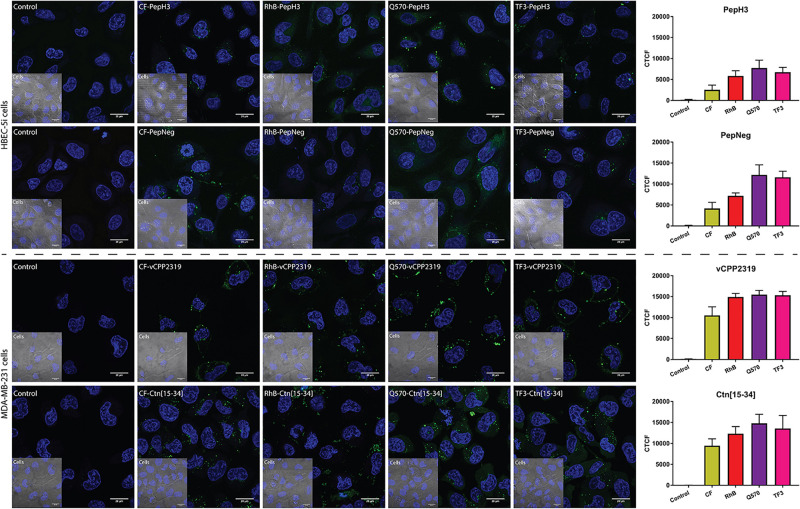
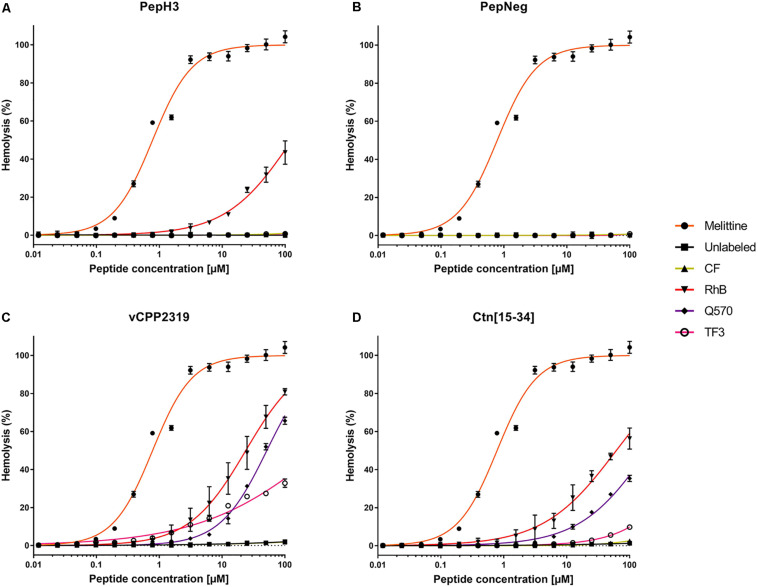
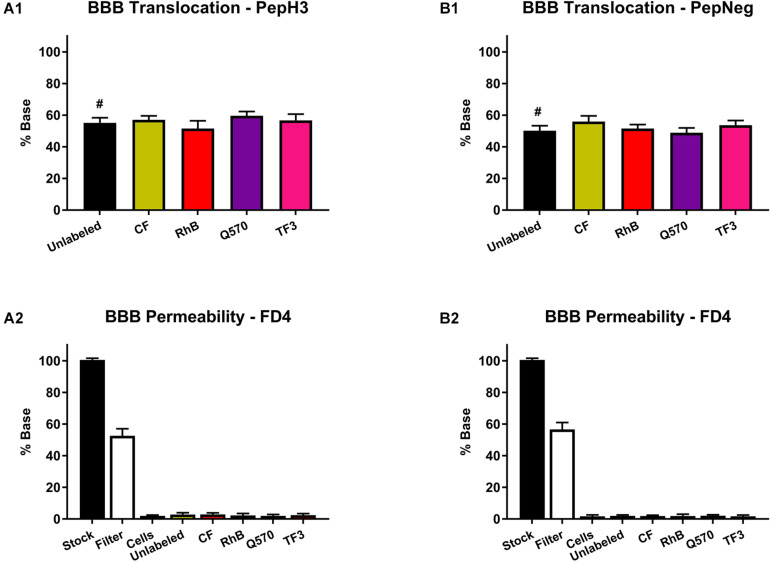
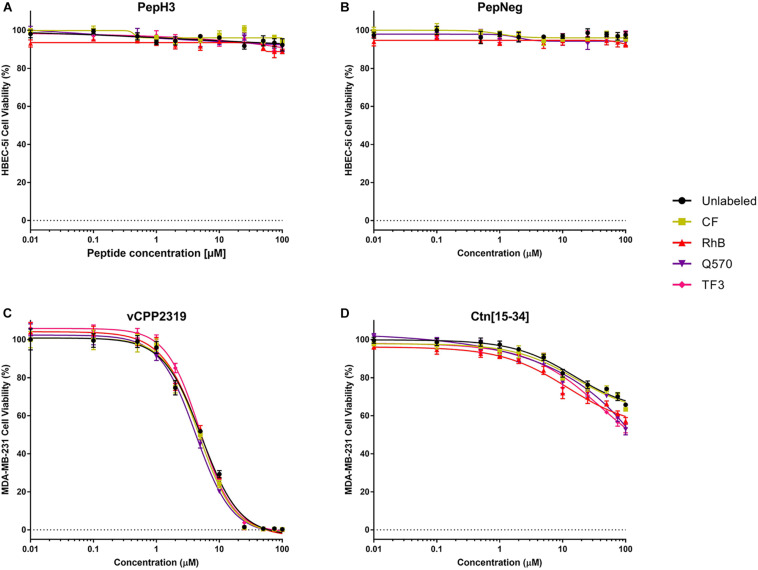
The characterization of biologically active peptides relies heavily on the study of their efficacy, toxicity, mechanism of action, cellular uptake, or intracellular location, using both and studies. These studies frequently depend on the use of fluorescence-based techniques. Since most peptides are not intrinsically fluorescent, they are conjugated to a fluorophore. The conjugation may interfere with peptide properties, thus biasing the results. The selection of the most suitable fluorophore is highly relevant. Here, a comprehensive study with blood-brain barrier (BBB) peptide shuttles (PepH3 and PepNeg) and antimicrobial peptides (AMPs) (vCPP2319 and Ctn[15-34]), tested as anticancer peptides (ACPs), having different fluorophores, namely 5(6)-carboxyfluorescein (CF), rhodamine B (RhB), quasar 570 (Q570), or tide fluor 3 (TF3) attached is presented. The goal is the evaluation of the impact of the selected fluorophores on peptide performance, applying routinely used techniques to assess cytotoxicity/toxicity, secondary structure, BBB translocation, and cellular internalization. Our results show that some fluorophores significantly modulate peptide activity when compared with unlabeled peptides, being more noticeable in hydrophobic and charged fluorophores. This study highlights the need for a careful experimental design for fluorescently labeled molecules, such as peptides.
生物活性肽的特性很大程度上依赖于对其功效、毒性、作用机制、细胞摄取或细胞内定位的研究,同时使用体内和体外研究。这些研究常常依赖于基于荧光的技术。由于大多数肽本身不具有荧光,它们会与荧光团共轭。这种共轭可能会干扰肽的特性,从而使结果产生偏差。选择最合适的荧光团至关重要。在此,展示了一项全面的研究,该研究使用了血脑屏障(BBB)肽穿梭体(PepH3和PepNeg)以及抗菌肽(AMPs)(vCPP2319和Ctn[15 - 34])作为抗癌肽(ACPs)进行测试,这些肽连接了不同的荧光团,即5(6)-羧基荧光素(CF)、罗丹明B(RhB)、量子点570(Q570)或Tide Fluor 3(TF3)。目的是评估所选荧光团对肽性能的影响,应用常用技术来评估细胞毒性/毒性、二级结构、BBB转运和细胞内化。我们的结果表明,与未标记的肽相比,一些荧光团会显著调节肽的活性,在疏水性和带电荷的荧光团中更为明显。这项研究强调了对荧光标记分子(如肽)进行仔细实验设计的必要性。