Gorte Olga, Nazarova Natalja, Papachristou Ioannis, Wüstner Rüdiger, Leber Klaus, Syldatk Christoph, Ochsenreither Katrin, Frey Wolfgang, Silve Aude
Institute of Process Engineering in Life Science 2: Technical Biology, Karlsruhe Institute of Technology, Karlsruhe, Germany.
Institute for Pulse Power and Microwave Technology (IHM), Karlsruhe Institute of Technology, Karlsruhe, Germany.
Front Bioeng Biotechnol. 2020 Sep 11;8:575379. doi: 10.3389/fbioe.2020.575379. eCollection 2020.
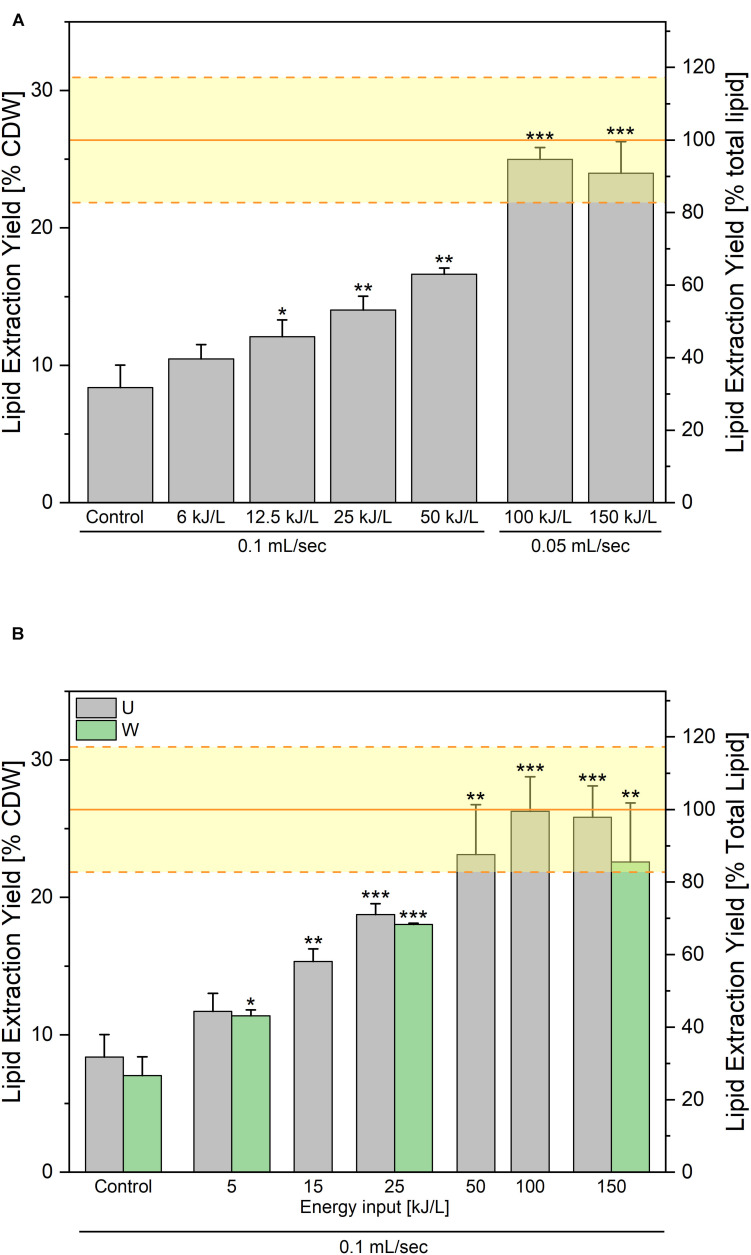
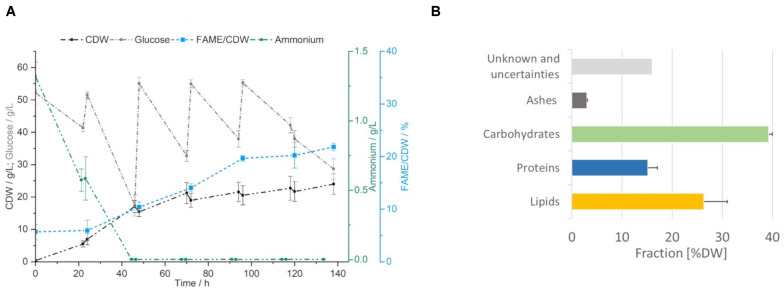
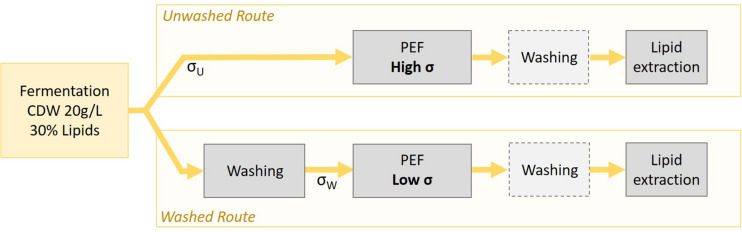
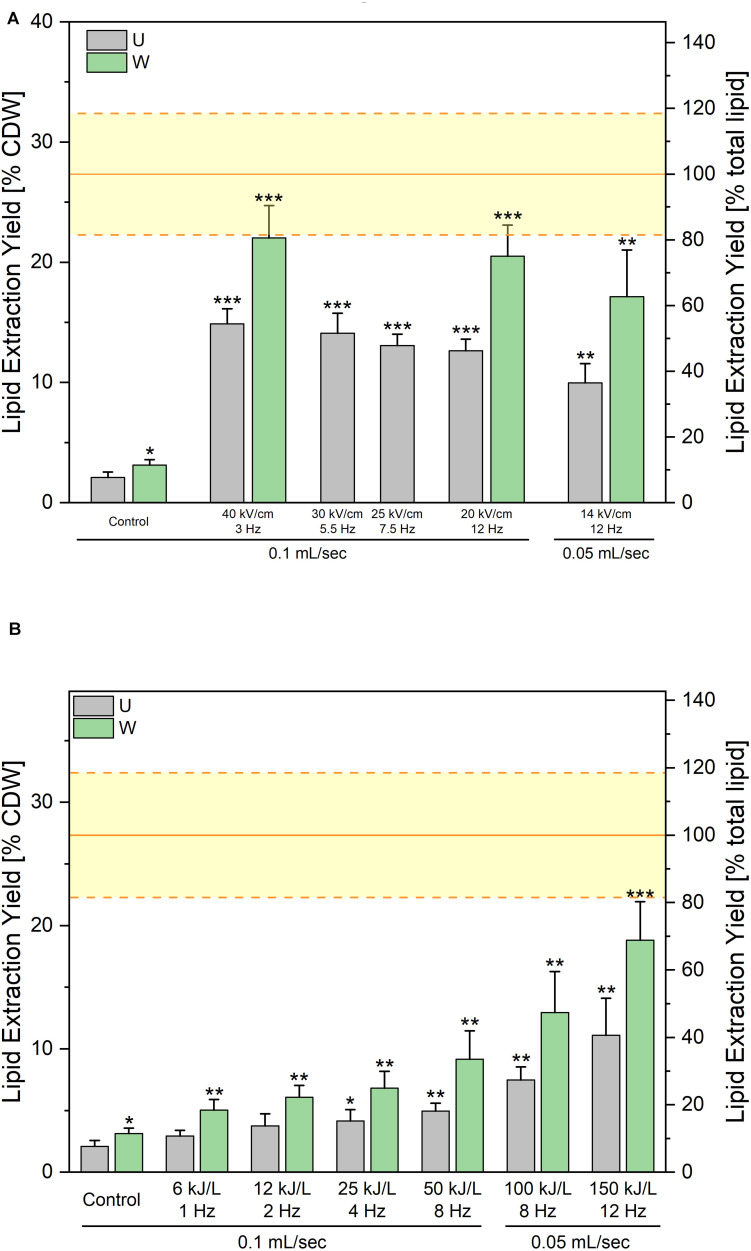
This study reports on the use of pulsed electric field (PEF) as a pre-treatment step to enhance lipid extraction yield using extraction with ethanol-hexane blend on fresh oleaginous yeast The yeasts were cultivated on nitrogen-depleted condition and had a lipid content of 26.4 ± 4.6% of dry weight. PEF-treatment was applied on the yeast suspension either directly after harvesting (unwashed route) or after a washing step (washed route) which induced a reduction of conductivity by a factor eight. In both cases, cell concentration was 20 g of biomass per liter of suspension. In the unwashed route, the lipid extraction efficiency increased from 7% (untreated) to 54% thanks to PEF-treatment. In case an additional washing step was added after PEF-treatment, up to 81% of the lipid content could be recovered. The washed route was even more efficient since lipid extraction yields increased from 26% (untreated) to 99% of total lipid. The energy input for the PEF-treatment never exceeded 150 kJ per liter of initial suspension. The best lipid recovery scenario was obtained using pulses of 1 μs, an electric field of 40 kV/cm and it required slightly less than 11 MJ/kg. This amount of energy can be further reduced by at least a factor five by optimizing the treatment and especially by increasing the concentration of the treated biomass. The process can be easily up-scaled and does not require any expensive handling of the biomass such as freezing or freeze-drying. These findings demonstrate the potential benefit of PEF-treatment in the downstream processing of oleaginous yeast. From a basic research point of view, the influence of conductivity on PEF energy requirements and extraction yields was examined, and results suggest a higher efficiency of PEF-treatment in terms of energy when treatment is performed at lower conductivity.
本研究报告了使用脉冲电场(PEF)作为预处理步骤,以提高在新鲜含油酵母上使用乙醇 - 己烷混合物萃取脂质的产率。酵母在缺氮条件下培养,脂质含量为干重的26.4±4.6%。在收获后直接(未洗涤途径)或经过洗涤步骤(洗涤途径)后对酵母悬浮液进行PEF处理,洗涤步骤使电导率降低了八倍。在这两种情况下,细胞浓度均为每升悬浮液20克生物质。在未洗涤途径中,由于PEF处理,脂质提取效率从7%(未处理)提高到54%。如果在PEF处理后增加额外的洗涤步骤,则可回收高达81%的脂质含量。洗涤途径效率更高,因为脂质提取产率从26%(未处理)提高到总脂质的99%。PEF处理的能量输入每升初始悬浮液从未超过150千焦。使用1微秒的脉冲、40千伏/厘米的电场可获得最佳脂质回收方案,所需能量略低于11兆焦/千克。通过优化处理,特别是通过提高处理生物质的浓度,该能量量可进一步降低至少五倍。该过程可以很容易地扩大规模,并且不需要对生物质进行任何昂贵的处理,如冷冻或冷冻干燥。这些发现证明了PEF处理在含油酵母下游加工中的潜在益处。从基础研究的角度来看,研究了电导率对PEF能量需求和提取产率的影响,结果表明在较低电导率下进行处理时,PEF处理在能量方面具有更高的效率。