Storsve Andreas B, Johnsen Line, Nyborg Christoffer, Melau Jørgen, Hisdal Jonny, Burri Lena
Aker BioMarine Antarctic AS, Lysaker, Norway.
Department of Clinical Medicine, Faculty of Medicine, University of Oslo, Oslo, Norway.
Front Nutr. 2020 Aug 18;7:133. doi: 10.3389/fnut.2020.00133. eCollection 2020.
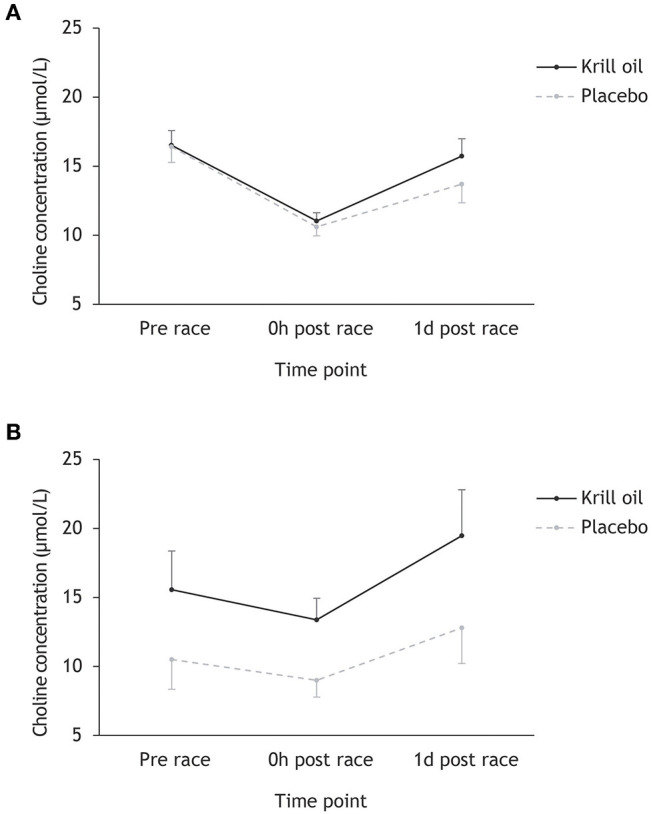
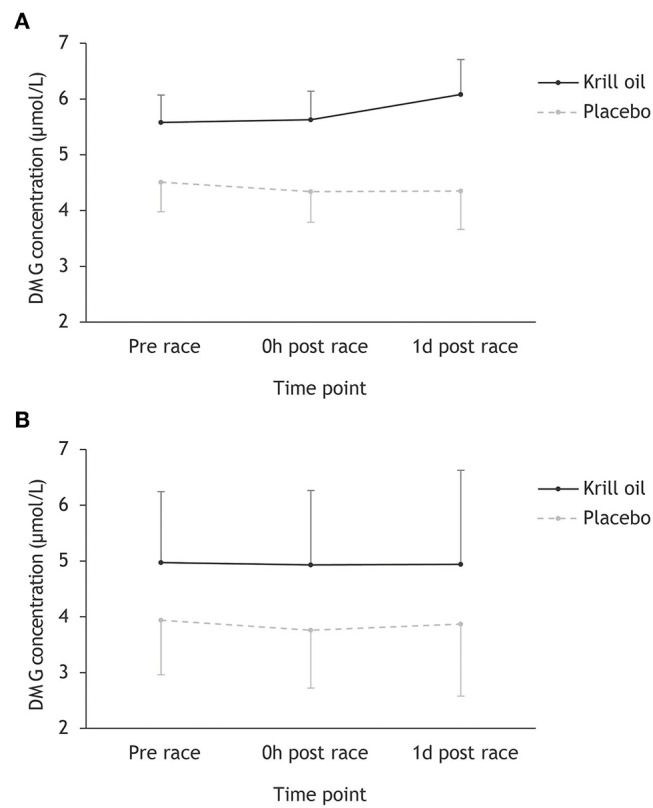
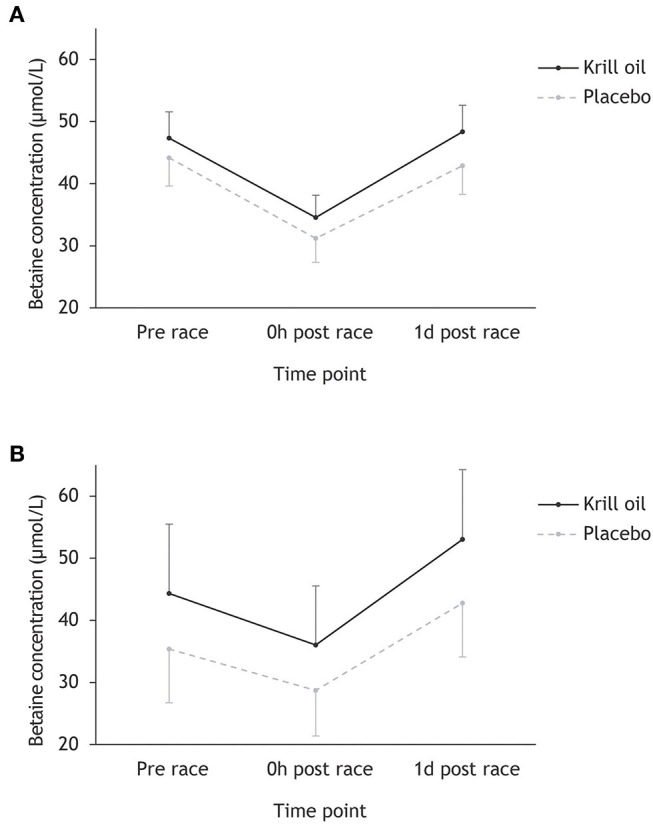
Choline is an essential nutrient that has been implicated in athletic performance due to its role in maintaining normal muscle function. The concentration of free choline in serum may decrease during long-distance high-intensity exercise, yet few nutritional strategies to counteract this potentially performance-depleting loss in choline have been investigated outside the laboratory. This exploratory field study was performed to investigate if pre-race supplementation with phosphatidylcholine from krill oil can counteract the expected drop in choline and some of its metabolites during triathlon competitions. Forty-seven triathletes, 12 females and 35 males ranging in age from 25 to 61 years, were recruited from participants in the Ironman-distance Norseman Xtreme triathlon and the Sprint/Olympic-distance Oslo Triathlon. Twenty-four athletes were randomly allocated to the krill oil group, receiving 4 g of Superba™ krill oil daily for 5 weeks prior to the race, and 23 athletes were randomly allocated to the placebo group, receiving 4 g of mixed vegetable oil daily. Blood samples were obtained before the race, immediately after completion of the race, and the day after the race for analysis of choline and its metabolites. The results showed that serum choline concentrations significantly decreased from pre-race to race finish in all races, with a more pronounced decrease observed in the Ironman-distance Norseman Xtreme triathlon (34% decrease) relative to the Sprint/Olympic-distance Oslo Triathlon (15% decrease). A reduction in betaine was also observed, while dimethylglycine (DMG) concentrations remained stable across all time points. Significantly higher concentrations of choline (9.4% on average) and DMG (21.4% on average) were observed in the krill oil compared to the placebo group, and the krill oil group showed a significantly greater increase in serum choline following race completion. In conclusion, krill oil may help to prevent that circulating choline concentrations become limiting during endurance competitions.
胆碱是一种必需营养素,因其在维持正常肌肉功能方面的作用而与运动表现相关。在长距离高强度运动期间,血清中游离胆碱的浓度可能会降低,但在实验室之外,很少有营养策略被研究来抵消这种可能会消耗运动表现的胆碱流失。这项探索性的实地研究旨在调查赛前补充磷虾油中的磷脂酰胆碱是否可以抵消铁人三项比赛期间胆碱及其一些代谢物预期的下降。从铁人距离的挪威人极限铁人三项赛和短距离/奥林匹克距离的奥斯陆铁人三项赛的参与者中招募了47名铁人三项运动员,其中12名女性和35名男性,年龄在25至61岁之间。24名运动员被随机分配到磷虾油组,在比赛前5周每天服用4克Superba™磷虾油,23名运动员被随机分配到安慰剂组,每天服用4克混合植物油。在比赛前、比赛结束后立即以及比赛后的第二天采集血样,用于分析胆碱及其代谢物。结果表明,在所有比赛中,血清胆碱浓度从赛前到比赛结束时均显著下降,相对于短距离/奥林匹克距离的奥斯陆铁人三项赛(下降15%),在铁人距离的挪威人极限铁人三项赛中观察到更明显的下降(下降34%)。还观察到甜菜碱减少,而二甲基甘氨酸(DMG)浓度在所有时间点保持稳定。与安慰剂组相比,磷虾油组中胆碱(平均高9.4%)和DMG(平均高21.4%)的浓度显著更高,并且磷虾油组在比赛结束后血清胆碱的增加明显更大。总之,磷虾油可能有助于防止在耐力比赛期间循环胆碱浓度变得受限。