Rowett Institute, University of Aberdeen, Foresterhill, Aberdeen, AB25 2ZD, UK.
Institute of Aquaculture, Stirling University, Stirling, UK.
Eur J Nutr. 2021 Jun;60(4):2063-2075. doi: 10.1007/s00394-020-02396-w. Epub 2020 Oct 5.
Farmed fish are increasingly raised on feeds containing vegetable oils, which affects their composition and possibly health properties. We investigated the effects of consuming farmed salmon, raised on different feeding regimes, on nutrient status and health outcomes in healthy subjects.
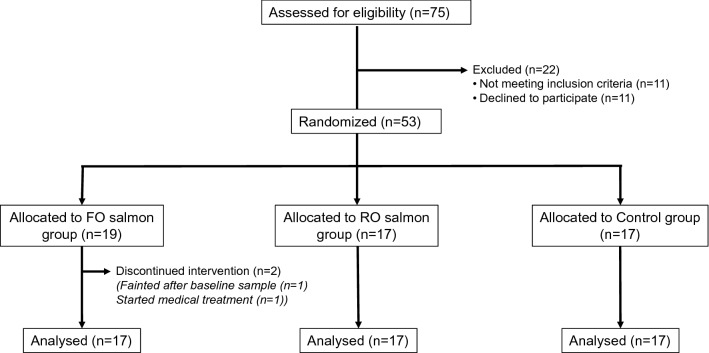
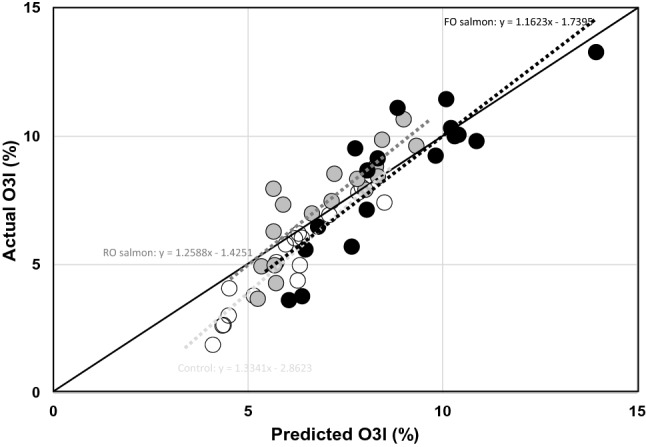
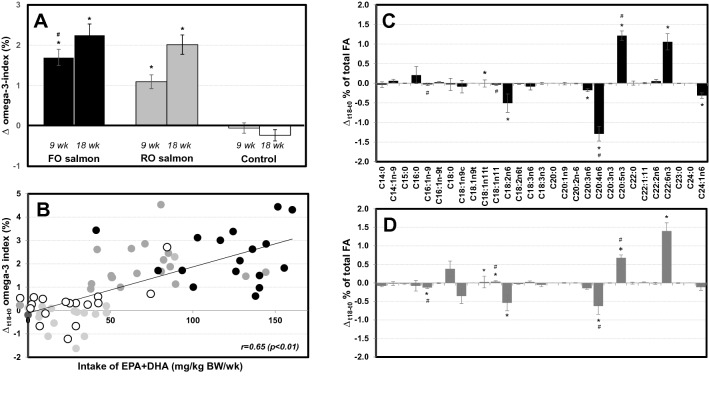
Salmon were grown on feeds containing mainly fish oil (FO) or rapeseed oil (RO), resulting in an eicosapentaenoic acid (EPA) + docosahexaenoic acid (DHA) content of fillets of 2.1 or 0.9 g/100 g, respectively. In a randomized parallel controlled trial, 51 healthy subjects were allocated to consume 2 portions/week of FO salmon (n = 17), RO salmon (n = 17) or no additional salmon (Control, n = 17) as part of their habitual diet, for 18 weeks. We collected blood at 0, 9 and 18 weeks to measure omega-3 index (O3I) in red blood cells, plasma markers of cardiovascular risk, serum 25(OH)-vitamin D (25(OH)D) and plasma trace elements.
After 18 weeks, O3I was similarly increased in subjects consuming 2 portions/week of FO or RO salmon compared to control (both p < 0.05). Serum 25(OH)D was significantly higher, whereas plasma triacylglycerols were significantly lower in subjects consuming RO salmon compared to control (both p < 0.05). Heart rate was significantly lower in subjects consuming FO salmon after 9 weeks, compared to control (p < 0.01). Salmon consumption did not affect other markers.
Consuming two portions/week of salmon raised on rapeseed oil rather than fish oil increased the O3I and vitamin D status, and decreased plasma triacylglycerols. These outcomes endorse opportunities for developing more sustainable feeds within aquaculture food systems.
This trial was registered at clinicaltrials.gov as NCT01916434.
养殖鱼类越来越多地以含有植物油的饲料喂养,这会影响其成分,甚至可能影响其健康特性。我们研究了食用以不同喂养方式养殖的三文鱼对健康受试者的营养状况和健康结果的影响。
三文鱼以主要含有鱼油(FO)或菜籽油(RO)的饲料喂养,结果鱼片的二十碳五烯酸(EPA)+二十二碳六烯酸(DHA)含量分别为 2.1 克/100 克和 0.9 克/100 克。在一项随机平行对照试验中,51 名健康受试者被分配每周食用 2 份 FO 三文鱼(n=17)、RO 三文鱼(n=17)或不额外食用三文鱼(对照组,n=17),作为其日常饮食的一部分,持续 18 周。我们在 0、9 和 18 周收集血液,以测量红细胞中的ω-3 指数(O3I)、心血管风险的血浆标志物、血清 25-羟维生素 D(25(OH)D)和血浆微量元素。
18 周后,与对照组相比,每周食用 2 份 FO 或 RO 三文鱼的受试者的 O3I 均显著增加(均 p<0.05)。与对照组相比,食用 RO 三文鱼的受试者的血清 25(OH)D 显著升高,而血浆三酰甘油显著降低(均 p<0.05)。与对照组相比,食用 FO 三文鱼的受试者在 9 周后心率显著降低(p<0.01)。食用三文鱼对其他标志物没有影响。
每周食用 2 份以菜籽油而非鱼油养殖的三文鱼可提高 O3I 和维生素 D 水平,降低血浆三酰甘油。这些结果为水产养殖食品系统中开发更可持续的饲料提供了机会。
本试验在 clinicaltrials.gov 上注册为 NCT01916434。