Crocker J C, Farrar N, Cook J A, Treweek S, Woolfall K, Chant A, Bostock J, Locock L, Rees S, Olszowski S, Bulbulia R
Nuffield Department of Primary Care Health Sciences, Oxford, UK.
National Institute for Health Research Oxford Biomedical Research Centre, Oxford, UK.
BJS Open. 2020 Oct 4;4(6):1238-45. doi: 10.1002/bjs5.50345.
Recruitment and retention of participants in surgical trials is challenging. Knowledge of the most common and problematic issues will aid future trial design. This study aimed to identify trial staff perspectives on the main issues affecting participant recruitment and retention in UK surgical trials.
An online survey of UK surgical trial staff was performed. Respondents were asked whether or not they had experienced a range of recruitment and retention issues, and, if yes, how relatively problematic these were (no, mild, moderate or serious problem).
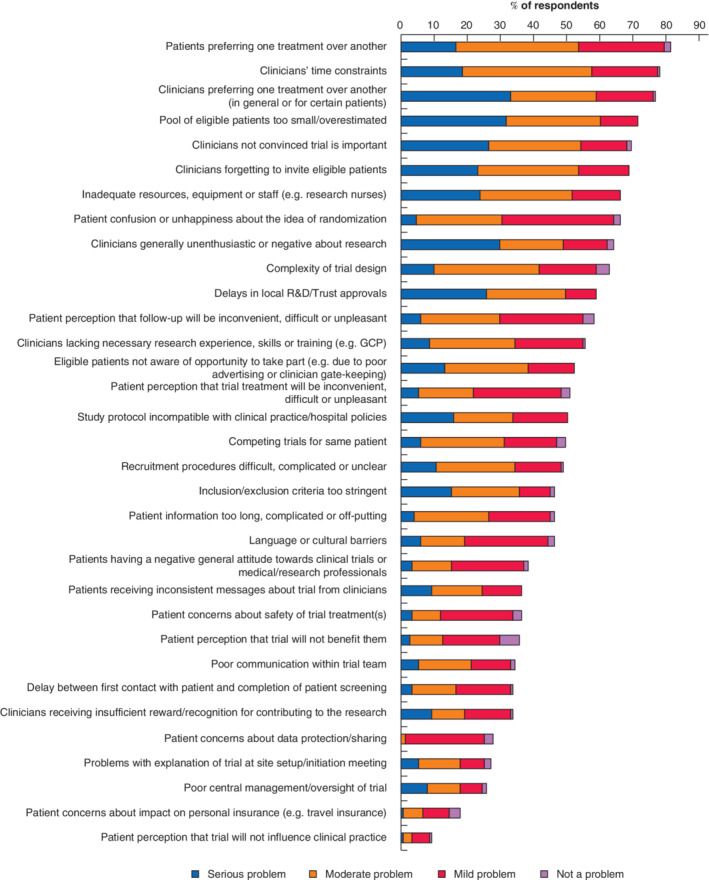
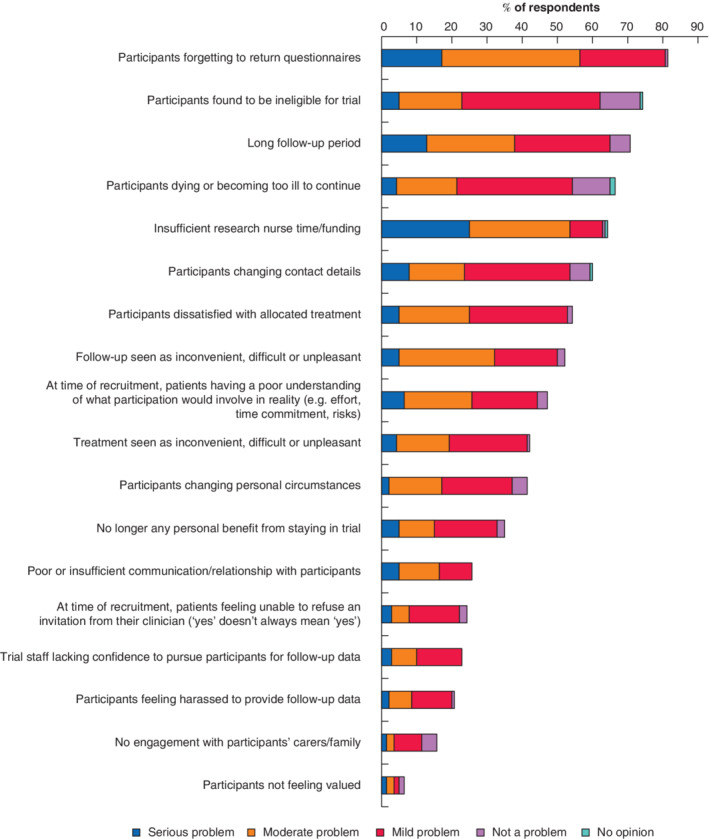
The survey was completed by 155 respondents including 60 trial managers, 53 research nurses, 20 trial methodologists and 19 chief investigators. The three most common recruitment issues were: patients preferring one treatment over another (81·5 per cent of respondents); clinicians' time constraints (78·1 per cent); and clinicians preferring one treatment over another (76·8 per cent). Seven recruitment issues were rated moderate or serious problems by a majority of respondents, the most problematic being a lack of eligible patients (60·3 per cent). The three most common retention issues were: participants forgetting to return questionnaires (81·4 per cent); participants found to be ineligible for the trial (74·3 per cent); and long follow-up period (70·7 per cent). The most problematic retention issues, rated moderate or serious by the majority of respondents, were participants forgetting to return questionnaires (56·4 per cent) and insufficient research nurse time/funding (53·6 per cent).
The survey identified a variety of common recruitment and retention issues, several of which were rated moderate or serious problems by the majority of participating UK surgical trial staff. Mitigation of these problems may help boost recruitment and retention in surgical trials.
在外科试验中招募和留住参与者具有挑战性。了解最常见和最具问题性的问题将有助于未来试验的设计。本研究旨在确定试验人员对影响英国外科试验中参与者招募和留住的主要问题的看法。
对英国外科试验人员进行了一项在线调查。询问受访者是否经历过一系列招募和留住方面的问题,如果是,这些问题相对有多严重(无、轻微、中度或严重问题)。
155名受访者完成了调查,其中包括60名试验经理、53名研究护士、20名试验方法学家和19名首席研究员。三个最常见的招募问题是:患者更喜欢一种治疗方法而非另一种(81.5%的受访者);临床医生的时间限制(78.1%);以及临床医生更喜欢一种治疗方法而非另一种(76.8%)。大多数受访者将七个招募问题评为中度或严重问题,最具问题的是缺乏符合条件的患者(60.3%)。三个最常见的留住问题是:参与者忘记返还问卷(81.4%);发现参与者不符合试验条件(74.3%);以及随访期长(70.7%)。大多数受访者评为中度或严重的最具问题的留住问题是参与者忘记返还问卷(56.4%)和研究护士时间/资金不足(53.6%)。
该调查确定了各种常见的招募和留住问题,其中一些被大多数参与的英国外科试验人员评为中度或严重问题。缓解这些问题可能有助于提高外科试验中的招募和留住率。