Dong Fureng Economic & Social Development School, Wuhan University, Wuhan, Hubei, China.
Beijing University of Chinese Medicine (BUCM), Beijing, China.
Hum Vaccin Immunother. 2021 Apr 3;17(4):1196-1204. doi: 10.1080/21645515.2020.1807812. Epub 2020 Oct 5.
To evaluate cost-utility of universal Hepatitis B vaccination program in the Beijing city (Beijing).
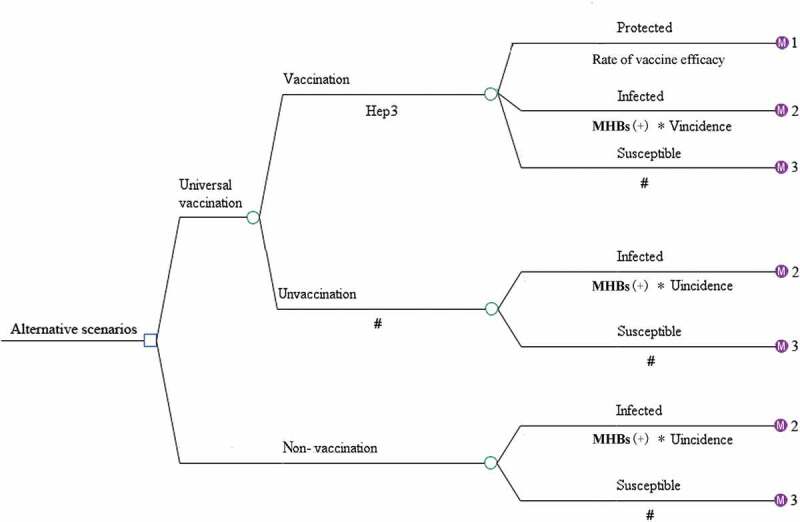
A decision-Markov model was constructed to determine the cost-utility of the universal immunization program for infants (universal vaccination program) by comparing with a hypothetic nonvaccination strategy in Beijing. Parameters in models were extracted from Beijing Center for Disease Control and Prevention (CDC) annual work report, Beijing health statistical yearbook, National Health Survey report, Beijing 1% population sample survey report, Beijing Health and Medical Price Monitoring Data Platform, and public literatures. The incremental cost‑utility ratio (ICUR) was used to compare alternative scenarios. One-way sensitivity analysis and probabilistic sensitivity analysis were used to assess parameter uncertainties.
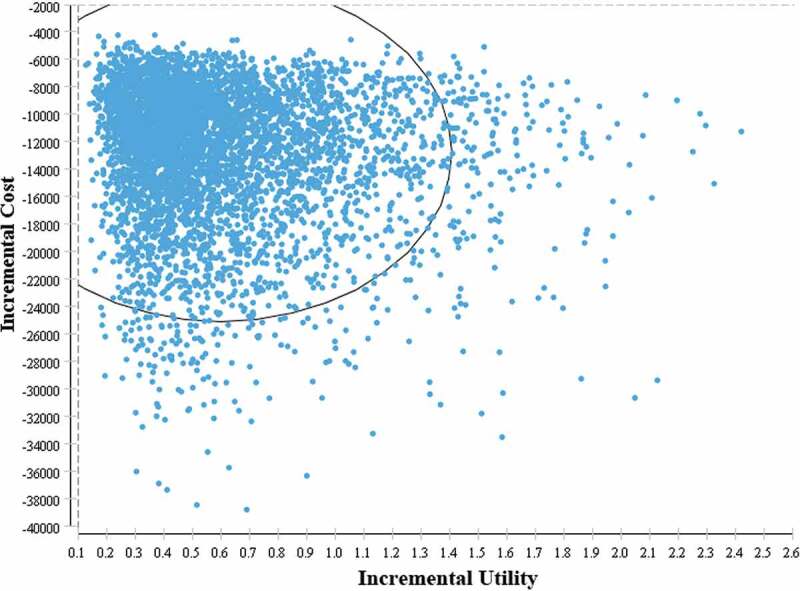
The universal vaccination program had increased the utility and reduced cost among infants born in 2016 in Beijing. The ICUR was CNY -24,576.61 (US$ -3779.16) per QALY for universal vaccination program comparing with non-vaccination scenario from healthcare perspective. It was estimated that the universal vaccination would save direct medical treatment cost of CNY 2,262,869,173.50 (US$ 347,962,414.43) and prevent loss of 18322.25 QALYs within lifetime of target cohort. Discount rate accounted for the most remarkable influence on ICUR in one-way sensitivity analysis. The result of probabilistic sensitivity analysis illustrated that all of the ICURs were located in the fourth quadrant of the cost-utility incremental plot undergone 5000 times of Monte Carlo simulation.
Current universal hepatitis B vaccination program in Beijing was highly cost utility. The investment was reasonable for current universal vaccination program in Beijing.
评估北京市(北京)乙型肝炎普遍免疫接种计划的成本效用。
通过将婴儿普遍免疫接种计划(普遍接种计划)与北京假设的非接种策略进行比较,构建决策模型来确定普遍免疫计划的成本效用。模型中的参数从北京市疾病预防控制中心(CDC)年度工作报告、北京卫生统计年鉴、国家卫生调查报告、北京 1%人口抽样调查报告、北京卫生和医疗价格监测数据平台以及公共文献中提取。增量成本效益比(ICUR)用于比较替代方案。采用单因素敏感性分析和概率敏感性分析评估参数不确定性。
普遍接种计划增加了北京市 2016 年出生婴儿的效用并降低了成本。从医疗保健角度来看,与非接种方案相比,普遍接种方案的 ICUR 为 24576.61 元人民币(3779.16 美元)/人年。预计普遍接种将节省直接医疗费用 2262869173.50 元人民币(347962414.43 美元),并在目标队列的一生中预防损失 18322.25 个 QALYs。单因素敏感性分析中,贴现率对 ICUR 的影响最大。概率敏感性分析的结果表明,在经过 5000 次蒙特卡罗模拟的成本效用增量图的第四象限中,所有 ICUR 都位于其中。
目前北京市乙型肝炎普遍免疫接种计划具有高度的成本效益。目前北京市普遍接种计划的投资是合理的。