Arch Suicide Res. 2022 Apr-Jun;26(2):731-747. doi: 10.1080/13811118.2020.1828208. Epub 2020 Oct 5.
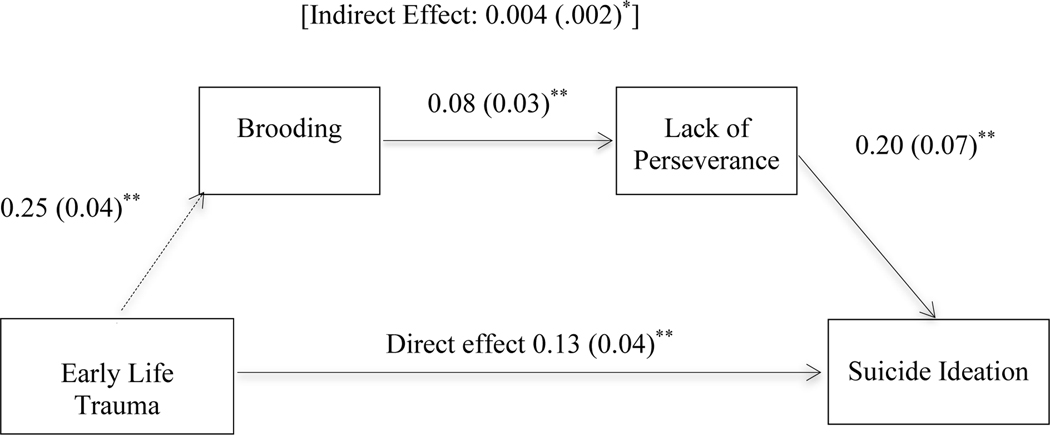
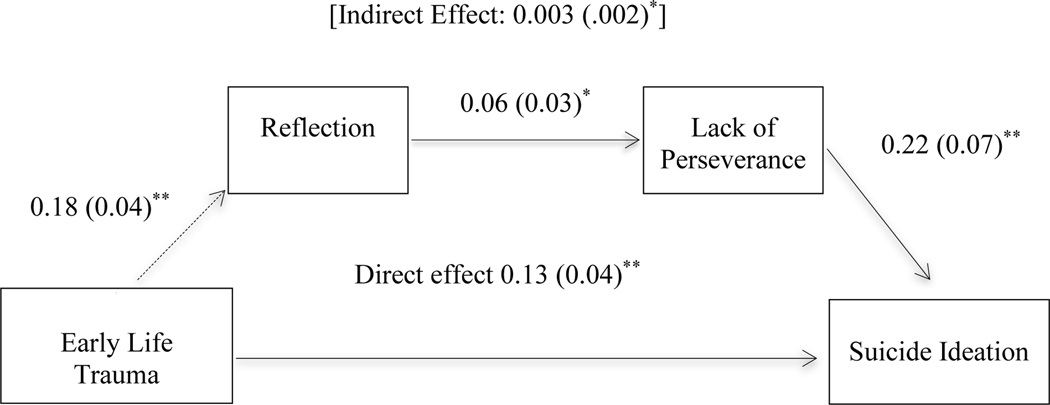
Suicide is the second leading cause of death for young adults in the United States. One of the many risk factors for suicide includes exposure to early life trauma. The present study examined whether rumination and impulsivity play a role in the relationship between early life trauma and increased risk for suicidal behavior (i.e., suicide ideation and suicide attempts) among 426 young adults. Early life trauma was associated with brooding, reflective rumination, and impulsivity in the form of negative urgency. Current or recent suicide ideators self-reported greater early life trauma, ruminative thinking, and impulsivity than non-ideators and non-attempters. Further, a multinomial logistic regression found that early life trauma, reflection, lack of premeditation, and lack of perseverance were associated with higher odds of reporting suicide ideation in the previous 6 months. We also found indirect relationships between early life trauma and suicide ideation through brooding or reflection and lack of perseverance in serial mediation analyses. These findings suggest that early life trauma may increase risk of suicide ideation to the degree that it leads to ruminative thinking and lack of follow-through with difficult tasks. How early life trauma might increase risk for ruminative thinking, impulsivity, and subsequent suicidal behavior is discussed.
自杀是美国年轻人的第二大主要死因。自杀的众多风险因素之一包括早期生活创伤。本研究探讨了反刍思维和冲动性是否在早期生活创伤与自杀行为(即自杀意念和自杀企图)风险增加之间发挥作用,研究对象为 426 名年轻人。早期生活创伤与沉思、反思性反刍思维以及以负性冲动形式的冲动性有关。目前或最近有自杀意念的人自我报告的早期生活创伤、沉思和冲动性比非意念者和非企图者更高。此外,多项逻辑回归发现,早期生活创伤、反思、缺乏预谋和缺乏毅力与报告过去 6 个月有自杀意念的可能性更高有关。我们还在序列中介分析中发现了早期生活创伤与自杀意念之间的间接关系,即沉思或反思以及缺乏毅力。这些发现表明,早期生活创伤可能会增加自杀意念的风险,从而导致沉思和难以完成任务时缺乏坚持。早期生活创伤如何增加沉思、冲动和随后自杀行为的风险将进行讨论。