Department of Biochemistry, Faculty of Medicine, University of Peradeniya, Peradeniya, Sri Lanka.
Department of Medicine, Faculty of Medicine, University of Peradeniya, Peradeniya, Sri Lanka.
PLoS Negl Trop Dis. 2020 Oct 5;14(10):e0008668. doi: 10.1371/journal.pntd.0008668. eCollection 2020 Oct.
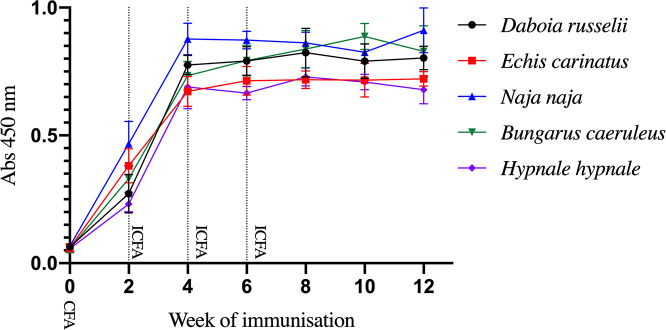
Detection and quantification of snake venom in envenomed patients' blood is important for identifying the species responsible for the bite, determining administration of antivenom, confirming whether sufficient antivenom has been given, detecting recurrence of envenoming, and in forensic investigation. Currently, snake venom detection is not available in clinical practice in Sri Lanka. This study describes the development of enzyme immunoassays (EIA) to differentiate and quantify venoms of Russell's viper (Daboia russelii), saw-scaled viper (Echis carinatus), common cobra (Naja naja), Indian krait (Bungarus caeruleus), and hump-nosed pit viper (Hypnale hypnale) in the blood of envenomed patients in Sri Lanka.
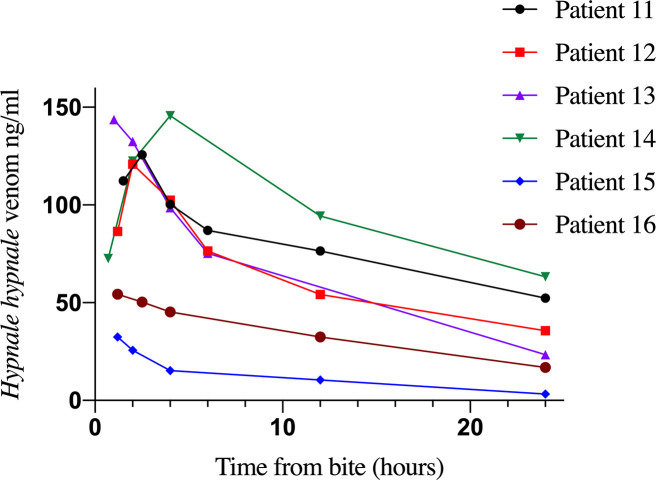
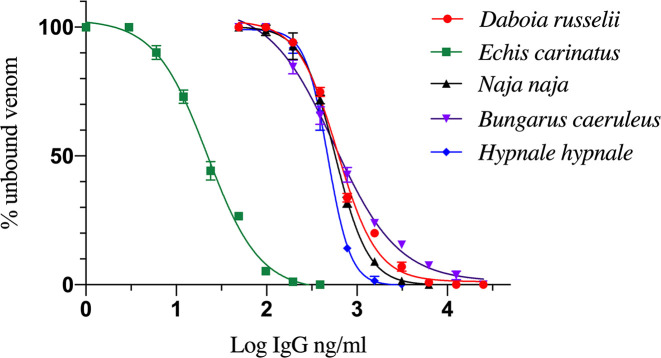
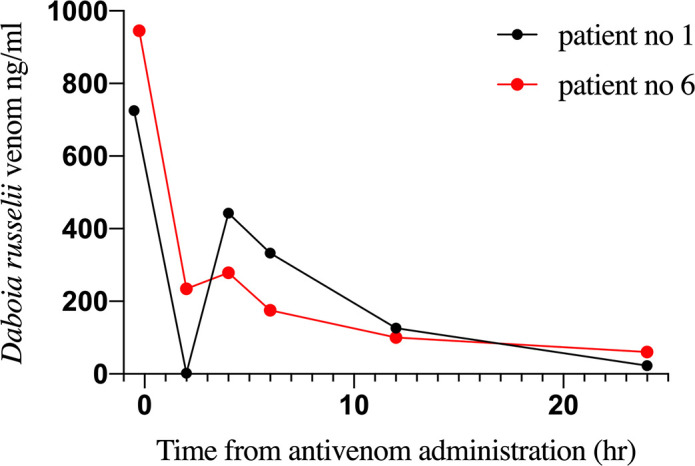
METHODOLOGY / PRINCIPAL FINDINGS: A double sandwich EIA of high analytical sensitivity was developed using biotin-streptavidin amplification for detection of venom antigens. Detection and quantification of D. russelii, N. naja, B. caeruleus, and H. hypnale venoms in samples from envenomed patients was achieved with the assay. Minimum (less than 5%) cross reactivity was observed between species, except in the case of closely related species of the same genus (i.e., Hypnale). Persistence/ recurrence of venom detection following D. russelii envenoming is also reported, as well as detection of venom in samples collected after antivenom administration. The lack of specific antivenom for Hypnale sp envenoming allowed the detection of venom antigen in circulation up to 24 hours post bite.
The EIA developed provides a highly sensitive assay to detect and quantify five types of Sri Lankan snake venoms, and should be useful for toxinological research, clinical studies, and forensic diagnosis.
在被蛇咬伤的患者血液中检测和定量蛇毒对于确定导致咬伤的物种、确定是否给予抗蛇毒血清、确认是否给予了足够的抗蛇毒血清、检测是否再次发生蛇毒、以及在法医学调查中都很重要。目前,斯里兰卡的临床实践中还无法检测蛇毒。本研究描述了酶免疫分析(EIA)的发展,用于区分和定量斯里兰卡被蛇咬伤的患者血液中的罗素蝰蛇(Daboia russelii)、锯鳞蝰(Echis carinatus)、普通眼镜蛇(Naja naja)、印度金环蛇(Bungarus caeruleus)和喜马拉雅白头蝰(Hypnale hypnale)的毒液。
方法/主要发现:该方法使用生物素-链霉亲和素放大的双夹心 EIA 检测毒液抗原,具有高分析灵敏度。该检测方法可用于检测和定量来自被蛇咬伤患者的样本中的 D. russelii、N. naja、B. caeruleus 和 H. hypnale 毒液。除了同一属的密切相关物种(即 Hypnale)之外,各物种之间观察到的交叉反应性最小(<5%)。D. russelii 蛇毒中毒后也报告了毒液的持续存在/复发,以及在给予抗蛇毒血清后采集的样本中检测到毒液。由于缺乏针对 Hypnale sp 蛇毒中毒的特异性抗蛇毒血清,因此能够在咬伤后 24 小时内检测到循环中的毒液抗原。
开发的 EIA 提供了一种高度敏感的检测和定量五种类型的斯里兰卡蛇毒的方法,应该对毒理学研究、临床研究和法医诊断有用。