Department of Microbiology, Universidade Federal de Minas Gerais, Belo Horizonte, Minas Gerais, Brazil.
Centro de Controle de Zoonoses, Belo Horizonte, Minas Gerais, Brazil.
PLoS Negl Trop Dis. 2020 Oct 5;14(10):e0008658. doi: 10.1371/journal.pntd.0008658. eCollection 2020 Oct.
From the end of 2016 until the beginning of 2019, Brazil faced a massive sylvatic yellow fever (YF) outbreak. The 2016-2019 YF epidemics affected densely populated areas, especially the Southeast region, causing thousands of deaths of humans and non-human primates (NHP).
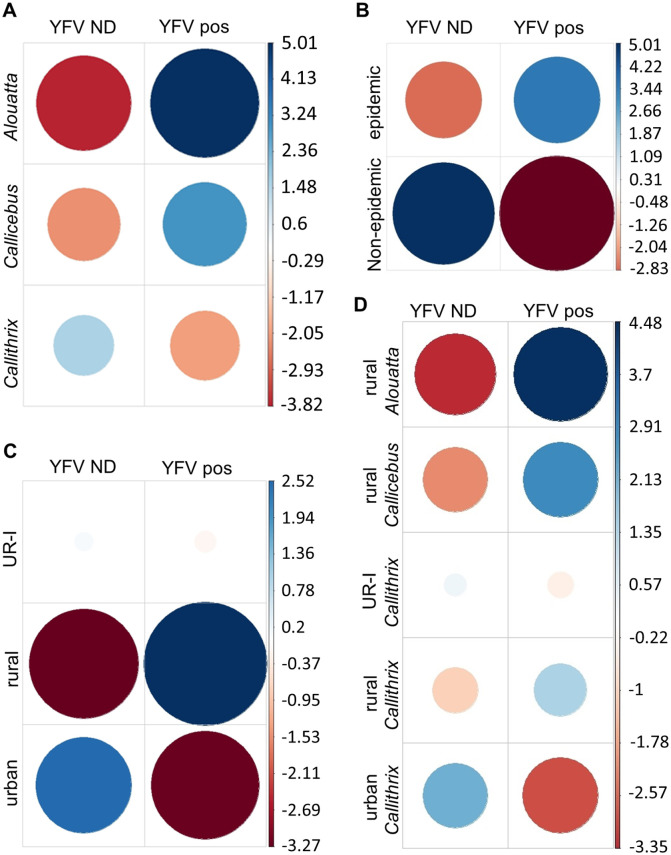
METHODOLOGY/PRINCIPAL FINDINGS: We conducted a molecular investigation of yellow fever virus (YFV) RNA in 781 NHP carcasses collected in the urban, urban-rural interface, and rural areas of Minas Gerais state, from January 2017 to December 2018. Samples were analyzed according to the period of sampling, NHP genera, sampling areas, and sampling areas/NHP genera to compare the proportions of YFV-positive carcasses and the estimated YFV genomic loads. YFV infection was confirmed in 38.1% of NHP carcasses (including specimens of the genera Alouatta, Callicebus, Callithrix, and Sapajus), from the urban, urban-rural interface, and rural areas. YFV RNA detection was positively associated with epidemic periods (especially from December to March) and the rural environment. Higher median viral genomic loads (one million times) were estimated in carcasses collected in rural areas compared to urban ones.
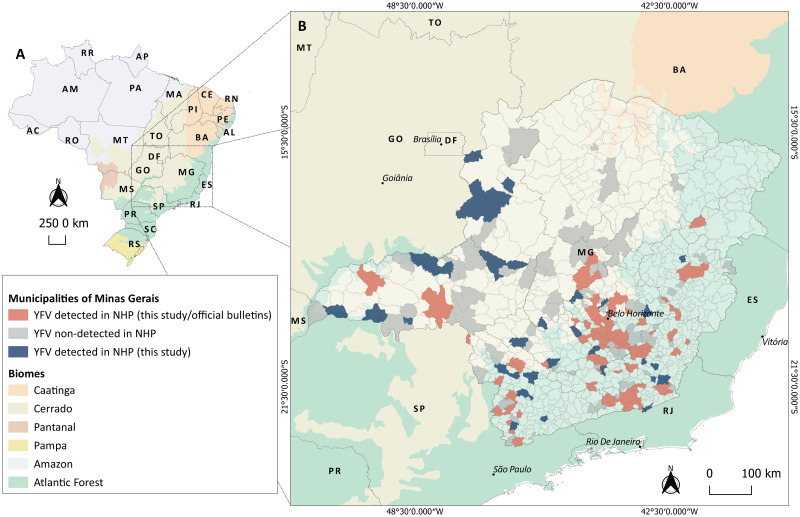
CONCLUSIONS/SIGNIFICANCE: The results showed the wide occurrence of YF in Minas Gerais in epidemic and non-epidemic periods. According to the sylvatic pattern of YF, a gradient of viral dissemination from rural towards urban areas was observed. A high YF positivity was observed for NHP carcasses collected in urban areas with a widespread occurrence in 67 municipalities of Minas Gerais, including large urban centers. Although there was no documented case of urban/Aedes YFV transmission to humans in Brazil during the 2016-2019 outbreaks, YFV-infected NHP in urban areas with high infestation by Aedes aegypti poses risks for YFV urban/Aedes transmission and urbanization.
从 2016 年底到 2019 年初,巴西遭遇了大规模的丛林黄热病(YF)疫情。2016-2019 年的 YF 疫情影响了人口稠密的地区,特别是东南部地区,导致数千人死亡,其中包括人类和非人类灵长类动物(NHP)。
方法/主要发现:我们对 2017 年 1 月至 2018 年 12 月期间在米纳斯吉拉斯州城市、城乡结合部和农村地区采集的 781 只 NHP 尸体中的黄热病病毒(YFV)RNA 进行了分子调查。根据采样期、NHP 属、采样区和采样区/NHP 属进行分析,比较 YFV 阳性尸体的比例和估计的 YFV 基因组载量。在城市、城乡结合部和农村地区的 NHP 尸体中,YFV 感染率为 38.1%(包括 Alouatta、Callicebus、Callithrix 和 Sapajus 属的标本)。YFV RNA 检测与流行期(尤其是 12 月至 3 月)和农村环境呈正相关。与城市地区相比,农村地区采集的尸体估计的病毒基因组载量中位数(一百万倍)更高。
结论/意义:结果表明,米纳斯吉拉斯州在流行期和非流行期都广泛发生了 YF。根据 YF 的丛林模式,观察到病毒从农村向城市传播的梯度。在米纳斯吉拉斯州的 67 个城市中,包括大城市中心,都广泛存在从城市地区采集的 YF 阳性 NHP 尸体,这些尸体的 YF 阳性率很高。尽管在 2016-2019 年疫情期间,巴西没有记录到城市/埃及伊蚊 YFV 向人类传播的病例,但在城市地区,受埃及伊蚊大量侵扰的感染 YFV 的 NHP 对 YFV 城市/埃及伊蚊传播和城市化构成了风险。