School of Medicine, University of São Paulo, São Paulo, Brazil.
Front Cell Infect Microbiol. 2019 Jul 17;9:259. doi: 10.3389/fcimb.2019.00259. eCollection 2019.
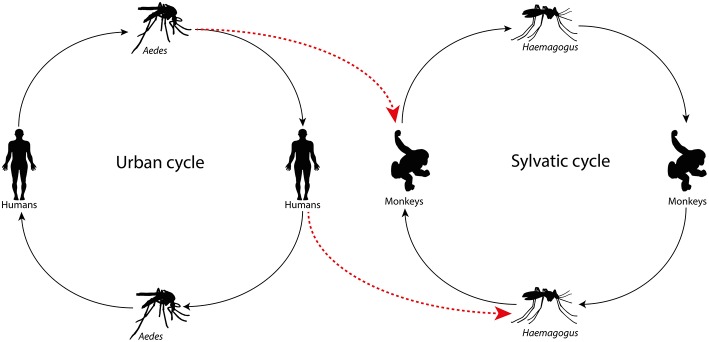
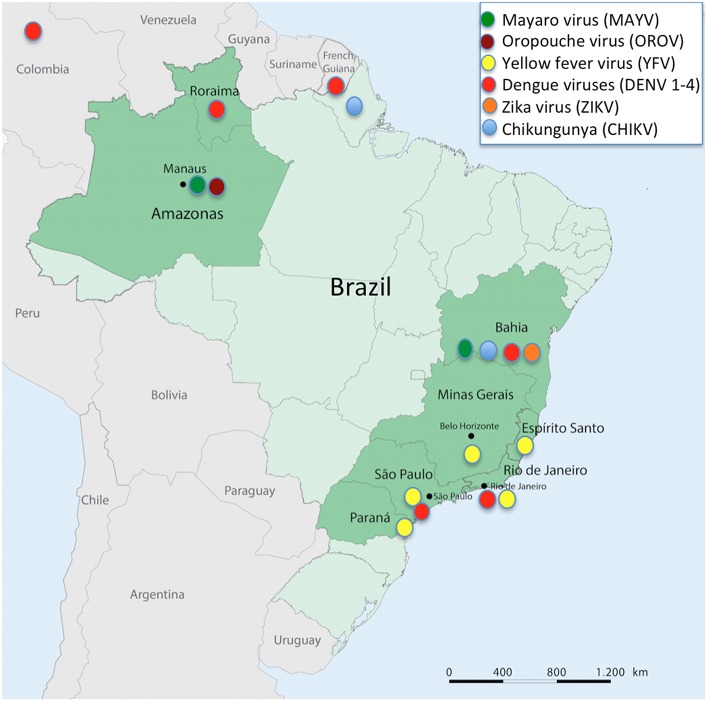
The present study shows that the most prominent human arboviruses worldwide (dengue viruses 1, 2, 3, and 4, Chikungunya virus, and Zika virus) can infect wild animals and transfer from urban to sylvatic maintenance cycles in South America, as did the yellow fever virus (YFV) in the past. All these viruses are transmitted by the anthropophilic mosquito and cause epidemics throughout Brazil. The YFV is the oldest example of an urban arbovirus that became sylvatic in South America. Currently, the disease is a zoonosis of non-human primates that moves like a wave through the forests of the Brazilian countryside, traveling thousands of kilometers, killing many animals and eventually infecting man. However, since 2016, this zoonotic wave has reached the highly populated areas of Southeast Brazil, producing the largest human outbreak in the past 60 years. As with the YFV, sylvatic cycles may occur with dengue, Chikungunya, and Zika. In order to become sylvatic, arboviruses require an apparently unlikely conjunction of factors to unexpectedly take place. These arboviruses could start to infect sylvatic primates and be transmitted by mosquitoes that inhabit tree canopies. We mention here publications reporting evidence of sylvatic cycles of dengue, Chikungunya, and Zika virus in South America. Indeed, it is almost unfeasible to control these cycles of arboviruses since it is impossible to know where, when or why an arboviral spill-over would occur in wild animals. The sylvatic maintenance cycle could preclude the eradication of an arbovirus. Moreover, an arbovirus in a sylvatic cycle could re-emerge anytime, infecting humans and producing outbreaks. In case of the reemergence of an arbovirus, it is crucial to prevent the occurrence of an urban cycle as a spill-back from the sylvatic cycle.
本研究表明,目前全球流行的主要人类虫媒病毒(登革病毒 1、2、3、4 型、基孔肯雅热病毒和寨卡病毒)可感染野生动物,并从城市传播到南美洲的森林维持循环,就像过去的黄热病病毒(YFV)一样。所有这些病毒都通过嗜人蚊传播,并在巴西引发疫情。YFV 是首例成为南美洲森林型的城市虫媒病毒。目前,该疾病是一种非人类灵长类动物的人畜共患病,在巴西农村的森林中像波浪一样传播,传播数千公里,杀死许多动物,最终感染人类。然而,自 2016 年以来,这种人畜共患病波已蔓延到巴西南部人口稠密地区,引发了过去 60 年来最大的人类疫情。与 YFV 一样,登革热、基孔肯雅热和寨卡病毒也可能发生森林型循环。为了成为森林型病毒,虫媒病毒需要发生一些看似不太可能的因素的意外结合。这些虫媒病毒可能开始感染森林型灵长类动物,并通过栖息在树冠中的蚊子传播。我们在此提到了一些报道表明,在南美洲发现了登革热、基孔肯雅热和寨卡病毒的森林型循环的证据。实际上,由于不可能知道虫媒病毒何时何地会在野生动物中溢出,因此几乎不可能控制这些虫媒病毒的循环。森林型维持循环可能会阻止虫媒病毒的根除。此外,森林型循环中的虫媒病毒可能随时重新出现,感染人类并引发疫情。在虫媒病毒重新出现的情况下,防止其从森林型循环中溢出到城市型循环非常重要。