Zhang Xinyang, Liu Xuemei, Xia Ruyu, Li Nannan, Liao Xing, Chen Zhigang
Department of Neurology.
Central Laboratory, Dongfang Hospital.
Medicine (Baltimore). 2020 Oct 2;99(40):e22455. doi: 10.1097/MD.0000000000022455.
Cerebral small vessel disease (CSVD) is the most common etiology of vascular cognitive impairment (VCI). VCI in CSVD (CSVD-VCI) shows a progressive course with multiple stages and is also associated with dysfunctions such as gait, emotional and behavioral, and urinary disturbances, which seriously affect the life quality of elderly people. In mainland China, Chinese herbal medicine (CHM) is clinically used for CSVD-VCI and presenting positive efficacy, but the evidence revealed in relevant clinical trials has not been systematically evaluated. The purpose of this study is to assess the current evidence available for the clinical efficacy and safety of CHM for CSVD-VCI.
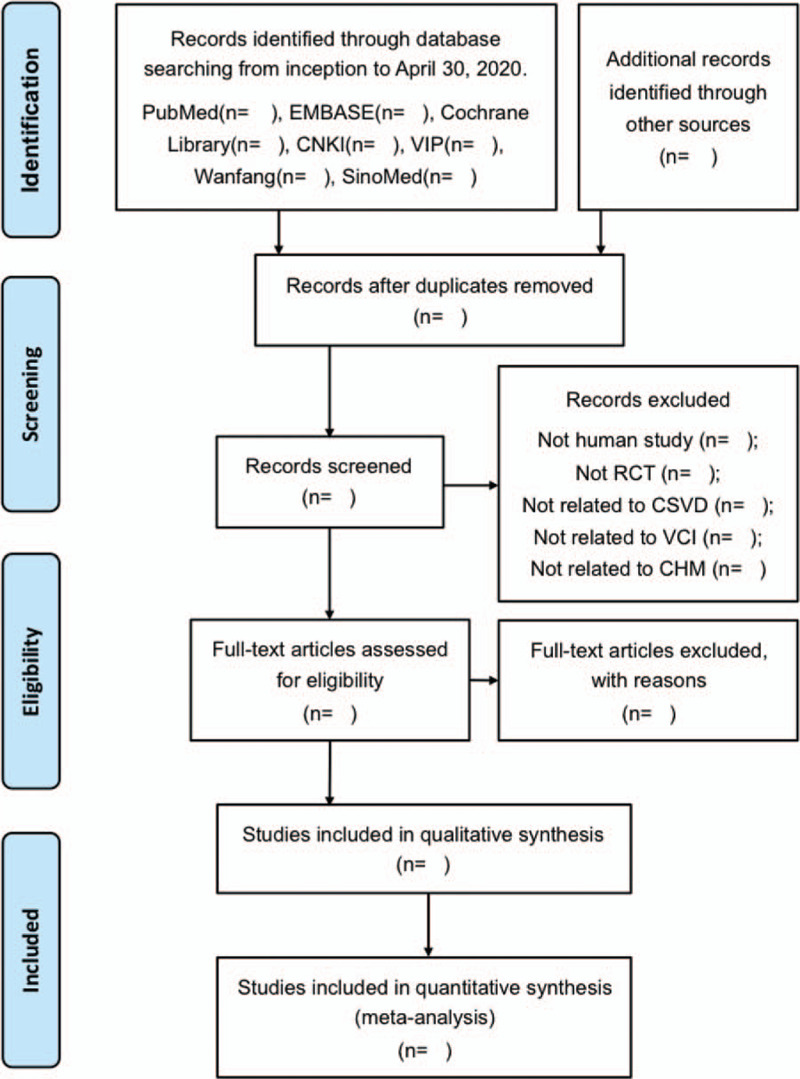
A literature search of published RCTs up to April 30, 2020, has been conducted in the following 7 electronic databases: PubMed, Embase, the Cochrane Library, Chinese National Knowledge Infrastructure Database (CNKI), Chinese Science and Technology Journals Database (VIP), Wanfang Database, and Chinese Biomedical Literature Service System (SinoMed). For unpublished studies, 2 clinical trial online registration websites will be searched: ClinicalTrials.gov and Chinese Clinical Trial Registry (ChiCTR). Only randomized controlled trials (RCTs) using CHM in the treatment of patients with CSVD-VCI, which compares CHM with no treatment, placebo, or other conventional treatments, will be included in this systematic review. Primary outcomes will be set as acknowledged scales measuring cognitive function. Secondary outcomes will involve activities of daily living, behavioral, and psychological symptoms, global performance of dementia, neurological function, biological markers of endothelial dysfunction, the clinical effective rate, and adverse events. After screening studies and extracting data, the Cochrane Collaborations tool for assessing risk of bias will be applied to assess the methodological quality of included RCTs. Review Manager Version 5.3 software will be used for data synthesis and statistical analysis. Subgroup analyses, sensitivity analyses, and meta-regression will be conducted to detect potential sources of heterogeneity. The funnel plot and Eggers test will be developed to evaluate publication bias, if available. We will perform the Grading of Recommendations Assessment, Development and Evaluation (GRADE) system to appraise the quality of evidence.
Evidence exhibited in this systematic review will provide practical references in the field of CHM treating CSVD-VCI. Moreover, our detailed appraisals of methodological deficiencies of relevant RCTs will offer helpful advice for researchers who are designing trials of CHMs in the treatment of CSVD-VCI.
The conclusion about the clinical efficacy and safety of CHM for CSVD-VCI will be provided for clinical plans, decisions, and policy developments in the full version of this systematic review.
INPLASY202080120.
脑小血管病(CSVD)是血管性认知障碍(VCI)最常见的病因。CSVD所致的VCI(CSVD-VCI)呈多阶段的进行性病程,还伴有步态、情感和行为以及排尿功能障碍等,严重影响老年人的生活质量。在中国内地,中药(CHM)临床上用于治疗CSVD-VCI且显示出了积极疗效,但相关临床试验中揭示的证据尚未得到系统评价。本研究的目的是评估现有关于CHM治疗CSVD-VCI的临床疗效和安全性的证据。
检索了以下7个电子数据库中截至2020年4月30日发表的随机对照试验(RCT):PubMed、Embase、Cochrane图书馆、中国知网数据库(CNKI)、维普中文科技期刊数据库(VIP)、万方数据库和中国生物医学文献服务系统(SinoMed)。对于未发表的研究,将检索2个临床试验在线注册网站:ClinicalTrials.gov和中国临床试验注册中心(ChiCTR)。本系统评价仅纳入使用CHM治疗CSVD-VCI患者的随机对照试验,这些试验将CHM与未治疗、安慰剂或其他传统治疗进行比较。主要结局将设定为公认的测量认知功能的量表。次要结局将包括日常生活活动、行为和心理症状、痴呆的整体表现、神经功能、内皮功能障碍的生物标志物、临床有效率及不良事件。在筛选研究和提取数据后,将应用Cochrane协作网的偏倚风险评估工具来评估纳入RCT的方法学质量。将使用Review Manager 5.3版软件进行数据合成和统计分析。将进行亚组分析、敏感性分析和meta回归以检测潜在的异质性来源。若可行,将绘制漏斗图并进行Egger检验以评估发表偏倚。我们将采用推荐意见分级的评估、制定与评价(GRADE)系统来评价证据质量。
本系统评价中展示的证据将为CHM治疗CSVD-VCI领域提供实际参考。此外,我们对相关RCT方法学缺陷的详细评价将为设计CHM治疗CSVD-VCI试验的研究人员提供有益建议。
本系统评价的完整版本将提供关于CHM治疗CSVD-VCI临床疗效和安全性的结论,以供临床规划、决策及政策制定参考。
INPLASY202080120
