Charmpi Christina, Van Reckem Emiel, Sameli Nikoleta, Van der Veken David, De Vuyst Luc, Leroy Frédéric
Research Group of Industrial Microbiology and Food Biotechnology (IMDO), Faculty of Sciences and Bioengineering Sciences, Vrije Universiteit Brussel, Pleinlaan 2, B-1050 Brussels, Belgium.
Foods. 2020 Oct 1;9(10):1386. doi: 10.3390/foods9101386.
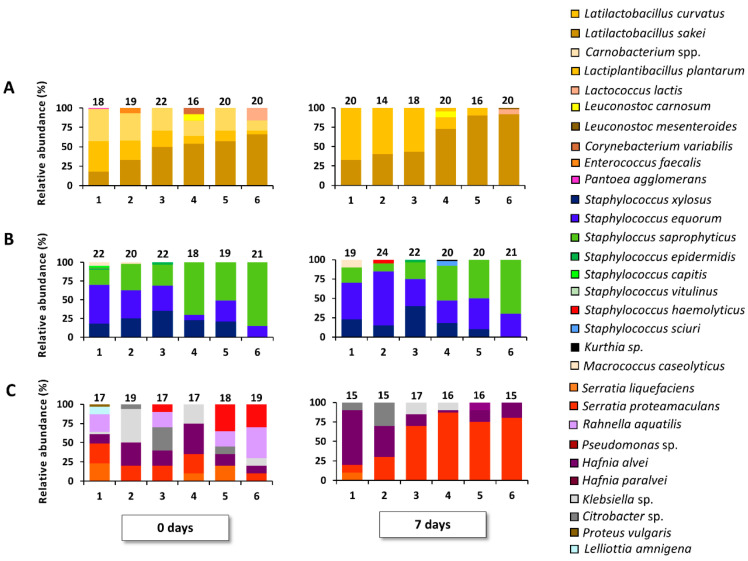
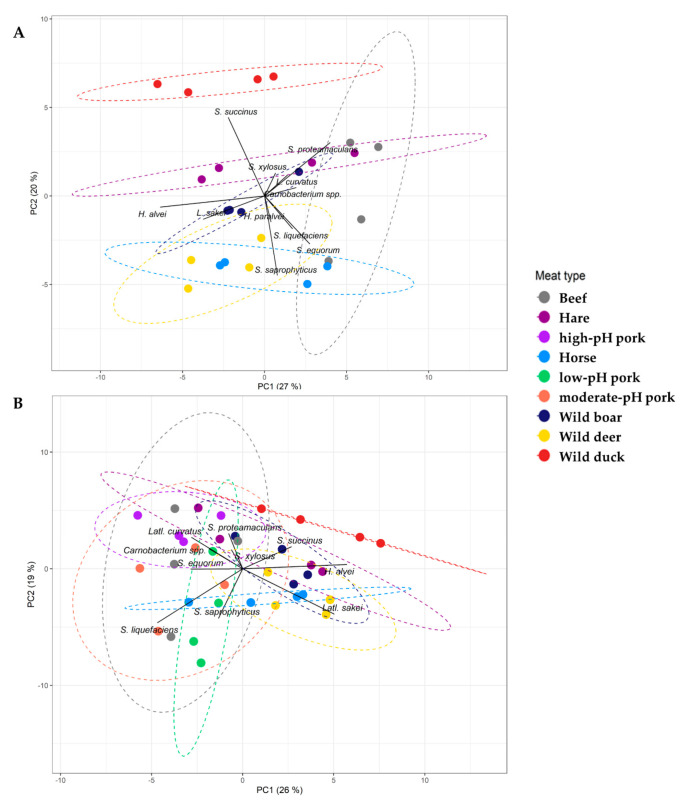
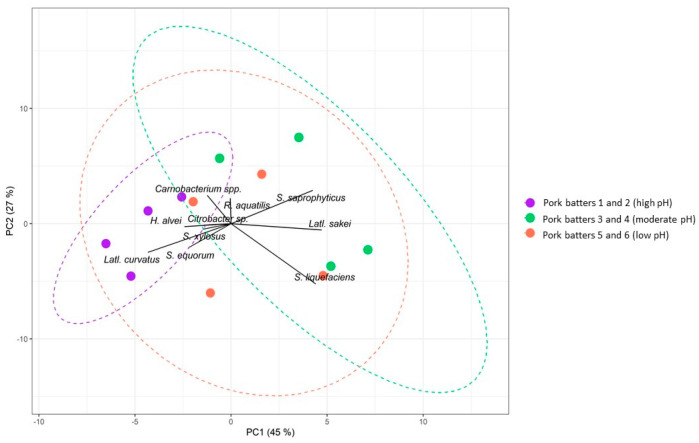
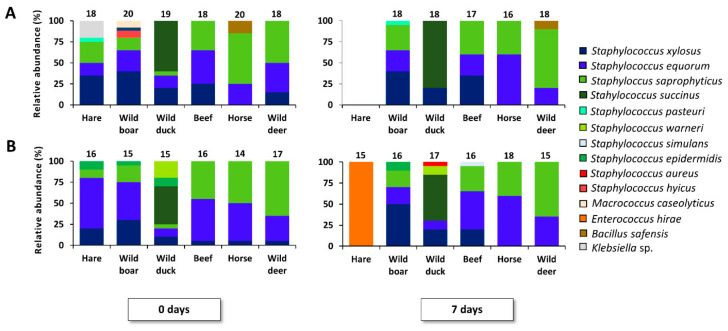
The bacterial communities that are established during natural meat fermentation depend on the processing conditions and the type of meat substrate used. Six pork samples of variable quality (reflected in pH values) and six less conventional meats (beef, horse, hare, wild deer, wild duck, and wild boar) were naturally fermented under controlled conditions in model systems. The development of lactic acid bacteria (LAB), coagulase-negative staphylococci (CNS), and enterobacteria was followed using culture-dependent techniques and (GTG)-PCR fingerprinting of genomic DNA from the isolates obtained. Taken together, was the most abundant LAB species, although was more manifest in high-pH pork. Within staphylococci, common species were encountered (i.e., , , and ), although some atypical ones (i.e., ) were also recovered. Within enterobacteria, spp. prevailed in more acidic pork batches and in beef, whereas spp. prevailed in game meat fermentations. Enterobacterial counts were particularly high in fermentations with low acidity, namely for some pork batches, hare, wild duck, and wild boar. These findings should be considered when naturally fermented meat products are manufactured, as the use of game meat or meat with high pH can give rise to safety concerns.
在天然肉类发酵过程中形成的细菌群落取决于加工条件和所用肉类底物的类型。在模型系统中,在受控条件下对六个质量不同(以pH值反映)的猪肉样本以及六种不太常见的肉类(牛肉、马肉、兔肉、野生鹿肉、野鸭和野猪)进行了天然发酵。使用基于培养的技术以及对所获得分离株的基因组DNA进行(GTG)-PCR指纹分析,跟踪乳酸菌(LAB)、凝固酶阴性葡萄球菌(CNS)和肠杆菌的生长情况。总体而言, 是最丰富的LAB菌种,不过 在高pH值的猪肉中更为明显。在葡萄球菌中,发现了常见菌种(即 、 和 ),但也分离出了一些非典型菌种(即 )。在肠杆菌中, spp. 在酸性较强的猪肉批次和牛肉中占主导地位,而 spp. 在野味肉发酵中占主导地位。在低酸度发酵中,肠杆菌数量特别高,即在一些猪肉批次、兔肉、野鸭和野猪中。在生产天然发酵肉制品时应考虑这些发现,因为使用野味肉或高pH值的肉可能会引发安全问题。