Bioproduction Research Institute, National Institute of Advanced Industrial Science and Technology (AIST), Sapporo 062-8517, Japan.
Sensors (Basel). 2020 Oct 1;20(19):5632. doi: 10.3390/s20195632.
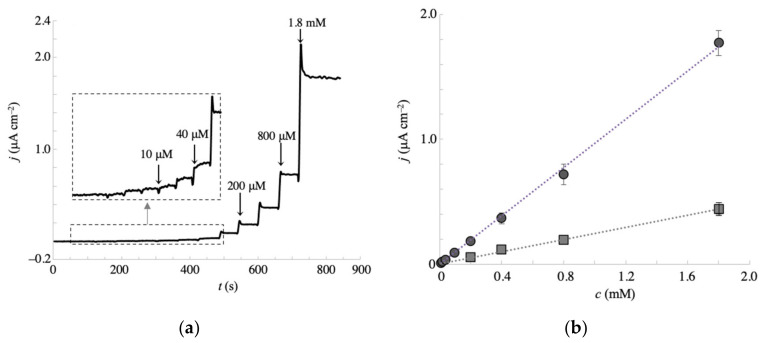
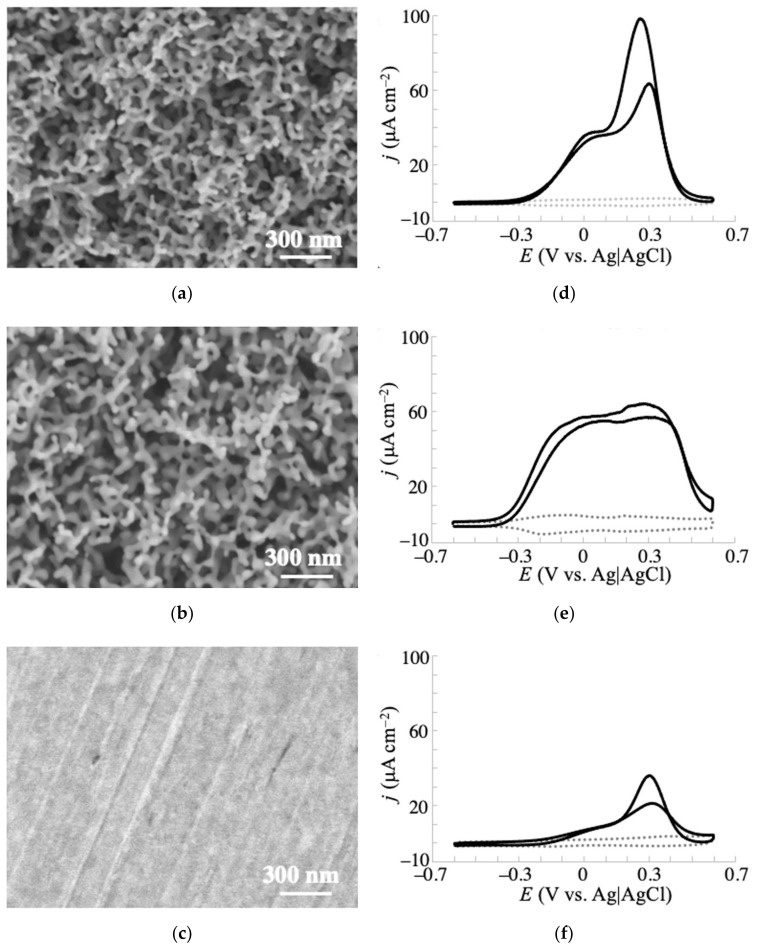
Non-enzymatic saccharide sensors are of great interest in diagnostics, but their non-selectivity limits their practical diagnostic abilities. In this study, we investigated the electrochemical oxidation of monosaccharides at nanoporous gold (NPG) catalysts with different contributions of surface crystallographic orientations. Fructose elicited no clear electrochemical response, but glucose, galactose, and mannose produced clear oxidative current. The onset potentials for oxidation of these saccharides depended on the surface atomic structure of the NPG. The oxidation potential was approximately 100 mV less positive at the Au(100)-enhanced NPG than at the Au(111)-enhanced NPG. Furthermore, the voltammetric responses significantly differed among the saccharides. Galactose was oxidized at less positive potential and exhibited a higher current response than the other saccharides. This tendency was enhanced in the presence of chloride ions. These features enabled the selective and sensitive detection of galactose at an NPG electrode without enzymes under physiological conditions. A linear range of 10 μM to 1.8 mM was obtained in the calibration plot, which was comparable to those in previously reported enzymatic galactose sensors. Thus, we demonstrated that controlling the crystallographic orientation on the nanostructured electrode surface is useful in developing electrochemical sensors.
非酶糖传感器在诊断学中具有重要意义,但它们的非选择性限制了它们的实际诊断能力。在这项研究中,我们研究了在具有不同表面晶面取向贡献的纳米多孔金 (NPG) 催化剂上单糖的电化学氧化。果糖没有引起明显的电化学响应,但葡萄糖、半乳糖和甘露糖产生了明显的氧化电流。这些糖的氧化起始电位取决于 NPG 的表面原子结构。在 Au(100)增强的 NPG 上的氧化电位比在 Au(111)增强的 NPG 上约正 100 mV。此外,糖的伏安响应在不同糖之间有显著差异。半乳糖在较正的电位下被氧化,并且比其他糖具有更高的电流响应。在存在氯离子的情况下,这种趋势得到了增强。这些特性使得在生理条件下无需酶即可在 NPG 电极上选择性和灵敏地检测半乳糖。在校准图中获得了 10 μM 至 1.8 mM 的线性范围,与先前报道的酶半乳糖传感器相当。因此,我们证明了在纳米结构电极表面控制晶体取向在开发电化学传感器方面是有用的。