Kole Christo, Charalampakis Nikolaos, Tsakatikas Sergios, Vailas Michail, Moris Dimitrios, Gkotsis Efthymios, Kykalos Stylianos, Karamouzis Michalis V, Schizas Dimitrios
First Department of Surgery, National and Kapodistrian University of Athens, Laikon General Hospital, 115 27 Athens, Greece.
Department of Medical Oncology, Metaxa Cancer Hospital, 185 37 Athens, Greece.
Cancers (Basel). 2020 Oct 4;12(10):2859. doi: 10.3390/cancers12102859.
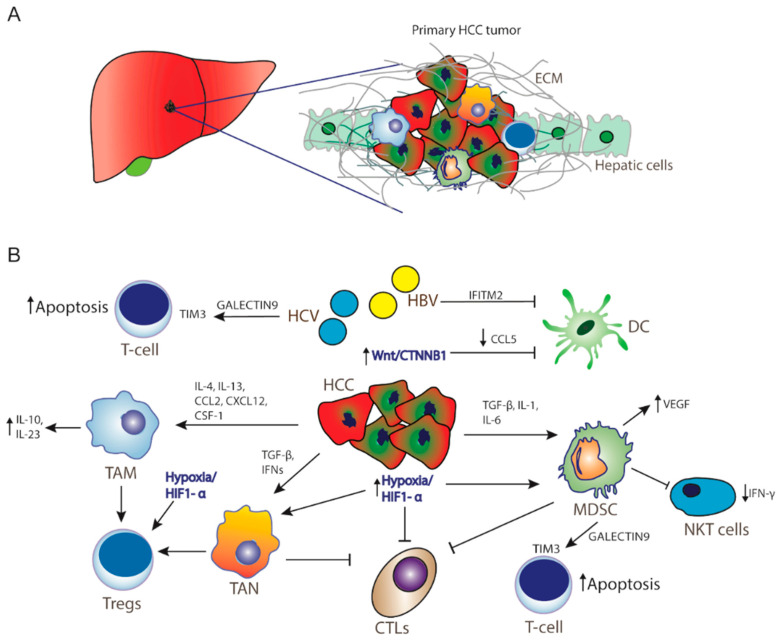
Hepatocellular carcinoma (HCC) is one of one of the most frequent liver cancers and the fourth leading cause of cancer-related mortality worldwide. Current treatment options such as surgery, neoadjuvant chemoradiotherapy, liver transplantation, and radiofrequency ablation will benefit only a very small percentage of patients. Immunotherapy is a novel treatment approach representing an effective and promising option against several types of cancer. The aim of our study is to present the currently ongoing clinical trials and to evaluate the efficacy of immunotherapy in HCC. In this paper, we demonstrate that combination of different immunotherapies or immunotherapy with other modalities results in better overall survival (OS) and progression-free survival (PFS) compared to single immunotherapy agent. Another objective of this paper is to demonstrate and highlight the importance of tumor microenvironment as a predictive and prognostic marker and its clinical implications in immunotherapy response.
肝细胞癌(HCC)是最常见的肝癌之一,也是全球癌症相关死亡的第四大主要原因。目前的治疗选择,如手术、新辅助放化疗、肝移植和射频消融,仅能使极少数患者受益。免疫疗法是一种新型治疗方法,是对抗多种癌症的有效且有前景的选择。我们研究的目的是介绍当前正在进行的临床试验,并评估免疫疗法在肝癌中的疗效。在本文中,我们证明,与单一免疫治疗药物相比,不同免疫疗法的联合或免疫疗法与其他治疗方式的联合可带来更好的总生存期(OS)和无进展生存期(PFS)。本文的另一个目的是证明并强调肿瘤微环境作为预测和预后标志物的重要性及其在免疫治疗反应中的临床意义。