Department of Medicine, Division of Rheumatology, Johns Hopkins University School of Medicine, Baltimore, Maryland, USA.
University of Maryland Medical Center, Baltimore, Maryland, USA.
Lupus Sci Med. 2020 Oct;7(1). doi: 10.1136/lupus-2020-000423.
BACKGROUND/PURPOSE: Loss of positivity of antiphospholipid antibodies has been observed in clinical practice post-thrombosis in patients with SLE with secondary antiphospholipid syndrome (APS). Our study defined the frequency of this loss and the duration before positivity recurred.
In this prospective study, patients with SLE having at least two positive antiphospholipid markers prior to thrombosis and at least 1 year of follow-up after thrombosis were included. Antiphospholipid markers included lupus anticoagulant (dilute Russell viper venom test >45 s followed by mixing and confirmatory tests) and/or anticardiolipin titre (aCL IgG ≥20, aCL IgM ≥20 and/or aCL IgA ≥20). The percentage of visits with positive antiphospholipid markers after thrombosis was calculated. For patients with a negative antiphospholipid marker any time after thrombosis, survival estimates were performed to calculate the time to return of antiphospholipid positivity.
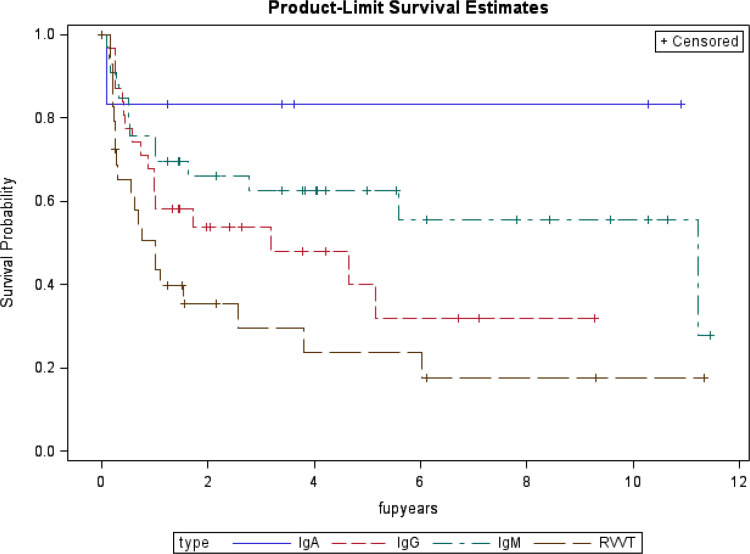
In APS due to SLE, complete loss of antiphospholipid positivity post-thrombosis was up to 41% for aCL IgG, 51% for IgM and 50% for IgA, but only 20% for those with lupus anticoagulant. Of those who at some point lost aCL IgG or became negative for lupus anticoagulant, the majority (60% and 76%, respectively) reacquired the antibody within 5 years. In contrast, of those who lost aCL IgM or IgA, fewer reacquired it within 5 years (37% and 17%, respectively).
Intermittent positivity of antiphospholipid antibodies is present in APS due to SLE. These fluctuations make it difficult to decide on length of anticoagulation. Lupus anticoagulant is more likely to persist post-thrombosis.
背景/目的:在伴有继发抗磷脂综合征(APS)的系统性红斑狼疮(SLE)患者血栓形成后临床实践中观察到抗磷脂抗体的阳性率降低。我们的研究定义了这种丢失的频率以及再次出现阳性之前的持续时间。
在这项前瞻性研究中,纳入了至少有两次血栓形成前抗磷脂标志物阳性且血栓形成后至少有 1 年随访的 SLE 患者。抗磷脂标志物包括狼疮抗凝剂(稀释的 Russell 蝰蛇 venom 试验>45 秒,然后进行混合和确认试验)和/或抗心磷脂抗体滴度(aCL IgG≥20、aCL IgM≥20 和/或 aCL IgA≥20)。计算血栓形成后抗磷脂标志物阳性的就诊百分比。对于任何时间血栓形成后抗磷脂标志物阴性的患者,进行生存估计以计算抗磷脂抗体再次出现的时间。
在 SLE 引起的 APS 中,完全丧失抗磷脂抗体阳性的情况在 aCL IgG 中高达 41%,在 IgM 中高达 51%,在 IgA 中高达 50%,但在狼疮抗凝剂中仅为 20%。在某些时候失去 aCL IgG 或狼疮抗凝剂呈阴性的患者中,大多数(分别为 60%和 76%)在 5 年内再次获得该抗体。相比之下,在失去 aCL IgM 或 IgA 的患者中,较少的人在 5 年内再次获得(分别为 37%和 17%)。
SLE 引起的 APS 中存在抗磷脂抗体的间歇性阳性。这些波动使得难以决定抗凝治疗的时间长度。狼疮抗凝剂在血栓形成后更有可能持续存在。