CAS Key Laboratory of Pathogenic Microbiology and Immunology, Institute of Microbiology, Center for Influenza Research and Early-warning (CASCIRE), CAS-TWAS Center of Excellence for Emerging Infectious Diseases (CEEID), Chinese Academy of Sciences, Beijing, 100101, China.
School of Life Sciences and Department of Statistics, University of Warwick, Coventry, CV4 7AL, UK.
Nat Commun. 2020 Oct 6;11(1):5006. doi: 10.1038/s41467-020-18836-4.
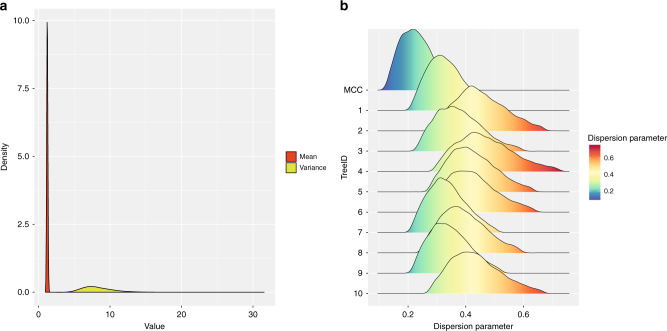
Coronavirus disease 2019 (COVID-19) was first identified in late 2019 in Wuhan, Hubei Province, China and spread globally in months, sparking worldwide concern. However, it is unclear whether super-spreading events occurred during the early outbreak phase, as has been observed for other emerging viruses. Here, we analyse 208 publicly available SARS-CoV-2 genome sequences collected during the early outbreak phase. We combine phylogenetic analysis with Bayesian inference under an epidemiological model to trace person-to-person transmission. The dispersion parameter of the offspring distribution in the inferred transmission chain was estimated to be 0.23 (95% CI: 0.13-0.38), indicating there are individuals who directly infected a disproportionately large number of people. Our results showed that super-spreading events played an important role in the early stage of the COVID-19 outbreak.
2019 年冠状病毒病(COVID-19)最初于 2019 年末在中国湖北省武汉市被发现,并在数月内全球传播,引发全球关注。然而,目前尚不清楚在早期爆发阶段是否发生了超级传播事件,因为其他新兴病毒已经观察到了这种情况。在这里,我们分析了在早期爆发阶段收集的 208 个公开可用的 SARS-CoV-2 基因组序列。我们将系统发育分析与贝叶斯推断结合在流行病学模型下,以追踪人与人之间的传播。在推断的传播链中,后代分布的离散参数估计为 0.23(95%CI:0.13-0.38),这表明有一些人直接感染了大量的人。我们的研究结果表明,超级传播事件在 COVID-19 爆发的早期阶段发挥了重要作用。