Shoar Saeed, Musher Daniel M
Medical Care Line (Infectious Disease Section), Michael E. DeBakey Veterans Affairs Medical Center, 2002 Holcombe Boulevard, Room 4B-370, Houston, TX 77030 USA.
Department of Medicine, Baylor College of Medicine, Houston, TX 77030 USA.
Pneumonia (Nathan). 2020 Oct 5;12:11. doi: 10.1186/s41479-020-00074-3. eCollection 2020.
The etiology of community-acquired pneumonia (CAP) has evolved since the beginning of the antibiotic era. Recent guidelines encourage immediate empiric antibiotic treatment once a diagnosis of CAP is made. Concerns about treatment recommendations, on the one hand, and antibiotic stewardship, on the other, motivated this review of the medical literature on the etiology of CAP.
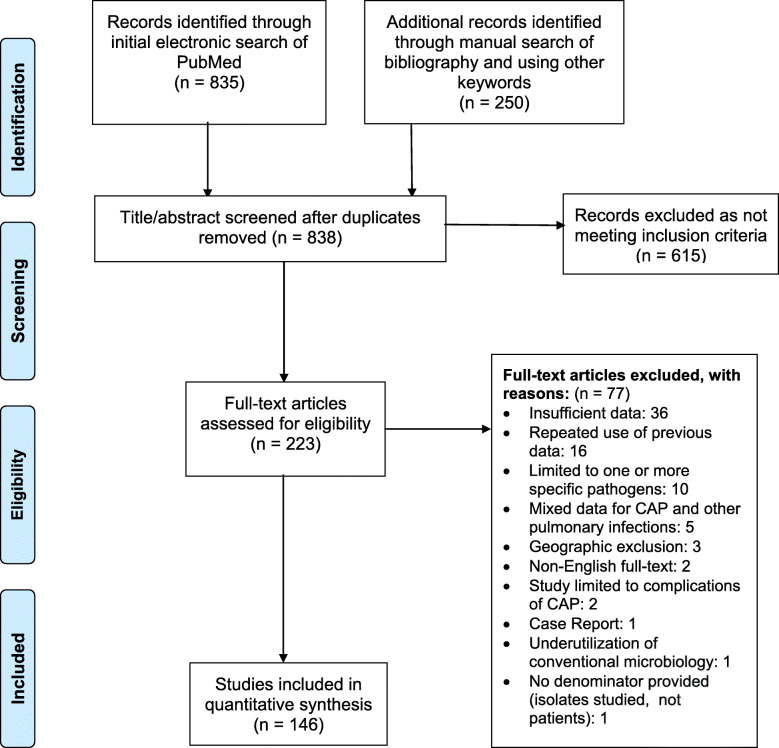
We conducted a systematic review of English-language literature on the etiology of CAP using methods defined by the Preferred Reporting Items for Systematic Reviews and Meta-Analyses (PRISMA) guidelines. We searched PubMed using a combination of the keywords 'pneumonia', 'CAP', 'etiology', 'microbiology', 'bacteriology', and 'pathogen'. We examined articles on antibiotics that were develop to treat pneumonia. We reviewed all 'related articles' as well as studies referenced by those that came up in the search. After we excluded articles that did not give sufficient microbiological data or failed to meet other predetermined criteria, 146 studies remained. Data were stratified into diagnostic categories according to the microbiologic studies that were done; results are presented as the percentage in each category of all cases in which an etiology was established.
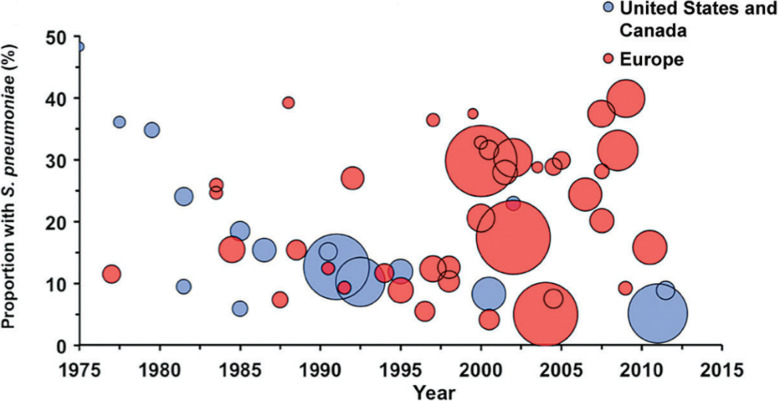
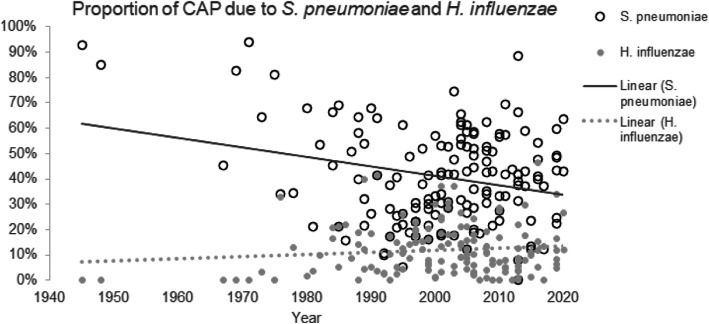
remains the most common cause of CAP although declining in incidence; this decline has been greater in the US than elsewhere. is the second most common cause of CAP, followed by and Gram negative bacilli. The incidence of all bacteria as causes of CAP has declined because, with routine use of PCR for viruses, the denominator, cases with an established etiology, has increased. Viruses were reported on average in about 10% of cases, but recent PCR-based studies identified a respiratory virus in about 30% of cases of CAP, with substantial rates of viral/bacterial coinfection.
The results of this study justify current guidelines for initial empiric treatment of CAP. With pneumococcus and continuing to predominate, efforts at antibiotic stewardship might be enhanced by greater attention to the routine use of sputum Gram stain and culture. Because viral/bacterial coinfection is relatively common, the identification of a virus by PCR does not, by itself, allow for discontinuation of the antibiotic therapy.
自抗生素时代开始以来,社区获得性肺炎(CAP)的病因已经发生了演变。最近的指南鼓励一旦确诊CAP,立即进行经验性抗生素治疗。一方面是对治疗建议的担忧,另一方面是对抗生素管理的关注,促使我们对关于CAP病因的医学文献进行了此次综述。
我们使用系统评价和Meta分析的首选报告项目(PRISMA)指南所定义的方法,对关于CAP病因的英文文献进行了系统评价。我们在PubMed上使用“肺炎”“CAP”“病因”“微生物学”“细菌学”和“病原体”等关键词组合进行搜索。我们研究了用于治疗肺炎的抗生素相关文章。我们审查了所有“相关文章”以及搜索中出现的文章所引用的研究。在排除那些没有提供足够微生物学数据或不符合其他预定标准的文章后,剩下146项研究。根据所进行的微生物学研究,将数据分层为诊断类别;结果以每种病因已明确的所有病例中各诊断类别的百分比表示。
仍是CAP最常见的病因,尽管发病率在下降;在美国,这种下降比其他地方更大。是CAP的第二大常见病因,其次是和革兰氏阴性杆菌。所有作为CAP病因的细菌的发病率都有所下降,因为随着病毒PCR的常规使用,分母(病因已明确的病例)增加了。病毒平均在约10%的病例中被报告,但最近基于PCR的研究在约30%的CAP病例中发现了呼吸道病毒,病毒/细菌混合感染率很高。
本研究结果证明了目前CAP初始经验性治疗指南的合理性。由于肺炎球菌和继续占主导地位,通过更加关注痰液革兰氏染色和培养的常规使用,可能会加强抗生素管理工作。因为病毒/细菌混合感染相对常见,通过PCR鉴定出病毒本身并不允许停止抗生素治疗。