Gusev Vitalyi E
Laboratoire d'Acoustique de l'Université du Mans, LAUM - UMR 6613 CNRS, Le Mans Université, Avenue Olivier Messiaen, 72085 Le Mans cedex 9, France.
Photoacoustics. 2020 Sep 4;20:100205. doi: 10.1016/j.pacs.2020.100205. eCollection 2020 Dec.
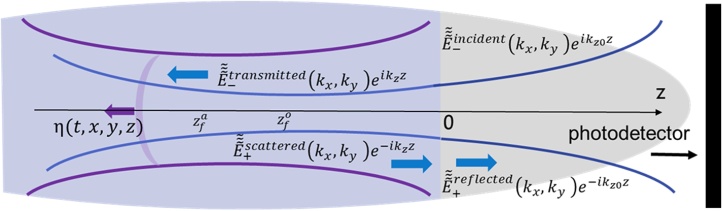
Time-domain Brillouin scattering is an opto-acousto-optical probe technique for the evaluation of transparent materials. Via optoacoustic conversion, ultrashort pump laser pulses launch coherent acoustic pulses in the sample. Time-delayed ultrashort probe laser pulses monitor the propagation of the coherent acoustic pulses via the photo-elastic effect, which induces light scattering. A photodetector collects both the acoustically scattered light and the probe light reflected by the sample structure for the heterodyning. The scattered probe light carries information on the acoustical, optical and acousto-optical parameters of the material for the current position of the coherent acoustic pulse. Thus, among other applications, time-domain Brillouin scattering is a technique for three-dimensional imaging. Sharp focusing of coherent acoustic pulses and probe laser pulses could increase lateral spatial resolution of imaging, but could potentially diminish the depth of imaging. However, the theoretical analysis presented in this manuscript contra-intuitively demonstrates that the depth and spectral resolution of the time-domain Brillouin scattering imaging, with collinearly propagating paraxial sound and light beams, do not depend on the focusing/diffraction of sound. The variations of the amplitude of the time-domain Brillouin scattering signal are only due to the variations of the probe light amplitude caused by light focusing/diffraction. Although the amplitude of the acoustically scattered light is proportional to the product of the local acoustical and probe light field amplitudes, the temporal dynamics of the time-domain Brillouin scattering signal amplitude is independent of the dynamics of the coherent acoustic pulse amplitude.
时域布里渊散射是一种用于评估透明材料的光声光学探测技术。通过光声转换,超短泵浦激光脉冲在样品中激发相干声脉冲。延时超短探测激光脉冲通过光弹效应监测相干声脉冲的传播,光弹效应会引起光散射。光电探测器收集经声散射的光以及由样品结构反射的探测光,用于外差检测。散射的探测光携带了关于材料的声学、光学和声光参数的信息,这些信息与相干声脉冲当前位置相关。因此,除了其他应用外,时域布里渊散射是一种用于三维成像的技术。相干声脉冲和探测激光脉冲的精确聚焦可以提高成像的横向空间分辨率,但可能会降低成像深度。然而,本手稿中给出的理论分析反直觉地表明,对于共线传播的傍轴声光光束,时域布里渊散射成像的深度和光谱分辨率并不取决于声音的聚焦/衍射。时域布里渊散射信号幅度的变化仅归因于由光聚焦/衍射引起的探测光幅度的变化。尽管经声散射的光的幅度与局部声学和探测光场幅度的乘积成正比,但时域布里渊散射信号幅度的时间动态与相干声脉冲幅度的动态无关。