Chen Xiaofeng, Hu Runmen, Hu Luoyu, Huang Yingcan, Shi Wenyang, Wei Qingshan, Li Zheng
Institute for Advanced Study, Shenzhen University, Shenzhen, China.
Department of Chemical and Biomolecular Engineering, North Carolina State University, Raleigh, NC, United States.
Front Chem. 2020 Sep 11;8:837. doi: 10.3389/fchem.2020.00837. eCollection 2020.
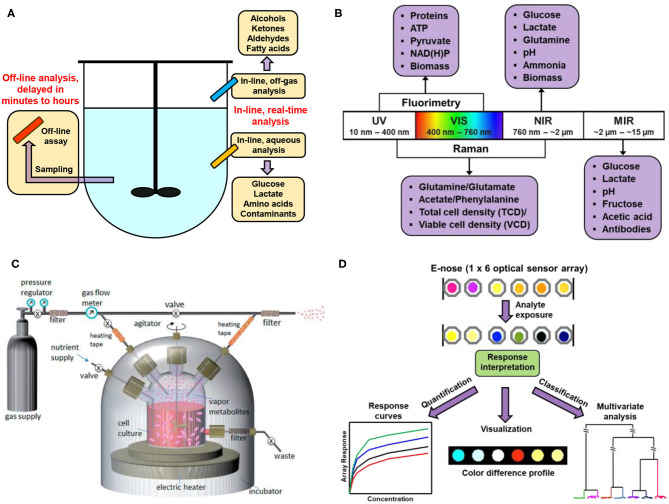
It is essential to develop effective analytical techniques for accurate and continuous monitoring of various biomanufacturing processes, such as the production of monoclonal antibodies and vaccines, through sensitive and quantitative detection of characteristic aqueous or gaseous metabolites and other analytes in the cell culture media. A comprehensive summary toward the use of mainstream techniques for bioprocess monitoring is critically reviewed here, which illustrates the instrumental and procedural advances and limitations of several major analytical tools in biomanufacturing applications. Despite those drawbacks present in modern detection systems such as mass spectrometry, gas chromatography or chemical/biological sensors, a considerable number of useful solutions and inspirations such as electronic or optoelectronic noses can be offered to greatly overcome the restrictions and facilitate the development of advanced analytical techniques that can target a more diverse range of key nutritious components, products or potential contaminants in different biomanufacturing processes.
通过灵敏且定量地检测细胞培养基中的特征性水性或气态代谢物及其他分析物,开发有效的分析技术以准确且持续地监测各种生物制造过程(如单克隆抗体和疫苗的生产)至关重要。本文对生物过程监测主流技术的应用进行了全面综述,阐述了几种主要分析工具在生物制造应用中的仪器和程序进展及局限性。尽管现代检测系统(如质谱、气相色谱或化学/生物传感器)存在这些缺点,但仍可提供大量有用的解决方案和启发(如电子或光电鼻),以极大地克服这些限制,并促进先进分析技术的发展,这些技术能够针对不同生物制造过程中更多样化的关键营养成分、产品或潜在污染物。