Faculty of Psychology, Speech Therapy and Educational Sciences, and Sensation and Perception Research Group, GIGA Consciousness, University of Liège, Liège, Belgium.
Interdisciplinary Algology Centre, CHU Liège, and Sensation and Perception Research Group, GIGA Consciousness, University of Liège, Liège, Belgium.
Qual Life Res. 2021 Feb;30(2):425-436. doi: 10.1007/s11136-020-02655-7. Epub 2020 Oct 6.
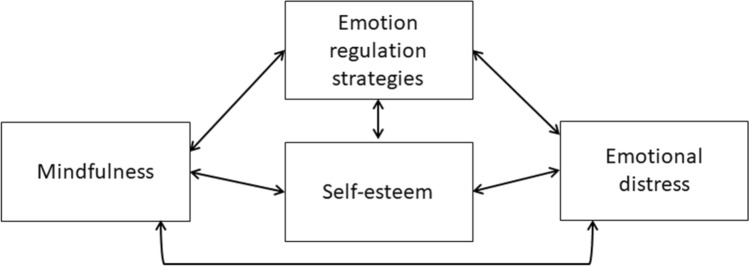
Cancer patients often report low self-esteem and high emotional distress. Two factors seem particularly linked to these symptoms: emotion regulation strategies and mindfulness. The interest of hypnosis and self-care to relieve these symptoms is not well documented. Our randomized controlled trial aimed at assessing the effect of a group intervention combining self-hypnosis and self-care on self-esteem, emotional distress, emotion regulation, and mindfulness abilities of post-treatment cancer patients, as well as investigating the links between these variables.
One hundred and four patients who had suffered from cancer were randomized into the intervention group (N = 52) and the wait-list control group (N = 52). They had to answer questionnaires before (T1) and after the intervention (T2). Nine men were excluded from the analyses, leading to a final sample of 95 women with cancer. Group-by-time changes were assessed with MANOVA, and associations with self-esteem and emotional distress were investigated with hierarchical linear regression models.
Participants in the intervention group (mean age = 51.65; SD = 12.54) reported better self-esteem, lower emotional distress, a decreased use of maladaptive emotion regulation strategies, and more mindfulness abilities after the intervention, compared to the WLCG. This increase in mindfulness explained 33% of the improvement of self-esteem and 41.6% of the decrease of emotional distress in the intervention group. Self-esteem and emotional distress also predicted each other.
Our study showed the efficacy of our hypnosis-based intervention to improve all the investigated variables. Mindfulness predicted the improvement of self-esteem and emotional distress. The primary impact of our intervention on mindfulness abilities seems to explain, at least in part, its efficacy. Registration: ClinicalTrials.gov (NCT03144154). Retrospectively registered on the 1st of May, 2017.
癌症患者常报告自尊心低和情绪困扰高。有两个因素似乎与这些症状特别相关:情绪调节策略和正念。催眠和自我保健缓解这些症状的效果尚未得到充分记录。我们的随机对照试验旨在评估结合自我催眠和自我保健的小组干预对治疗后癌症患者自尊心、情绪困扰、情绪调节和正念能力的影响,并调查这些变量之间的联系。
104 名患有癌症的患者被随机分为干预组(N=52)和等待名单对照组(N=52)。他们必须在干预前(T1)和干预后(T2)回答问卷。9 名男性被排除在分析之外,最终有 95 名患有癌症的女性纳入研究。采用 MANOVA 评估组间时间变化,采用分层线性回归模型调查与自尊心和情绪困扰的关联。
与 WLCG 相比,干预组(平均年龄 51.65;SD=12.54)的参与者在干预后自尊心更高,情绪困扰更低,使用适应性较差的情绪调节策略减少,正念能力增强。这种正念的增加解释了干预组自尊心提高的 33%和情绪困扰降低的 41.6%。自尊心和情绪困扰也相互预测。
我们的研究表明,我们基于催眠的干预措施可以有效改善所有研究变量。正念预测了自尊心和情绪困扰的改善。我们的干预对正念能力的主要影响似乎至少部分解释了其疗效。注册:ClinicalTrials.gov(NCT03144154)。于 2017 年 5 月 1 日进行了回顾性注册。