Department of Obstetrics and Gynaecology, Faculty of Medicine, University of Maribor, Taborska ulica 8, 2000 Maribor, Slovenia.
Division of Gynaecology and Perinatology, University Medical Centre Maribor, Ljubljanska ulica 5, 2000 Maribor, Slovenia.
Nutrients. 2020 Oct 5;12(10):3046. doi: 10.3390/nu12103046.
Identifying women at risk for small-for-gestational-age newborns (SGA) is an important challenge in obstetrics. Several different risk factors have been suggested to contribute to the development of SGA. Previous research is inconclusive on the role selenium (Se) plays in the development of SGA. The aim of the study was therefore to explore the role of Se concentrations in amniotic fluid in order to understand its possible role in the development of SGA.
This prospective, single center study investigated the relationships between Se concentrations in amniotic fluid and pregnancy outcomes. Amniotic fluid was collected from pregnant women during amniocentesis at 16/17 weeks of pregnancy. Se values were determined using the electrothermal atomic absorption spectrometry and expressed in µg/L. Characteristics of mothers and newborns were obtained from women and delivery records.
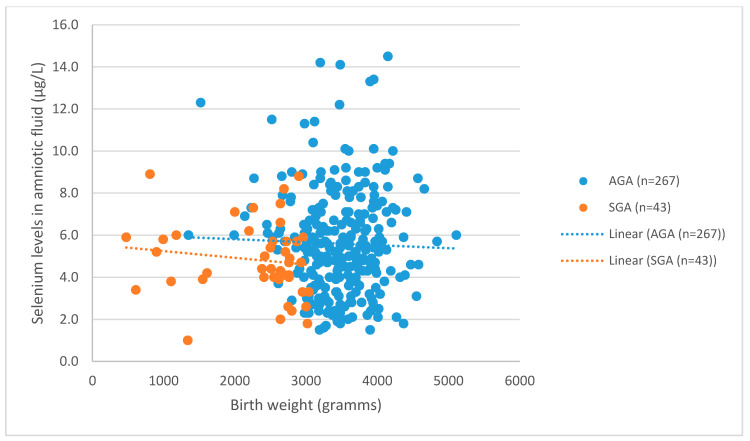
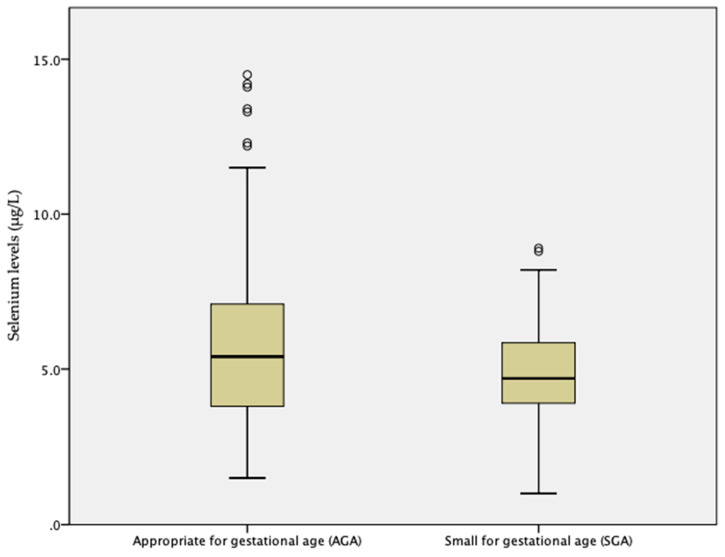
327 samples of amniotic fluid were evaluated. Patients with SGA newborns had significantly lower mean values of amniotic fluid concentrations of Se compared to appropriate-for-gestational-age (AGA) newborns (4.8 ± 1.9 µg/L versus 5.6 ± 2.5 µg/L ( = 0.017)). Adjusting for different risk factors, Se remained the only significant factor impacting the outcome of a newborn (b = -0.152, s.e. = 0.077; < 0.048). Se levels in amniotic fluid did not correlate with pre-eclampsia or preterm delivery.
Amniotic fluid Se levels represent a viable root of further investigation and assessment in order to identify women with low birth weight newborns early. Women with decreased Se levels had a statistically significant chance of developing SGA. Further research is needed to elucidate the link between Se, other trace elements, and other risk factors and their impact on the development of SGA newborns.
识别出患有小于胎龄儿(SGA)的孕妇是产科的重要挑战。已有多种不同的风险因素被认为与 SGA 的发生有关。之前的研究对于硒(Se)在 SGA 发展中的作用尚无定论。因此,本研究旨在探索羊水中 Se 浓度的作用,以了解其在 SGA 发生中的可能作用。
本前瞻性单中心研究调查了羊水 Se 浓度与妊娠结局之间的关系。在妊娠 16/17 周时通过羊膜穿刺术采集孕妇的羊水。使用电热原子吸收光谱法测定 Se 值,并以 µg/L 表示。母亲和新生儿的特征从女性和分娩记录中获得。
评估了 327 份羊水样本。与适于胎龄儿(AGA)新生儿相比,SGA 新生儿的羊水 Se 浓度均值明显较低(4.8 ± 1.9 µg/L 与 5.6 ± 2.5 µg/L, = 0.017)。调整了不同的风险因素后,Se 仍然是唯一对新生儿结局有显著影响的因素(b = -0.152,s.e. = 0.077; < 0.048)。羊水中的 Se 水平与子痫前期或早产无相关性。
羊水 Se 水平是进一步研究和评估的可行基础,以便早期识别出生体重低的孕妇。Se 水平降低的女性发生 SGA 的几率具有统计学意义。需要进一步研究阐明 Se、其他微量元素和其他风险因素之间的联系及其对 SGA 新生儿发生的影响。