School of Biological Sciences, Monash University, Clayton, Victoria, 3800, Australia.
BMC Biol. 2020 Oct 7;18(1):135. doi: 10.1186/s12915-020-00856-7.
Life-history theory predicts a trade-off between investment into immune defence and other fitness-related traits. Accordingly, individuals are expected to upregulate their immune response when subjected to immune challenge. However, this is predicted to come at the expense of investment into a range of other traits that are costly to maintain, such as growth, reproduction and survival. Currently, it remains unclear whether the magnitude of such costs, and trade-offs involving immune investment and other traits, manifests consistently across species and sexes. To address this, we conducted a meta-analysis to investigate how changes in sex, ontogenetic stage and environmental factors shape phenotypic trait expression following an immune challenge.
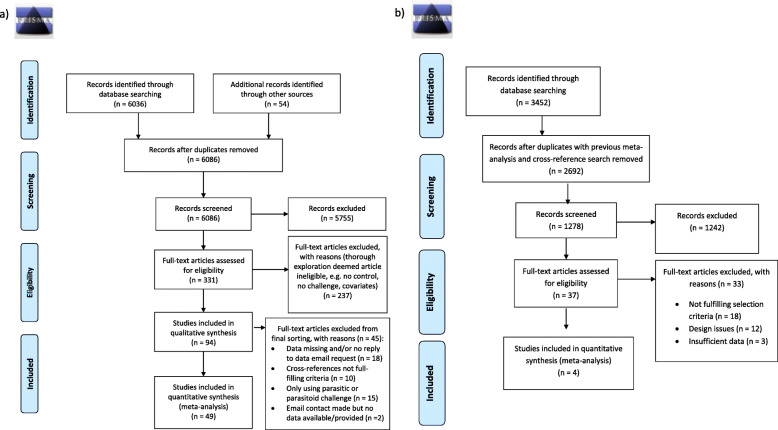
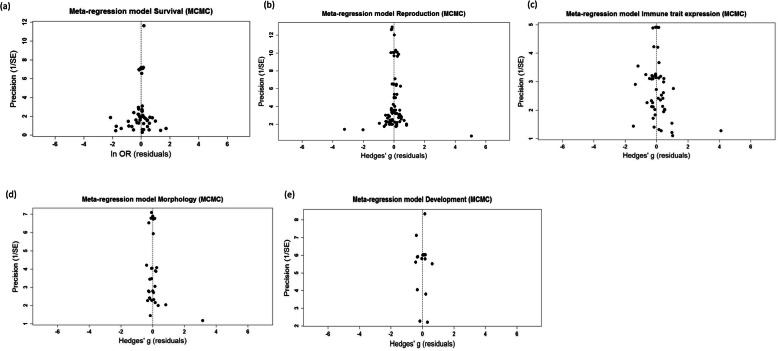
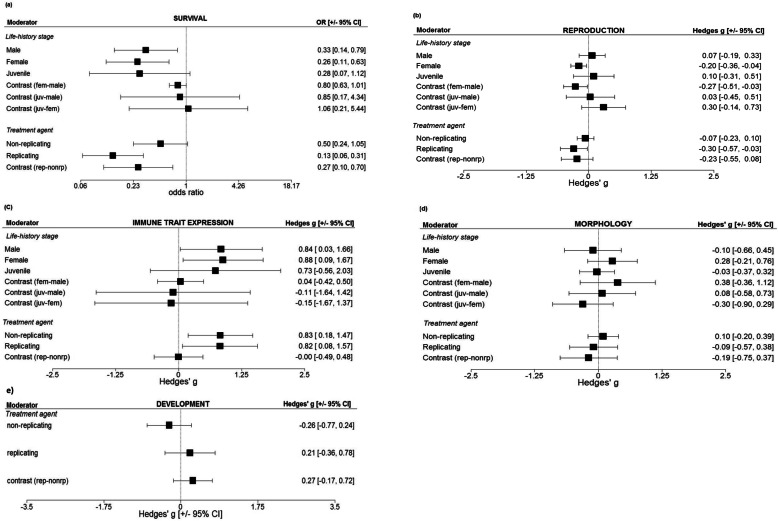
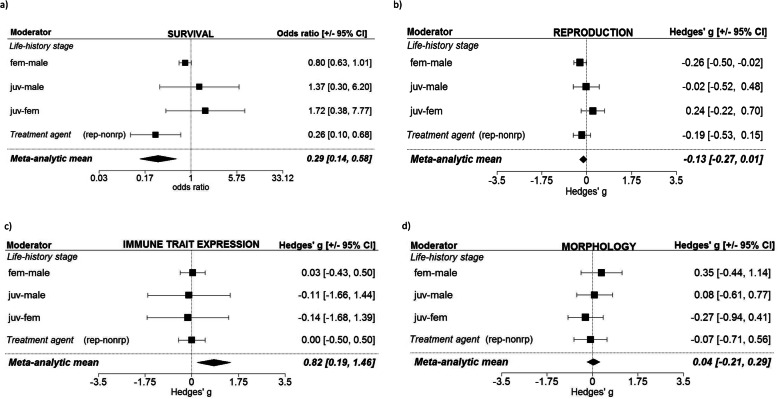
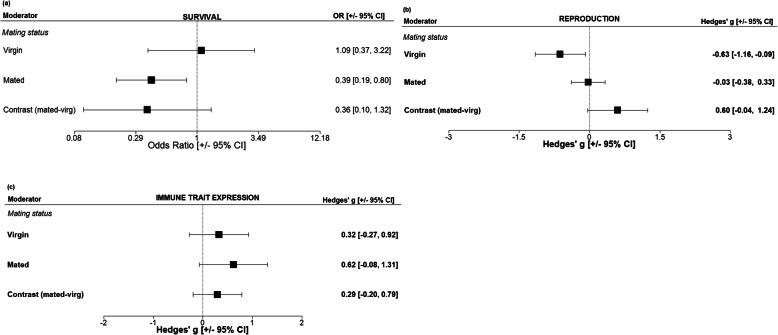
We explored the effects of immune challenge on three types of traits across sexually reproducing metazoans: life-history, morphological and proximate immune traits (235 effect sizes, 53 studies, 37 species [21 invertebrates vs. 16 vertebrates]). We report a general negative effect of immune challenge on survival and reproduction, a positive effect on immune trait expression, but no effect on morphology or development time. The negative effects of immune challenge on reproductive traits and survival were larger in females than males. We also report a pronounced effect of the immune treatment agent used (e.g. whether the treatment involved a live pathogen or not) on the host response to immune challenge, and find an effect of mating status on the host response in invertebrates.
These results suggest that costs associated with immune deployment following an immune challenge are context-dependent and differ consistently in their magnitude across the sexes of diverse taxonomic lineages. We synthesise and discuss the outcomes in the context of evolutionary theory on sex differences in life-history and highlight the need for future studies to carefully consider the design of experiments aimed at disentangling the costs of immune deployment.
生活史理论预测,免疫防御与其他与健康相关的特征之间存在权衡。因此,当个体受到免疫挑战时,预计会增强其免疫反应。然而,这预计会以牺牲对一系列其他特征的投资为代价,这些特征的维持成本很高,例如生长、繁殖和生存。目前,尚不清楚这种成本的大小,以及涉及免疫投资和其他特征的权衡,是否在不同物种和性别中一致表现出来。为了解决这个问题,我们进行了荟萃分析,以调查性别、个体发育阶段和环境因素如何在免疫挑战后塑造表型特征表达。
我们探讨了免疫挑战对有性繁殖后生动物的三种类型特征的影响:生活史、形态和近似免疫特征(235 个效应大小,53 项研究,37 个物种[21 种无脊椎动物与 16 种脊椎动物])。我们报告说,免疫挑战对生存和繁殖有普遍的负面影响,对免疫特征表达有积极影响,但对形态或发育时间没有影响。免疫挑战对雌性生殖特征和生存的负面影响大于雄性。我们还报告说,使用的免疫处理剂(例如,处理是否涉及活病原体)对宿主对免疫挑战的反应有明显影响,并发现交配状态对无脊椎动物宿主反应有影响。
这些结果表明,免疫挑战后与免疫部署相关的成本是上下文相关的,并且在不同分类群的性别之间其大小不一致。我们综合讨论了这些结果在关于生活史中性别差异的进化理论背景下,并强调未来研究需要仔细考虑旨在厘清免疫部署成本的实验设计。