Cancer Research Division, Cancer Council New South Wales, Sydney, NSW, Australia
University of Sydney, School of Public Health, Faculty of Medicine and Health, Sydney, NSW, Australia.
BMJ. 2020 Oct 7;371:m3503. doi: 10.1136/bmj.m3503.
To assess treatment related changes in quality of life up to 15 years after diagnosis of localised prostate cancer.
Population based, prospective cohort study with follow-up over 15 years.
New South Wales, Australia.
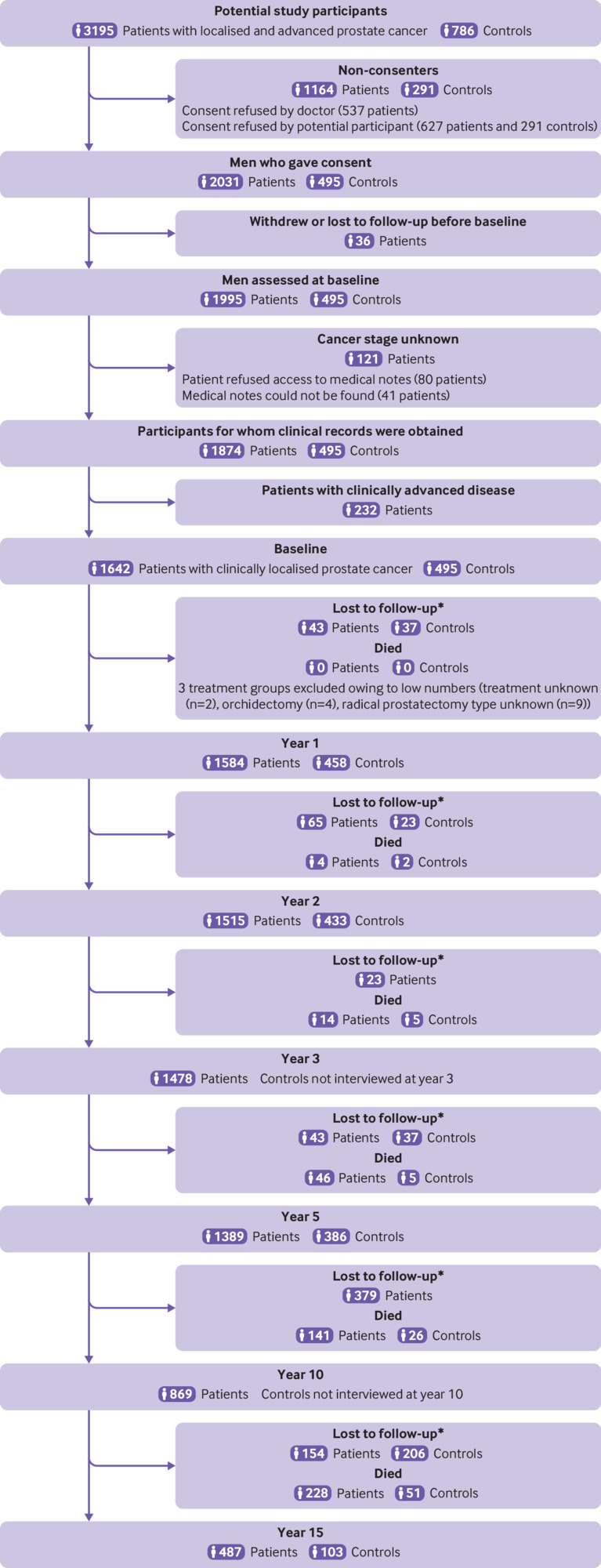
1642 men with localised prostate cancer, aged less than 70, and 786 controls randomly recruited from the New South Wales electoral roll into the New South Wales Prostate Cancer Care and Outcomes Study (PCOS).
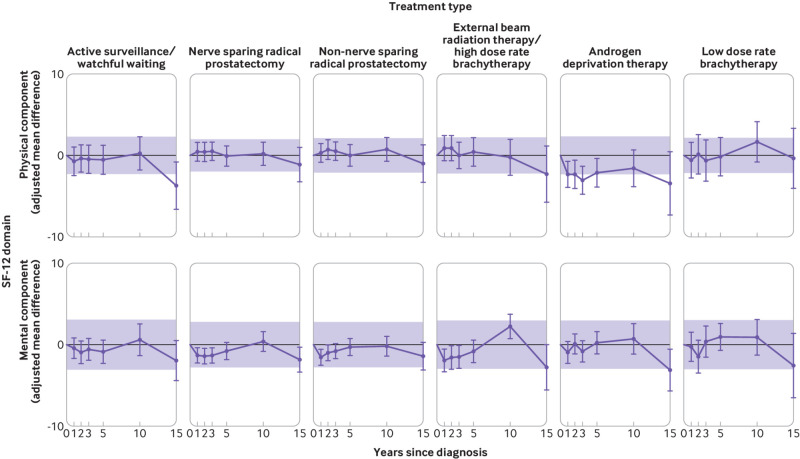
General health and disease specific quality of life were self-reported at seven time points over a 15 year period, using the 12-item Short Form Health Survey scale, University of California, Los Angeles prostate cancer index, and expanded prostate cancer index composite short form (EPIC-26). Adjusted mean differences were calculated with controls as the comparison group. Clinical significance of adjusted mean differences was assessed by the minimally important difference, defined as one third of the standard deviation (SD) from the baseline score.
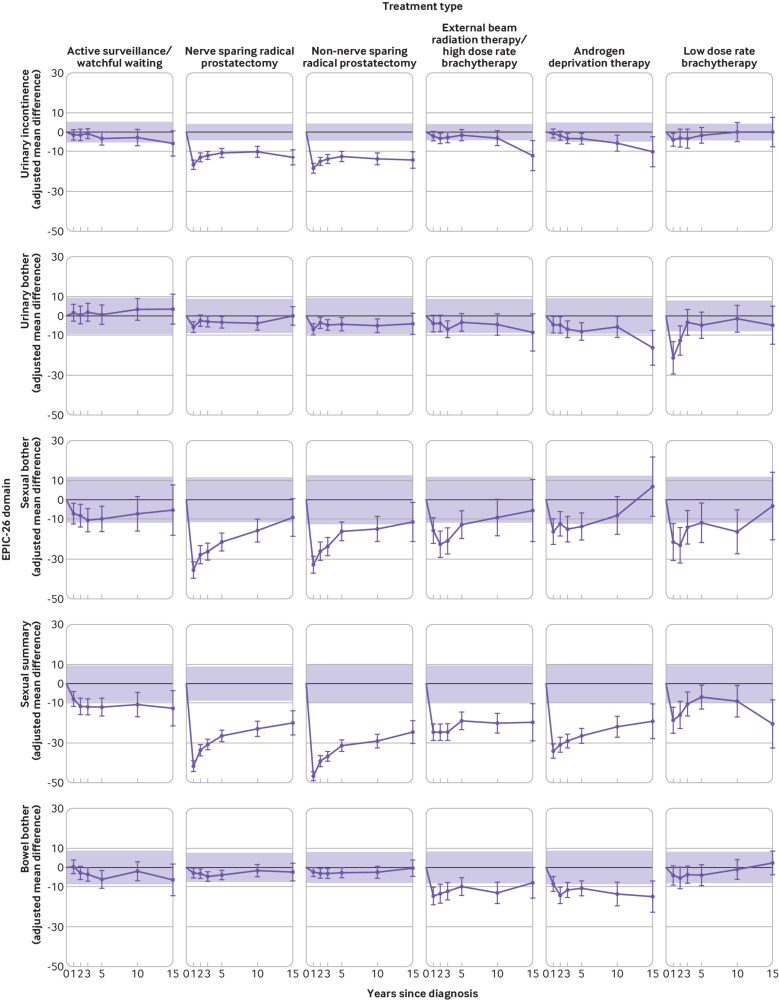
At 15 years, all treatment groups reported high levels of erectile dysfunction, depending on treatment (62.3% (active surveillance/watchful waiting, n=33/53) to 83.0% (non-nerve sparing radical prostatectomy, n=117/141)) compared with controls (42.7% (n=44/103)). Men who had external beam radiation therapy or high dose rate brachytherapy or androgen deprivation therapy as primary treatment reported more bowel problems. Self-reported urinary incontinence was particularly prevalent and persistent for men who underwent surgery, and an increase in urinary bother was reported in the group receiving androgen deprivation therapy from 10 to 15 years (year 10: adjusted mean difference -5.3, 95% confidence interval -10.8 to 0.2; year 15: -15.9; -25.1 to -6.7).
Patients receiving initial active treatment for localised prostate cancer had generally worse long term self-reported quality of life than men without a diagnosis of prostate cancer. Men treated with radical prostatectomy faired especially badly, particularly in relation to long term sexual outcomes. Clinicians and patients should consider these long term quality of life outcomes when making treatment decisions.
评估局部前列腺癌诊断后长达 15 年的治疗相关生活质量变化。
基于人群的前瞻性队列研究,随访时间超过 15 年。
澳大利亚新南威尔士州。
1642 名年龄小于 70 岁的局限性前列腺癌男性患者和 786 名从新南威尔士州选民名单中随机招募的对照组患者,参加了新南威尔士州前列腺癌护理和结局研究(PCOS)。
在 15 年的时间内,通过使用 12 项简短健康调查量表、加利福尼亚大学洛杉矶前列腺癌指数和扩展前列腺癌指数综合简短量表(EPIC-26),在 7 个时间点上自我报告一般健康状况和疾病特异性生活质量。与对照组相比,计算调整后的平均差异。通过最小重要差异(定义为基线评分标准差的三分之一)评估调整后的平均差异的临床意义。
15 年后,所有治疗组的勃起功能障碍发生率均较高,具体取决于治疗方式(主动监测/观察等待组为 62.3%(33/53),非神经保留根治性前列腺切除术组为 83.0%(117/141)),而对照组为 42.7%(44/103)。接受外照射放疗、高剂量率近距离放疗或雄激素剥夺治疗作为主要治疗方法的男性报告肠道问题较多。男性接受手术治疗后会出现更严重和持续的尿失禁问题,接受雄激素剥夺治疗的男性从 10 年到 15 年报告尿困扰增加(第 10 年:调整后平均差异-5.3,95%置信区间-10.8 至 0.2;第 15 年:-15.9;-25.1 至-6.7)。
接受局部前列腺癌初始积极治疗的患者的长期自我报告生活质量总体上比没有前列腺癌诊断的男性差。接受根治性前列腺切除术治疗的男性情况尤其糟糕,特别是在长期性功能方面。临床医生和患者在做出治疗决策时应考虑这些长期生活质量结果。