Morgan Hannah Louise, Eid Nader, Khoshkerdar Afsaneh, Watkins Adam John
Division of Child Health, Obstetrics and Gynaecology, Queen's Medical Centre, School of Medicine, University of Nottingham, Nottingham, United Kingdom.
Anim Reprod. 2020 Aug 5;17(3):e20200018. doi: 10.1590/1984-3143-AR2020-0018.
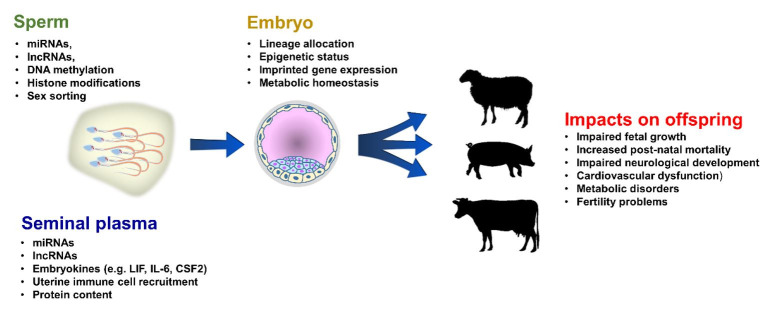
Assisted reproductive technologies such as artificial insemination have delivered significant benefits for farm animal reproduction. However, as with humans, assisted reproduction in livestock requires the manipulation of the gametes and preimplantation embryo. The significance of this 'periconception' period is that it represents the transition from parental genome regulation to that of the newly formed embryo. Environmental perturbations during these early developmental stages can result in persistent changes in embryonic gene expression, fetal organ development and ultimately the long-term health of the offspring. While associations between maternal health and offspring wellbeing are well-defined, the significance of paternal health for the quality of his semen and the post-conception development of his offspring have largely been overlooked. Human and animal model studies have identified sperm epigenetic status (DNA methylation levels, histone modifications and RNA profiles) and seminal plasma-mediated maternal uterine immunological, inflammatory and vascular responses as the two central mechanisms capable of linking paternal health and post-fertilisation development. However, there is a significant knowledge gap about the father's contribution to the long-term health of his offspring, especially with regard to farm animals. Such insights are essential to ensure the safety of widely used assisted reproductive practices and to gain better understanding of the role of paternal health for the well-being of his offspring. In this article, we will outline the impact of male health on semen quality (both sperm and seminal plasma), reproductive fitness and post-fertilisation offspring development and explore the mechanisms underlying the paternal programming of offspring health in farm animals.
人工授精等辅助生殖技术已为家畜繁殖带来了显著益处。然而,与人类一样,家畜的辅助生殖需要对配子和植入前胚胎进行操作。这个“围受孕”时期的重要性在于,它代表了从亲代基因组调控向新形成胚胎的基因组调控的转变。这些早期发育阶段的环境干扰可能导致胚胎基因表达、胎儿器官发育的持续变化,并最终影响后代的长期健康。虽然母体健康与后代健康之间的关联已得到明确界定,但父体健康对其精液质量和后代受孕后发育的重要性在很大程度上被忽视了。人类和动物模型研究已确定精子表观遗传状态(DNA甲基化水平、组蛋白修饰和RNA谱)以及精浆介导的母体子宫免疫、炎症和血管反应是能够将父体健康与受精后发育联系起来的两个核心机制。然而,关于父亲对其后代长期健康的贡献,尤其是在家畜方面,仍存在重大知识空白。这些见解对于确保广泛使用的辅助生殖实践的安全性以及更好地理解父体健康对其后代福祉的作用至关重要。在本文中,我们将概述雄性健康对精液质量(包括精子和精浆)、生殖适应性以及受精后后代发育的影响,并探讨家畜中父体对后代健康编程的潜在机制。