Department of Epidemiology and Biostatistics, School of Health Sciences, Wuhan University, Wuhan, Hubei, 430071, P. R. China.
Department of Information Management, School of Public Health and Management, Hubei University of Medicine, Shiyan, Hubei, 442000, P. R. China.
Cancer Commun (Lond). 2020 Nov;40(11):611-619. doi: 10.1002/cac2.12099. Epub 2020 Oct 8.
Statistical data on the burden and relevant risk factors of lung cancer are valuable for policy-making. This study aimed to compare the mortality of lung cancer attributable to smoking stratified by sex and age among adults in China and the United States (US).
We extracted age-standardized mortality rates of lung cancer during 1990-2017 using the comparative risk assessment framework of the 2017 Global Burden of Disease study. We performed an age-period-cohort analysis to estimate time trend of lung cancer mortality attributable to smoking.
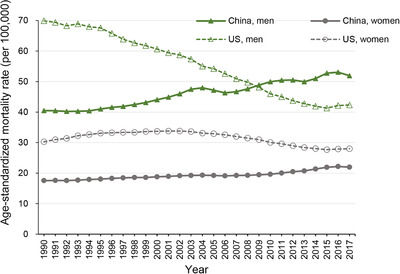
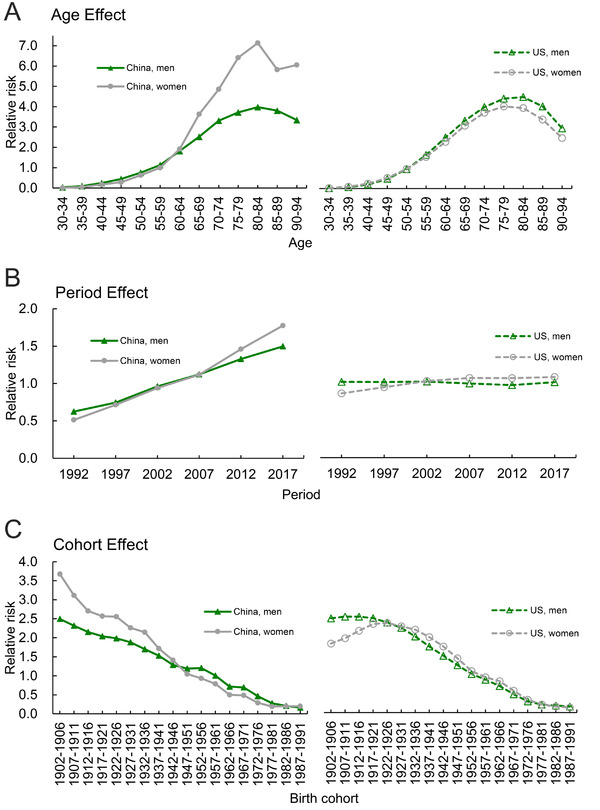
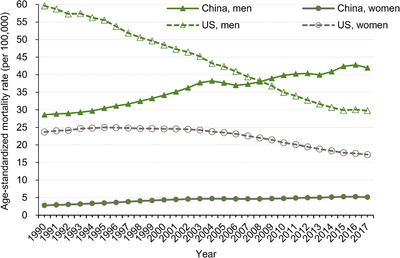
During 1990-2017, the age-standardized mortality rate of lung cancer was increasing in China but decreasing in the US for both sexes. The mortality attributable to smoking in China showed a generally increasing trend, while a continuous decrease was observed in the US. The age-period-cohort analysis showed a similar trend of age effect among adults between China and the US: the mortality substantially increased from the 30-34 to 80-84 age group and subsequently decreased in the 90-94 age group. However, the period effect rapidly increased in Chinese adults during 1990-2017, while it tended to be stable in the US although it was still slightly increasing in women. The cohort effect generally peaked in the earlier cohort born in 1902-1906 in the two countries.
During 1990-2017, the lung cancer mortality attributable to smoking and the period effect are generally increasing in Chinese adults; the mortality attributable to smoking is decreasing in the US adults, but the period effect tends to be stable. The rapid aging and prevalence of smoking may intensify the increasing mortality of lung cancer in China.
有关肺癌负担和相关风险因素的统计数据对政策制定具有重要意义。本研究旨在比较中国和美国成年人中由吸烟导致的肺癌死亡率,按性别和年龄分层。
我们使用 2017 年全球疾病负担研究的比较风险评估框架,提取了 1990-2017 年期间的肺癌年龄标准化死亡率。我们进行了年龄-时期-队列分析,以估计吸烟导致的肺癌死亡率的时间趋势。
1990-2017 年期间,中国男女肺癌年龄标准化死亡率均呈上升趋势,而美国则呈下降趋势。中国归因于吸烟的肺癌死亡率呈总体上升趋势,而美国则呈持续下降趋势。年龄-时期-队列分析显示,中国和美国成年人之间的年龄效应趋势相似:死亡率从 30-34 岁年龄组到 80-84 岁年龄组显著增加,随后在 90-94 岁年龄组下降。然而,中国成年人的时期效应在 1990-2017 年期间迅速增加,而美国则趋于稳定,尽管女性的时期效应仍在略有增加。队列效应总体上在中国和美国两个国家中,在 1902-1906 年出生的较早队列中达到峰值。
1990-2017 年期间,中国成年人归因于吸烟的肺癌死亡率和时期效应普遍增加;美国成年人归因于吸烟的死亡率下降,但时期效应趋于稳定。人口老龄化和吸烟的流行可能会加剧中国肺癌死亡率的上升。