Neves Beatriz, Kessous Igor M, Moura Ricardo L, Couto Dayvid R, Zanella Camila M, Antonelli Alexandre, Bacon Christine D, Salgueiro Fabiano, Costa Andrea F
Universidade Federal do Rio de Janeiro, Museu Nacional, Programa de Pós Graduação em Ciências Biológicas (Botânica), São Cristóvão, Rio de Janeiro, RJ, Brazil.
Gothenburg Global Biodiversity Centre, SE Gothenburg, Sweden.
AoB Plants. 2020 Aug 22;12(5):plaa046. doi: 10.1093/aobpla/plaa046. eCollection 2020 Oct.
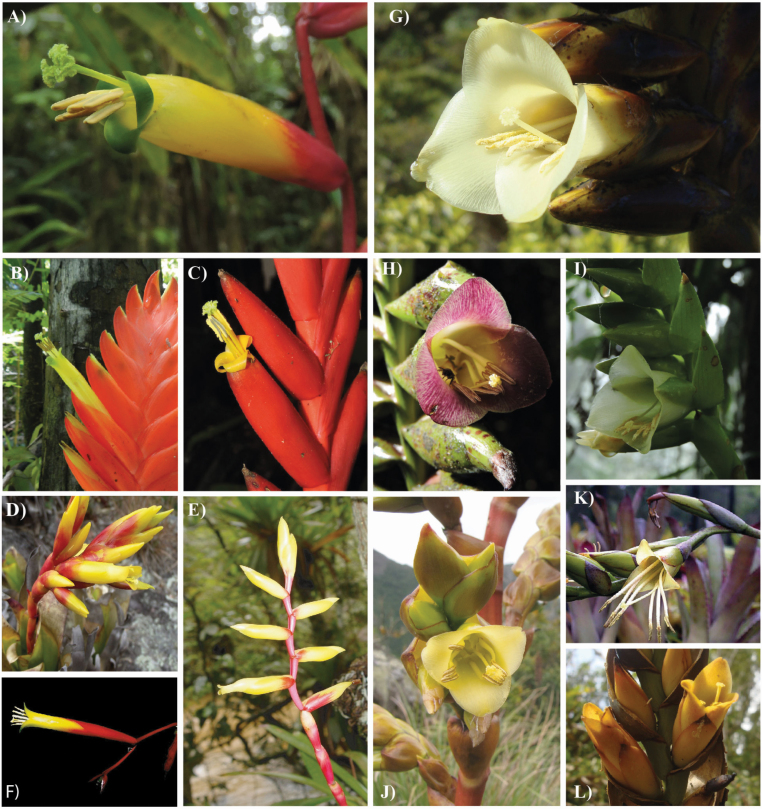
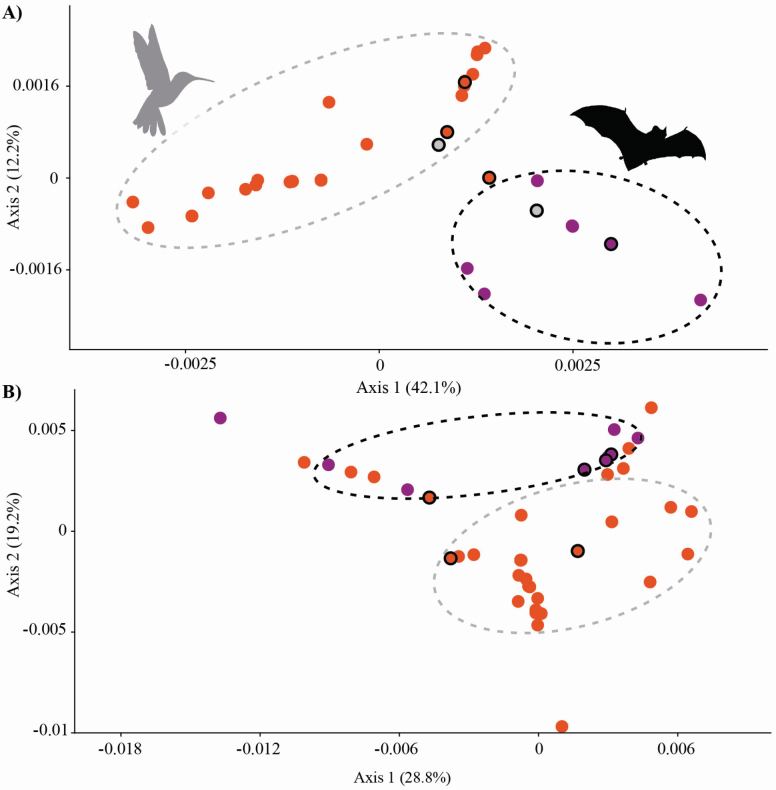
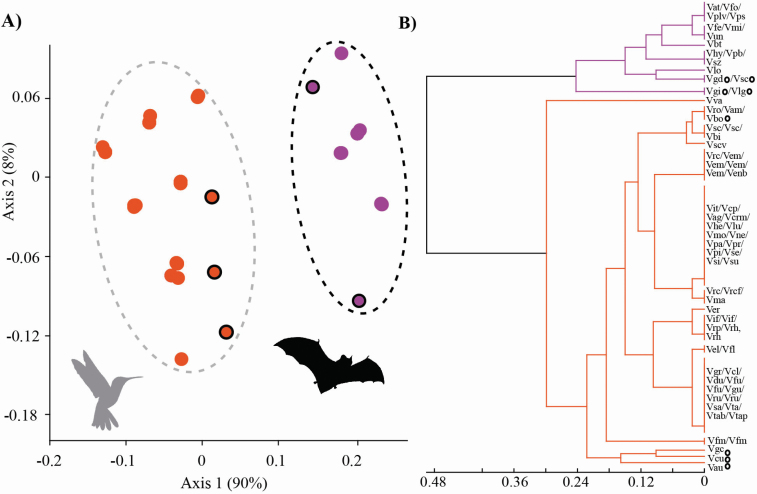
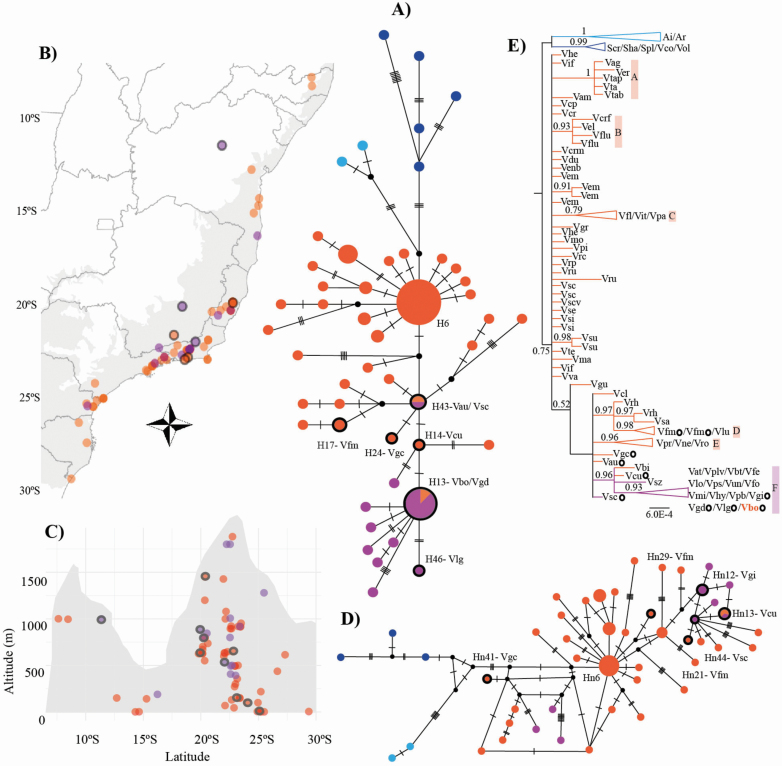
Pollinators are important drivers of angiosperm diversification at both micro- and macroevolutionary scales. Both hummingbirds and bats pollinate the species-rich and morphologically diverse genus across its distribution in the Brazilian Atlantic Forest. Here, we (i) determine if floral traits predict functional groups of pollinators as documented, confirming the pollination syndromes in and (ii) test if genetic structure in is driven by geography (latitudinal and altitudinal heterogeneity) or ecology (pollination syndromes). We analysed 11 floral traits of 58 species and performed a literature survey of pollination biology. The genealogy of haplotypes was inferred and phylogenetic analyses were performed using chloroplast ( and ) and nuclear () molecular markers. Floral traits accurately predict functional groups of pollinators in . Genetic groupings match the different pollination syndromes. Species with intermediate position were found between the groups, which share haplotypes and differ morphologically from the typical hummingbird- and bat-pollinated flowers of . The phylogeny revealed moderately to well-supported clades which may be interpreted as species complexes. Our results suggest a role of pollinators driving ecological isolation in clades. Incipient speciation and incomplete lineage sorting may explain the overall low genetic divergence within and among morphologically defined species, precluding the identification of clear species boundaries. The intermediate species with mixed floral types likely represent a window into shifts between pollinator syndromes. This study reports the morphological-genetic continuum that may be typical of ongoing pollinator-driven speciation in biodiversity hotspots.
传粉者在微观和宏观进化尺度上都是被子植物多样化的重要驱动因素。蜂鸟和蝙蝠都为分布于巴西大西洋森林的物种丰富且形态多样的该属植物传粉。在此,我们(i)确定花部性状是否如文献记载的那样能够预测传粉者的功能类群,从而证实该属植物的传粉综合征;(ii)检验该属植物的遗传结构是由地理因素(纬度和海拔异质性)还是生态因素(传粉综合征)驱动的。我们分析了58个该属物种的11种花部性状,并对该属植物的传粉生物学进行了文献调查。推断了单倍型谱系,并使用叶绿体(和)及核()分子标记进行了系统发育分析。花部性状能够准确预测该属植物传粉者的功能类群。遗传分组与不同的传粉综合征相匹配。在这些组之间发现了处于中间位置的物种,它们共享单倍型,且在形态上与该属典型的蜂鸟传粉花和蝙蝠传粉花不同。系统发育显示出得到适度至有力支持的分支,这些分支可被解释为物种复合体。我们的结果表明传粉者在该属植物分支中推动生态隔离方面发挥了作用。初始物种形成和不完全谱系分选可能解释了形态学定义的物种内部和之间总体较低的遗传分化,从而妨碍了明确物种界限的识别。具有混合花型的中间物种可能代表了传粉者综合征之间转变的一个窗口。本研究报告了形态 - 遗传连续体,这可能是生物多样性热点地区正在进行的传粉者驱动物种形成的典型特征。