Khalil Merette, Alameddine Mohamad
Department of Universal Health Coverage and Health Systems Development Eastern Mediterranean Regional Office, World Health Organization Cairo Egypt.
College of Medicine Mohammed Bin Rashid University of Medicine and Health Sciences Dubai United Arab Emirates.
Health Sci Rep. 2020 Oct 5;3(4):e192. doi: 10.1002/hsr2.192. eCollection 2020 Dec.
Understanding factors affecting recruitment and retention of health workers in rural and remote communities is necessary for proper policy development and the equitable achievement of Universal Health Coverage.
Review and synthesize the literature on interventions used to retain health workforce in rural and remote areas by low- and middle-income countries (LMICs) in the Eastern Mediterranean Region (EMR).
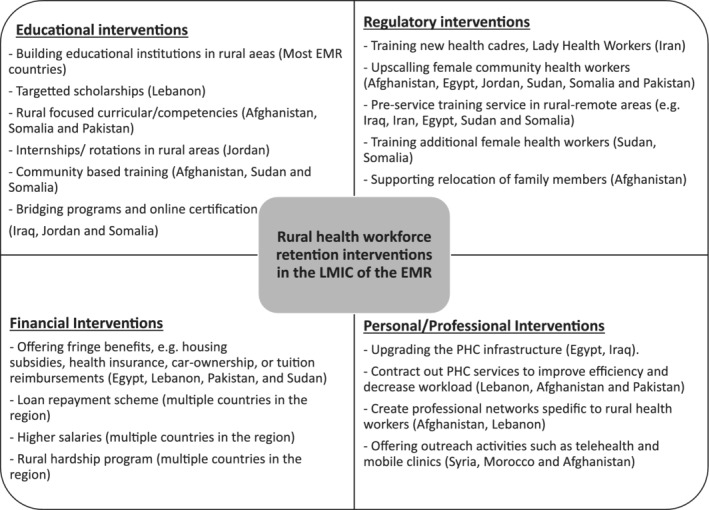
We carried out a narrative review of literature (peer-reviewed and gray) on the distribution and retention of health workers in rural and remote areas in the LMICs of the EMR. Out of the 130 retrieved articles, 21 met the inclusion criteria and were studied using WHO's Global Recommendations For Increasing Access To Health Workers In Remote And Rural Areas Through Improved Retention (education, regulation, financial, and personal/professional) as the analytical framework for extractions.
There is a dearth of literature on retention in rural areas in the EMR and a complete absence of evaluation studies for implemented intervention. Various LMICs in the EMR have implemented interventions across one or more of the WHO four categories, especially educational and regulatory interventions. Limitations in the number and quality of published studies, fragmented data, over-representation of certain cadres in research and policies, and poor governance were chief barriers to the design, implementation, and evaluation of health workforce retention policies in rural and remote areas. The main challenges for EMR countries are in policy implementation and evaluation. Strengthening data governance and health information systems would improve evidence-based policies and enhance retention in rural and remote areas.
There is a need for a focused research agenda supported by regional collaboration to guide policymakers on factors, challenges, and best practices that need to be considered for improving the distribution and retention of the health workforce by cadre, gender, and region.
了解影响农村和偏远社区卫生工作者招聘和留用的因素,对于制定恰当的政策以及公平实现全民健康覆盖至关重要。
回顾并综合东地中海区域低收入和中等收入国家(LMICs)用于留住农村和偏远地区卫生人力的干预措施相关文献。
我们对东地中海区域低收入和中等收入国家农村和偏远地区卫生工作者分布与留用情况的文献(同行评审文献和灰色文献)进行了叙述性综述。在检索到的130篇文章中,21篇符合纳入标准,并以世界卫生组织《通过改善留用情况增加偏远和农村地区卫生工作者可及性的全球建议》(教育、监管、财务以及个人/职业方面)作为提取的分析框架进行研究。
东地中海区域农村地区留用方面的文献匮乏,且完全没有对已实施干预措施的评估研究。东地中海区域的各个低收入和中等收入国家已在世界卫生组织的四类措施中的一类或多类上实施了干预措施,尤其是教育和监管干预措施。已发表研究的数量和质量存在局限、数据零散、某些干部在研究和政策中的代表性过高以及治理不善,是农村和偏远地区卫生人力留用政策设计、实施和评估的主要障碍。东地中海区域国家面临的主要挑战在于政策实施和评估。加强数据治理和卫生信息系统将改善基于证据的政策,并提高农村和偏远地区的留用率。
需要一个由区域合作支持的重点研究议程,以指导政策制定者考虑在按干部、性别和地区改善卫生人力分布和留用方面需要考虑的因素、挑战及最佳实践。