Department of Epidemiology and Biostatistics, West China School of Public Health and West China Fourth Hospital, Sichuan University, No. 16, Section 3, South Renmin Road, Chengdu, Sichuan, 610041, PR China.
Division of Infectious Disease & Key Laboratory of Surveillance and Early Warning on Infectious Disease, Chinese Center for Disease Control and Prevention, 155 Changbai Road, Changping District, Beijing, 102206, PR China.
BMC Public Health. 2020 Oct 9;20(1):1528. doi: 10.1186/s12889-020-09633-1.
Numerous studies have demonstrated the potential association between rainfall and hand, foot and mouth disease (HFMD), but the results are inconsistent. This study aimed to quantify the relationship between rainfall and HFMD based on a multicity study and explore the potential sources of spatial heterogeneity.
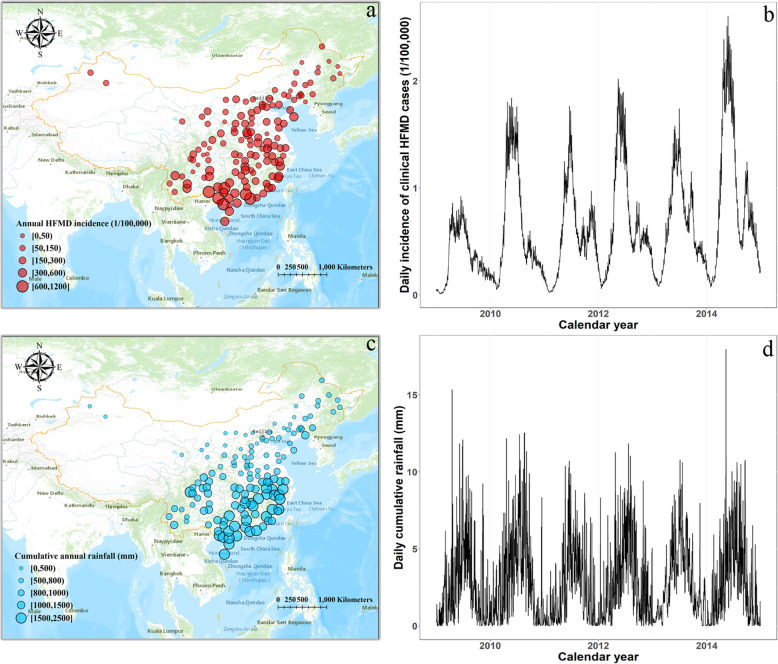
We retrieved the daily counts of childhood HFMD and the meteorological variables of the 143 cities in mainland China between 2009 and 2014. A common time series regression model was applied to quantify the association between rainfall and HFMD for each of the 143 cities. Then, we adopted the meta-regression model to pool the city-specific estimates and explore the sources of heterogeneity by incorporating city-specific characteristics.
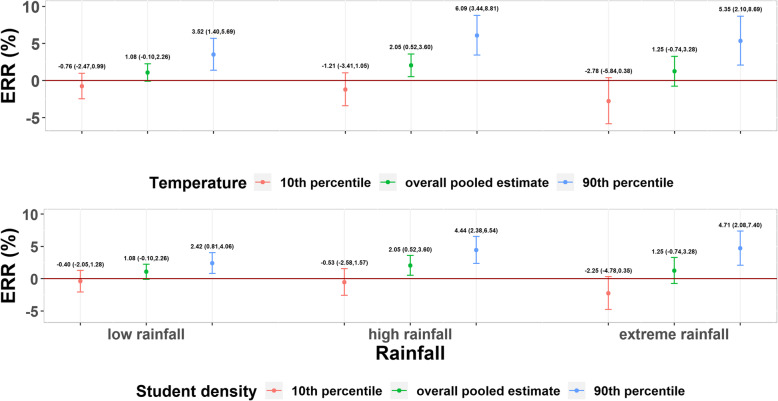
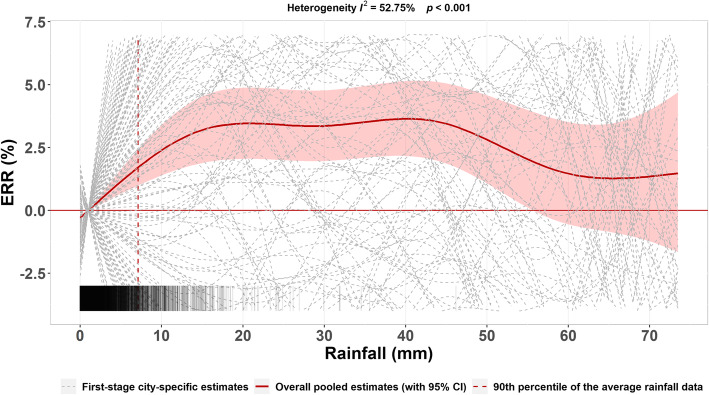
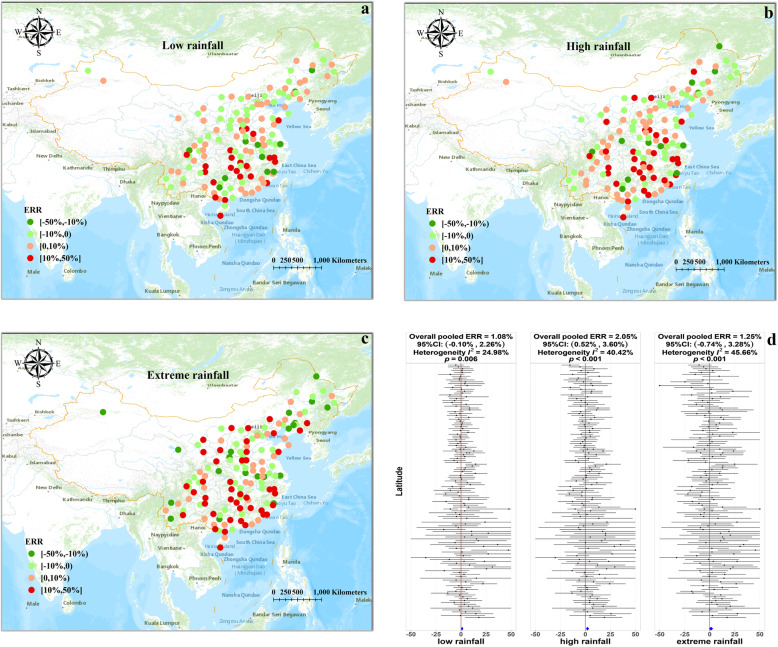
The overall pooled estimation suggested a nonlinear exposure-response relationship between rainfall and HFMD. Once rainfall exceeded 15 mm, the HFMD risk stopped increasing linearly and began to plateau with the excessive risk ratio (ERR) peaking at 21 mm of rainfall (ERR = 3.46, 95% CI: 2.05, 4.88). We also found significant heterogeneity in the rainfall-HFMD relationships (I = 52.75%, P < 0.001). By incorporating the city-specific characteristics into the meta-regression model, temperature and student density can explain a substantial proportion of spatial heterogeneity with I statistics that decreased by 5.29 and 6.80% at most, respectively.
Our findings verified the nonlinear association between rainfall and HFMD. The rainfall-HFMD relationship also varies depending on locations. Therefore, the estimation of the rain-HFMD relationship of one location should not be generalized to another location.
许多研究已经证明了降雨量与手足口病(HFMD)之间存在潜在的关联,但结果并不一致。本研究旨在基于多城市研究量化降雨量与 HFMD 之间的关系,并探讨空间异质性的潜在来源。
我们检索了中国大陆 143 个城市 2009 年至 2014 年期间儿童 HFMD 的日病例数和气象变量。应用普通时间序列回归模型来量化每个城市的降雨量与 HFMD 之间的关联。然后,我们采用荟萃回归模型来汇总城市特定的估计值,并通过纳入城市特定特征来探索异质性的来源。
总体汇总估计表明,降雨量与 HFMD 之间存在非线性暴露-反应关系。一旦降雨量超过 15 毫米,HFMD 风险就不再线性增加,并开始趋于平稳,过量风险比(ERR)在降雨量达到 21 毫米时达到峰值(ERR=3.46,95%CI:2.05,4.88)。我们还发现降雨量与 HFMD 之间的关系存在显著的异质性(I=52.75%,P<0.001)。通过将城市特定特征纳入荟萃回归模型,温度和学生密度可以解释相当大的空间异质性,I 统计量最多分别降低了 5.29%和 6.80%。
我们的研究结果验证了降雨量与 HFMD 之间的非线性关系。降雨量与 HFMD 之间的关系也因地点而异。因此,一个地点的雨-HFMD 关系的估计不应推广到另一个地点。