Nutrition Research Unit, Department of Animal Science, Aarhus University, Tjele, Denmark.
Section of Production, Nutrition and Health, Department of Veterinary and Animal Sciences, University of Copenhagen, Frederiksberg C, Denmark.
Physiol Rep. 2020 Oct;8(19):e14600. doi: 10.14814/phy2.14600.
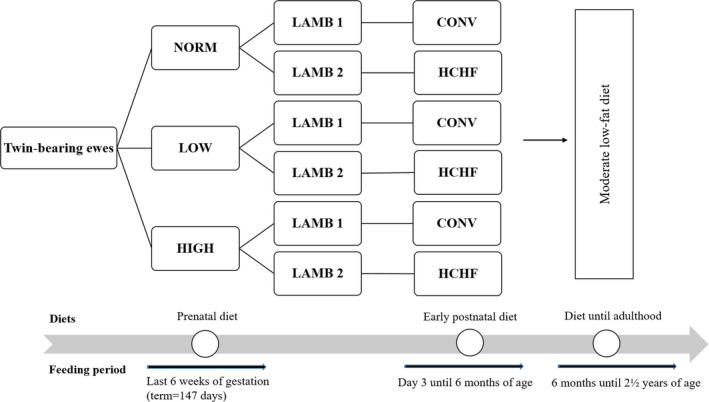
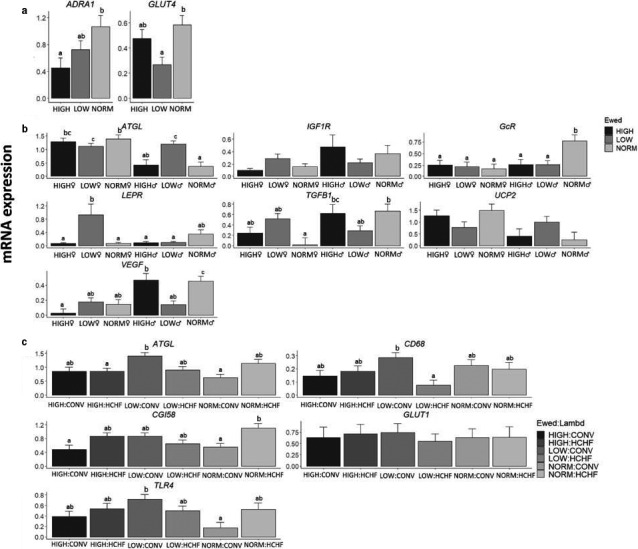
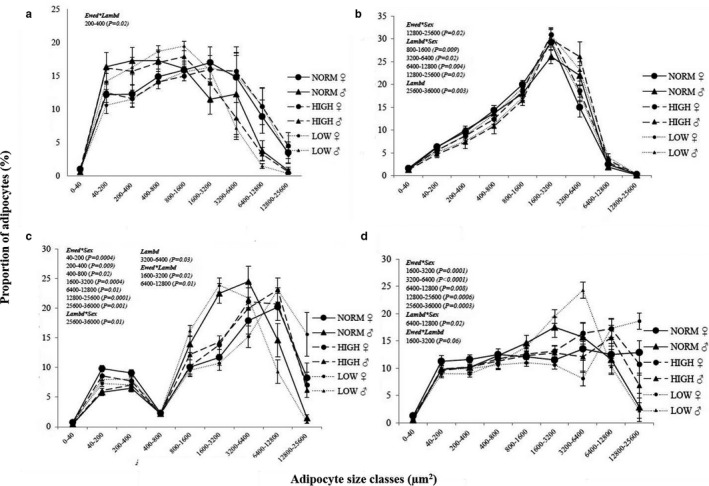
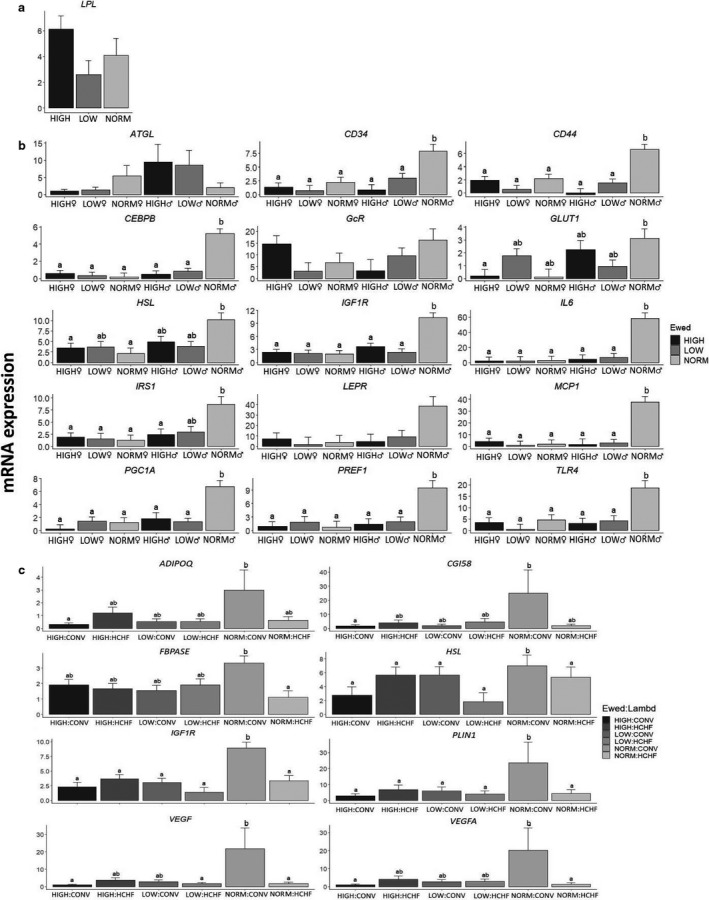
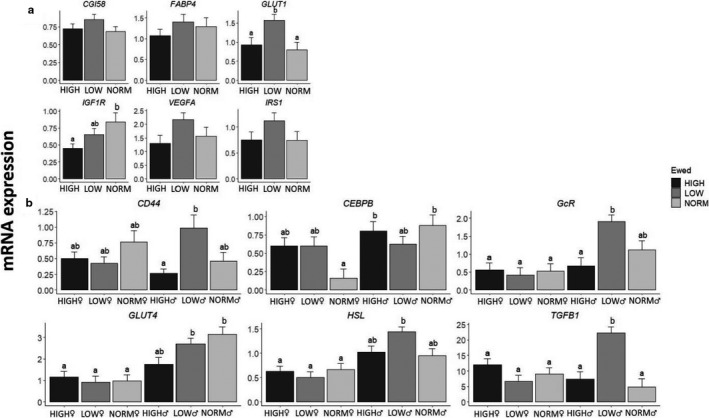
The aim was to investigate long-term, tissue and sex-specific impacts of pre and postnatal malnutrition on expandability and functional traits of different adipose tissues. Twin-pregnant ewes were fed NORM (~requirements), LOW (50% of NORM) or HIGH (150%/110% of energy/protein) diets the last 6 weeks prepartum (term ~147-days). Lambs received moderate, low-fat (CONV) or high-carbohydrate-high-fat (HCHF) diets from 3 days until 6 months of age, and thereafter CONV diet. At 2½ years of age (adulthood), histomorphometric and gene expression patterns were characterized in subcutaneous (SUB), perirenal (PER), mesenteric (MES), and epicardial (EPI) adipose tissues. SUB had sex-specific (♂<♀) upper-limits for adipocyte size and cell-number indices, irrespective of early life nutrition. PER mass and contents of adipocytes were highest in females and HIGH♂, whereas adipocyte cross-sectional area was lowest in LOW♂. Pre/postnatal nutrition affected gene expression sex-specifically in SUB + PER, but unrelated to morphological changes. In PER, LOW/LOW♂ were specific targets of gene expression changes. EPI was affected by postnatal nutrition, and HCHF sheep had enlarged adipocytes and upregulated expressions for adipogenic and lipogenic genes. Conclusion: upper-limits for SUB expandability were markedly lower in males. Major targets for prenatal malnutrition were PER and males. LOW♂ had the lowest PER expandability, whereas HIGH♂ had an adaptive advantage due to increased hypertrophic ability equivalent to females. Fixed expandability in SUB meant PER became a determining factor for MES and ectopic fat deposition, rendering LOW♂ particularly predisposed for obesity-associated metabolic risks. EPI, in contrast to other tissues, was targeted particularly by early postnatal obesity, resulting in adipocyte hypertrophy in adulthood.
目的在于探究围产期营养不良对不同脂肪组织扩展性和功能特征的长期、组织和性别特异性影响。在产前最后 6 周(妊娠期约 147 天),对双胎妊娠母羊进行正常(~需求)、低(50%正常)或高(能量/蛋白质 150%/110%)饮食喂养。羔羊在 3 天至 6 月龄期间接受中等、低脂肪(CONV)或高碳水化合物高脂肪(HCHF)饮食,此后接受 CONV 饮食。在 2 岁半(成年)时,对皮下(SUB)、肾周(PER)、肠系膜(MES)和心外膜(EPI)脂肪组织进行组织形态计量学和基因表达模式特征分析。无论早期生活营养如何,SUB 的脂肪细胞大小和细胞数量指数均具有性别特异性(♂<♀)的上限。雌性和 HIGH♂的 PER 质量和脂肪细胞含量最高,而 LOW♂的脂肪细胞横截面积最低。围产期营养对 SUB+PER 的基因表达具有性别特异性影响,但与形态变化无关。在 PER 中,LOW/LOW♂是基因表达变化的特定靶点。EPI 受产后营养影响,HCHF 绵羊的脂肪细胞增大,脂肪生成和脂肪生成基因表达上调。结论:SUB 的扩展性上限在雄性中明显较低。围产期营养不良的主要靶点是 PER 和雄性。LOW♂的 PER 扩展性最低,而 HIGH♂由于具有与雌性相当的增加肥大能力的适应性优势,因此具有优势。SUB 的固定扩展性意味着 PER 成为 MES 和异位脂肪沉积的决定因素,使 LOW♂特别容易受到肥胖相关代谢风险的影响。与其他组织相反,EPI 特别容易受到早期产后肥胖的影响,导致成年时脂肪细胞肥大。