The Reynolds Family Spine Laboratory, Department of Neurosurgery, New Jersey Medical School, Rutgers, The State University of New Jersey, Newark, NJ 07103, United States.
Department of Neurological Surgery, Hackensack Meridian School of Medicine, Nutley, NJ 07110, United States.
Brain Behav Immun. 2021 Jan;91:740-755. doi: 10.1016/j.bbi.2020.10.007. Epub 2020 Oct 8.
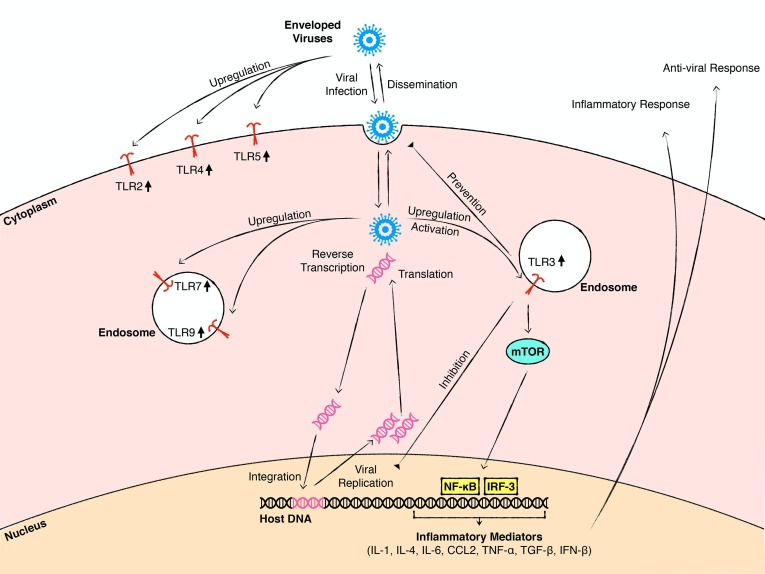
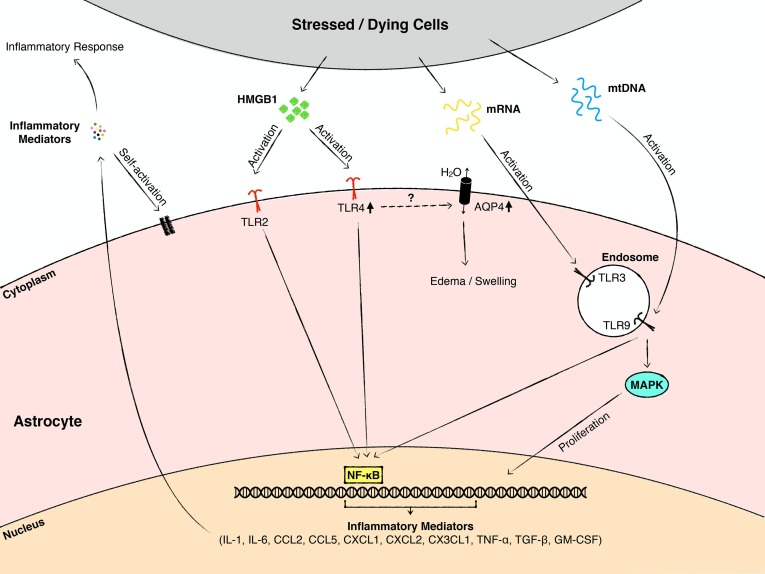
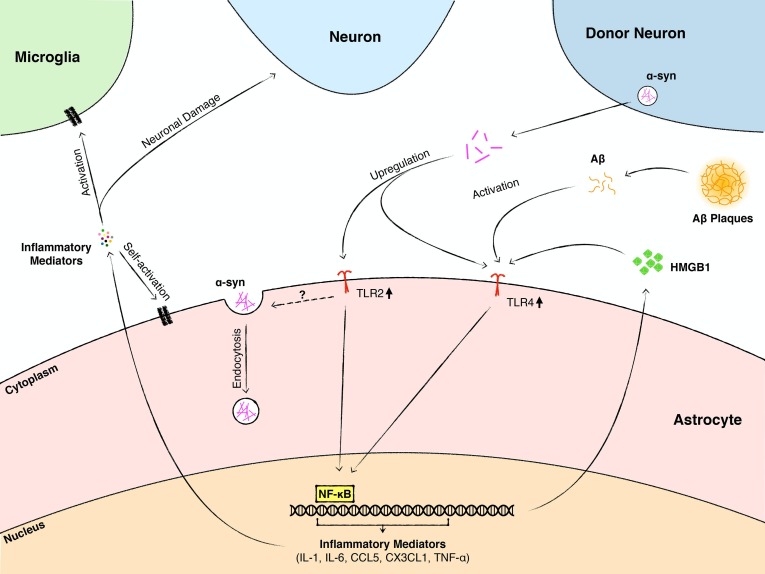
Central nervous system (CNS) innate immunity plays essential roles in infections, neurodegenerative diseases, and brain or spinal cord injuries. Astrocytes and microglia are the principal cells that mediate innate immunity in the CNS. Pattern recognition receptors (PRRs), expressed by astrocytes and microglia, sense pathogen-derived or endogenous ligands released by damaged cells and initiate the innate immune response. Toll-like receptors (TLRs) are a well-characterized family of PRRs. The contribution of microglial TLR signaling to CNS pathology has been extensively investigated. Even though astrocytes assume a wide variety of key functions, information about the role of astroglial TLRs in CNS disease and injuries is limited. Because astrocytes display heterogeneity and exhibit phenotypic plasticity depending on the effectors present in the local milieu, they can exert both detrimental and beneficial effects. TLRs are modulators of these paradoxical astroglial properties. The goal of the current review is to highlight the essential roles played by astroglial TLRs in CNS infections, injuries and diseases. We discuss the contribution of astroglial TLRs to host defense as well as the dissemination of viral and bacterial infections in the CNS. We examine the link between astroglial TLRs and the pathogenesis of neurodegenerative diseases and present evidence showing the pivotal influence of astroglial TLR signaling on sterile inflammation in CNS injury. Finally, we define the research questions and areas that warrant further investigations in the context of astrocytes, TLRs, and CNS dysfunction.
中枢神经系统(CNS)先天免疫在感染、神经退行性疾病以及脑或脊髓损伤中发挥着重要作用。星形胶质细胞和小胶质细胞是介导 CNS 先天免疫的主要细胞。星形胶质细胞和小胶质细胞表达的模式识别受体(PRRs)可识别病原体衍生或受损细胞释放的内源性配体,并启动先天免疫反应。Toll 样受体(TLRs)是一类特征明确的 PRRs。小胶质细胞 TLR 信号通路对 CNS 病理学的贡献已得到广泛研究。尽管星形胶质细胞具有多种关键功能,但有关星形胶质细胞 TLR 在 CNS 疾病和损伤中的作用的信息有限。由于星形胶质细胞表现出异质性,并根据局部环境中存在的效应物表现出表型可塑性,因此它们可以发挥有害和有益的作用。TLRs 是这些矛盾的星形胶质细胞特性的调节剂。本综述的目的是强调星形胶质细胞 TLR 在 CNS 感染、损伤和疾病中的重要作用。我们讨论了星形胶质细胞 TLR 对宿主防御以及 CNS 中病毒和细菌感染传播的贡献。我们研究了星形胶质细胞 TLR 与神经退行性疾病发病机制之间的联系,并提供了证据表明星形胶质细胞 TLR 信号对 CNS 损伤中无菌性炎症具有关键影响。最后,我们确定了与星形胶质细胞、TLRs 和 CNS 功能障碍相关的需要进一步研究的问题和领域。