Hughes Derralynn A, Aguiar Patricio, Deegan Patrick B, Ezgu Fatih, Frustaci Andrea, Lidove Olivier, Linhart Aleš, Lubanda Jean-Claude, Moon James C, Nicholls Kathleen, Niu Dau-Ming, Nowak Albina, Ramaswami Uma, Reisin Ricardo, Rozenfeld Paula, Schiffmann Raphael, Svarstad Einar, Thomas Mark, Torra Roser, Vujkovac Bojan, Warnock David G, West Michael L, Johnson Jack, Rolfe Mark J, Feriozzi Sandro
Lysosomal Storage Disorders Unit, Royal Free Hospital, London, UK
Department of Haematology, University College London, London, UK.
BMJ Open. 2020 Oct 10;10(10):e035182. doi: 10.1136/bmjopen-2019-035182.
The PRoposing Early Disease Indicators for Clinical Tracking in Fabry Disease (PREDICT-FD) initiative aimed to reach consensus among a panel of global experts on early indicators of disease progression that may justify FD-specific treatment initiation.
Anonymous feedback from panellists via online questionnaires was analysed using a modified Delphi consensus technique. Questionnaires and data were managed by an independent administrator directed by two non-voting cochairs. First, possible early indicators of renal, cardiac and central/peripheral nervous system (CNS/PNS) damage, and other disease and patient-reported indicators assessable in routine clinical practice were compiled by the cochairs and administrator from panellists' free-text responses. Second, the panel scored indicators for importance (5-point scale: 1=not important; 5=extremely important); indicators scoring ≥3 among >75% of panellists were then rated for agreement (5-point scale: 1=strongly disagree; 5=strongly agree). Indicators awarded an agreement score ≥4 by >67% of panellists achieved consensus. Finally, any panel-proposed refinements to consensus indicator definitions were adopted if >75% of panellists agreed.
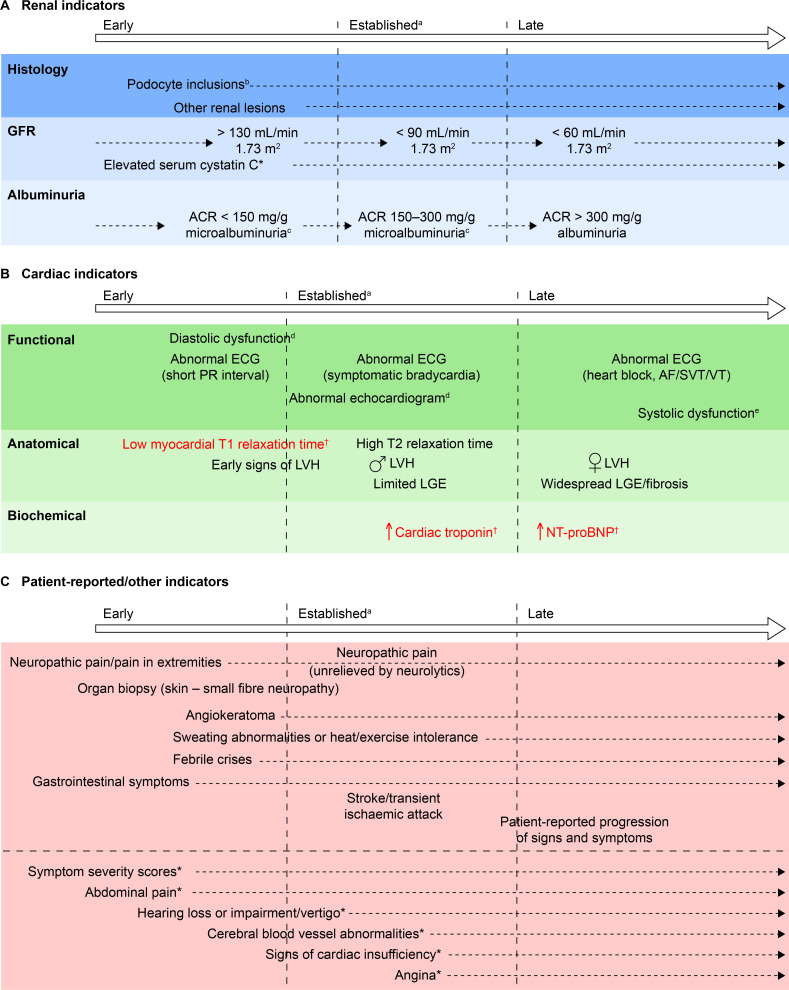
A panel of 21 expert clinicians from 15 countries provided information from which 83 possible current indicators of damage (kidney, 15; cardiac, 15; CNS/PNS, 13; other, 16; patient reported, 24) were compiled. Of 45 indicators meeting the importance criteria, consensus was reached for 29 and consolidated as 27 indicators (kidney, 6; cardiac, 10; CNS/PNS, 2; other, 6; patient reported, 3) including: (kidney) elevated albumin:creatinine ratio, histological damage, microalbuminuria; (cardiac) markers of early systolic/diastolic dysfunction, elevated serum cardiac troponin; (CNS/PNS) neuropathic pain, gastrointestinal symptoms suggestive of gastrointestinal neuropathy; (other) pain in extremities/neuropathy, angiokeratoma; (patient-reported) febrile crises, progression of symptoms/signs. Panellists revised and approved proposed chronologies of when the consensus indicators manifest. The panel response rate was >95% at all stages.
PREDICT-FD captured global opinion regarding current clinical indicators that could prompt FD-specific treatment initiation earlier than is currently practised.
法布里病临床追踪早期疾病指标提议(PREDICT - FD)倡议旨在让全球专家小组就疾病进展的早期指标达成共识,这些指标可能成为启动法布里病特异性治疗的依据。
采用改良的德尔菲共识技术分析专家小组成员通过在线问卷提供的匿名反馈。问卷和数据由一名独立管理员管理,该管理员由两名无投票权的联合主席指导。首先,联合主席和管理员根据专家小组成员的自由文本回复,汇总出肾脏、心脏和中枢/外周神经系统(CNS/PNS)损伤可能的早期指标,以及在常规临床实践中可评估的其他疾病和患者报告指标。其次,专家小组对指标的重要性进行评分(5分制:1 = 不重要;5 = 极其重要);在超过75%的专家小组成员中得分≥3的指标,随后进行一致性评分(5分制:1 = 强烈不同意;5 = 强烈同意)。获得超过67%的专家小组成员一致性评分≥4的指标达成共识。最后,如果超过75%的专家小组成员同意,专家小组对共识指标定义提出的任何改进建议都将被采纳。
来自15个国家的21名专家临床医生组成的小组提供了信息,从中汇总出83个可能的当前损伤指标(肾脏,15个;心脏,15个;CNS/PNS,13个;其他,16个;患者报告,24个)。在45个符合重要性标准的指标中,29个达成共识并整合为27个指标(肾脏,6个;心脏,10个;CNS/PNS,2个;其他,6个;患者报告,3个),包括:(肾脏)白蛋白:肌酐比值升高、组织学损伤、微量白蛋白尿;(心脏)早期收缩/舒张功能障碍标志物、血清心肌肌钙蛋白升高;(CNS/PNS)神经性疼痛、提示胃肠神经病变的胃肠道症状;(其他)四肢疼痛/神经病变、血管角质瘤;(患者报告)发热危机、症状/体征进展。专家小组成员修订并批准了共识指标出现时间的提议时间表。在所有阶段,专家小组的回复率均超过95%。
PREDICT - FD收集了关于当前临床指标的全球意见,这些指标可能促使比目前更早启动法布里病特异性治疗。