
批量伤患事件中的烧伤处理建议:世界卫生组织烧伤紧急医疗队技术工作组(2017-2020 年)。
Recommendations for burns care in mass casualty incidents: WHO Emergency Medical Teams Technical Working Group on Burns (WHO TWGB) 2017-2020.
机构信息
Interburns, International Network for Training, Education and Research in Burns, Swansea, Wales, UK; Humanitarian and Conflict Response Institute (HCRI), University of Manchester, UK; Cambridge Hospital NHS Foundation Trust (Addenbrookes), Paediatric ICU Department, UK.
Department of Plastic, Hand and Reconstructive Surgery, Norwegian National Burn Center, Haukeland University Hospital, Bergen, Norway; Faculty of Medicine, University of Bergen, Norway.
出版信息
Burns. 2021 Mar;47(2):349-370. doi: 10.1016/j.burns.2020.07.001. Epub 2020 Jul 13.
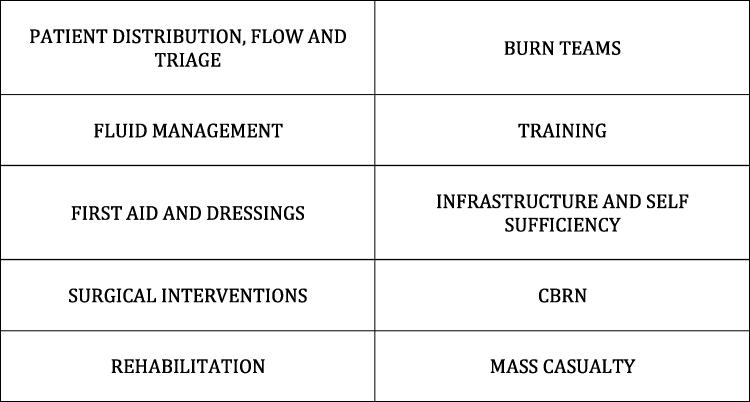
Health and logistical needs in emergencies have been well recognised. The last 7 years has witnessed improved professionalisation and standardisation of care for disaster affected communities - led in part by the World Health Organisation Emergency Medical Team (EMT) initiative. Mass casualty incidents (MCIs) resulting in burn injuries present unique challenges. Burn management benefits from specialist skills, expert knowledge, and timely availability of specialist resources. With burn MCIs occurring globally, and wide variance in existing burn care capacity, the need to strengthen burn care capability is evident. Although some high-income countries have well-established disaster management plans, including burn specific plans, many do not - the majority of countries where burn mass casualty events occur are without such established plans. Developing globally relevant recommendations is a first step in addressing this deficit and increasing preparedness to deal with such disasters. Global burn experts were invited to a succession of Technical Working Group on burns (TWGB) meetings to: 1) review literature on burn care in MCIs; and 2) define and agree on recommendations for burn care in MCIs. The resulting 22 recommendations provide a framework to guide national and international specialist burn teams and health facilities to support delivery of safe care and improved outcomes to burn patients in MCIs.
在紧急情况下,人们已经充分认识到健康和后勤需求。过去 7 年见证了受灾害影响社区的灾难护理的专业化和标准化的提高,这在一定程度上要归功于世界卫生组织紧急医疗队(EMT)倡议。大规模伤亡事件(MCI)导致烧伤,这带来了独特的挑战。烧伤管理受益于专业技能、专家知识以及及时获得专业资源。由于烧伤 MCI 在全球范围内发生,而且现有的烧伤护理能力存在很大差异,因此需要加强烧伤护理能力。尽管一些高收入国家制定了完善的灾害管理计划,包括针对烧伤的具体计划,但许多国家都没有这样的计划——发生烧伤 MCI 的大多数国家都没有这样的既定计划。制定具有全球相关性的建议是解决这一不足并提高应对此类灾害能力的第一步。全球烧伤专家应邀参加了一系列烧伤技术工作组(TWGB)会议,以:1)审查 MCI 中烧伤护理的文献;2)定义和商定 MCI 中烧伤护理的建议。由此产生的 22 项建议为指导国家和国际烧伤专家团队和医疗机构提供了一个框架,以支持为烧伤患者提供安全护理并改善烧伤患者的预后。
 Zotero 插件