Mantovani Elisa, Zucchella Chiara, Bottiroli Sara, Federico Angela, Giugno Rosalba, Sandrini Giorgio, Chiamulera Cristiano, Tamburin Stefano
Department of Neurosciences, Biomedicine and Movement Sciences, University of Verona, Verona, Italy.
Section of Neurology, Department of Neurosciences, Verona University Hospital, Verona, Italy.
Front Neurol. 2020 Sep 15;11:926. doi: 10.3389/fneur.2020.00926. eCollection 2020.
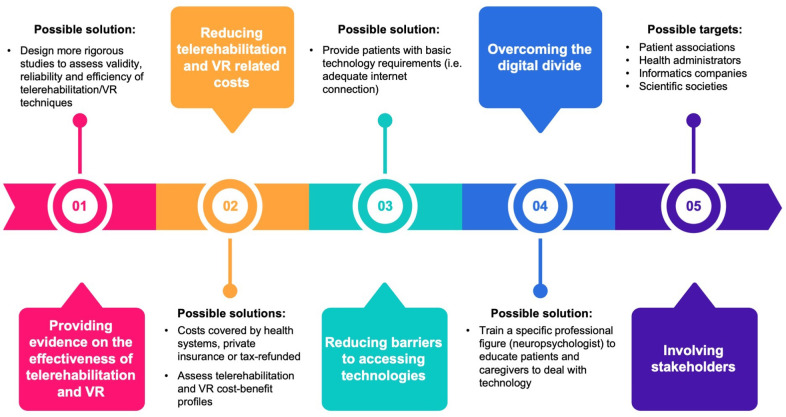
The current COVID-19 pandemic presents unprecedented new challenges to public health and medical care delivery. To control viral transmission, social distancing measures have been implemented all over the world, interrupting the access to routine medical care for many individuals with neurological diseases. Cognitive disorders are common in many neurological conditions, e.g., stroke, traumatic brain injury, Alzheimer's disease, and other types of dementia, Parkinson's disease and parkinsonian syndromes, and multiple sclerosis, and should be addressed by cognitive rehabilitation interventions. To be effective, cognitive rehabilitation programs must be intensive and prolonged over time; however, the current virus containment measures are hampering their implementation. Moreover, the reduced access to cognitive rehabilitation might worsen the relationship between the patient and the healthcare professional. Urgent measures to address issues connected to COVID-19 pandemic are, therefore, needed. Remote communication technologies are increasingly regarded as potential effective options to support health care interventions, including neurorehabilitation and cognitive rehabilitation. Among them, telemedicine, virtual reality, augmented reality, and serious games could be in the forefront of these efforts. We will briefly review current evidence-based recommendations on the efficacy of cognitive rehabilitation and offer a perspective on the role of tele- and virtual rehabilitation to achieve adequate cognitive stimulation in the era of social distancing related to COVID-19 pandemic. In particular, we will discuss issues related to their diffusion and propose a roadmap to address them. Methodological and technological improvements might lead to a paradigm shift to promote the delivery of cognitive rehabilitation to people with reduced mobility and in remote regions.
当前的新冠疫情给公共卫生和医疗服务带来了前所未有的新挑战。为控制病毒传播,世界各地都实施了社交 distancing 措施,这中断了许多患有神经系统疾病的个体获得常规医疗服务的途径。认知障碍在许多神经系统疾病中很常见,例如中风、创伤性脑损伤、阿尔茨海默病和其他类型的痴呆症、帕金森病和帕金森综合征以及多发性硬化症,应该通过认知康复干预来解决。为了有效,认知康复计划必须密集且长期实施;然而,当前的病毒防控措施正在阻碍其实施。此外,获得认知康复的机会减少可能会使患者与医疗保健专业人员之间的关系恶化。因此,需要采取紧急措施来解决与新冠疫情相关的问题。远程通信技术越来越被视为支持医疗保健干预措施的潜在有效选择,包括神经康复和认知康复。其中,远程医疗、虚拟现实、增强现实和严肃游戏可能处于这些努力的前沿。我们将简要回顾当前关于认知康复疗效的循证建议,并就远程和虚拟康复在与新冠疫情相关的社交 distancing 时代实现充分认知刺激方面的作用提供一个视角。特别是,我们将讨论与它们的传播相关的问题,并提出解决这些问题的路线图。方法学和技术上的改进可能会导致范式转变,以促进向行动不便者和偏远地区的人们提供认知康复服务。