Kwon Hyuk Nam, Lee Hyuk, Park Ji Won, Kim Young-Ho, Park Sunghyouk, Kim Jae J
College of Pharmacy, Natural Product Research Institute, Seoul National University, Seoul 08826, Korea.
Stem Cells and Metabolism Research Program, Faculty of Medicine/Helsinki Institute of Life Science, University of Helsinki, FIN-00014 Helsinki, Finland.
Cancers (Basel). 2020 Oct 9;12(10):2904. doi: 10.3390/cancers12102904.
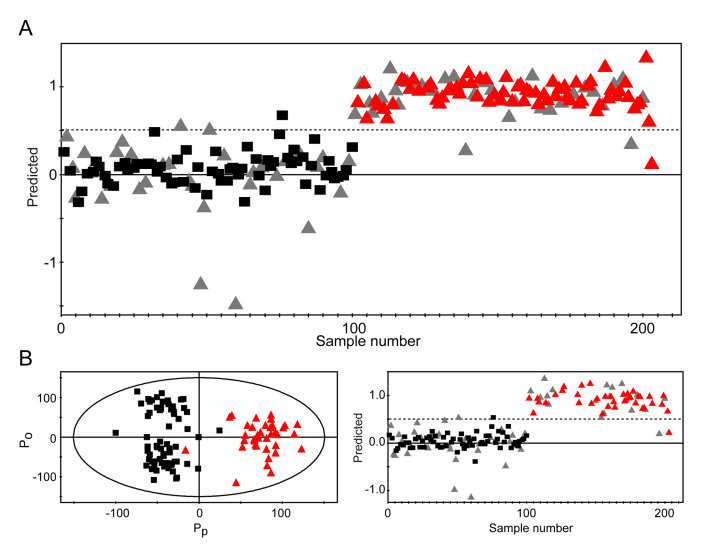
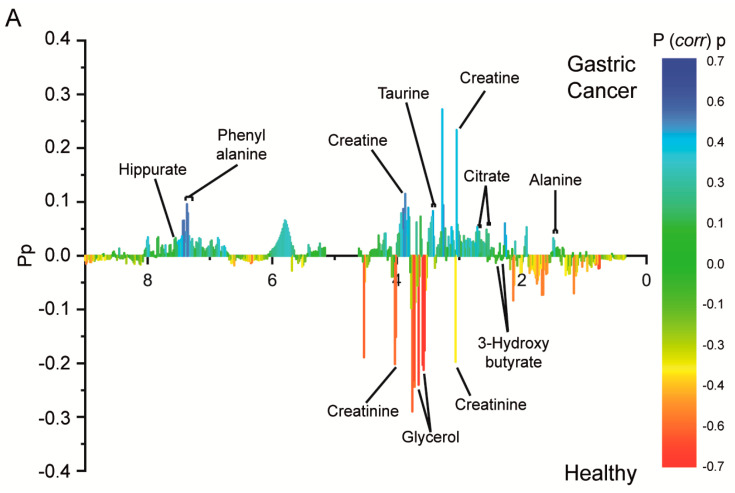
The early detection of gastric cancer (GC) could decrease its incidence and mortality. However, there are currently no accurate noninvasive markers for GC screening. Therefore, we developed a noninvasive diagnostic approach, employing urine nuclear magnetic resonance (NMR) metabolomics, to discover putative metabolic markers associated with GC. Changes in urine metabolite levels during oncogenesis were evaluated using samples from 103 patients with GC and 100 age- and sex-matched healthy controls. Approximately 70% of the patients with GC ( = 69) had stage I GC, with the majority ( = 56) having intramucosal cancer. A multivariate statistical analysis of the urine NMR data well discriminated between the patient and control groups and revealed nine metabolites, including alanine, citrate, creatine, creatinine, glycerol, hippurate, phenylalanine, taurine, and 3-hydroxybutyrate, that contributed to the difference. A diagnostic performance test with a separate validation set exhibited a sensitivity and specificity of more than 90%, even with the intramucosal cancer samples only. In conclusion, the NMR-based urine metabolomics approach may have potential as a convenient screening method for the early detection of GC and may facilitate consequent endoscopic examination through risk stratification.
胃癌(GC)的早期检测可降低其发病率和死亡率。然而,目前尚无用于胃癌筛查的准确无创标志物。因此,我们开发了一种无创诊断方法,采用尿液核磁共振(NMR)代谢组学来发现与胃癌相关的潜在代谢标志物。使用来自103例胃癌患者和100例年龄及性别匹配的健康对照的样本,评估肿瘤发生过程中尿液代谢物水平的变化。约70%的胃癌患者(n = 69)为I期胃癌,其中大多数(n = 56)为黏膜内癌。对尿液NMR数据进行多变量统计分析,能够很好地区分患者组和对照组,并揭示了9种代谢物,包括丙氨酸、柠檬酸盐、肌酸、肌酐、甘油、马尿酸盐、苯丙氨酸、牛磺酸和3-羟基丁酸盐,这些代谢物导致了差异。即使仅使用黏膜内癌样本,在一个单独的验证集上进行的诊断性能测试也显示出超过90%的灵敏度和特异性。总之,基于NMR的尿液代谢组学方法可能有潜力作为一种方便的筛查方法用于胃癌的早期检测,并可能通过风险分层促进后续的内镜检查。