Pakravan-Charvadeh Mohammad Reza, Mohammadi-Nasrabadi Fatemeh, Gholamrezai Saeed, Vatanparast Hassan, Flora Cornelia, Nabavi-Pelesaraei Ashkan
Department of Agricultural Economics and Rural Development, Faculty of Agriculture, Lorestan University, Khorramabad, Iran.
Research Department of Food and Nutrition Policy and Planning, National Nutrition and Food Technology Research Institute, Faculty of Nutrition Sciences and Food Technology, Shahid Beheshti University of Medical Sciences, Tehran, Iran.
J Clean Prod. 2021 Jan 25;281:124537. doi: 10.1016/j.jclepro.2020.124537. Epub 2020 Oct 6.
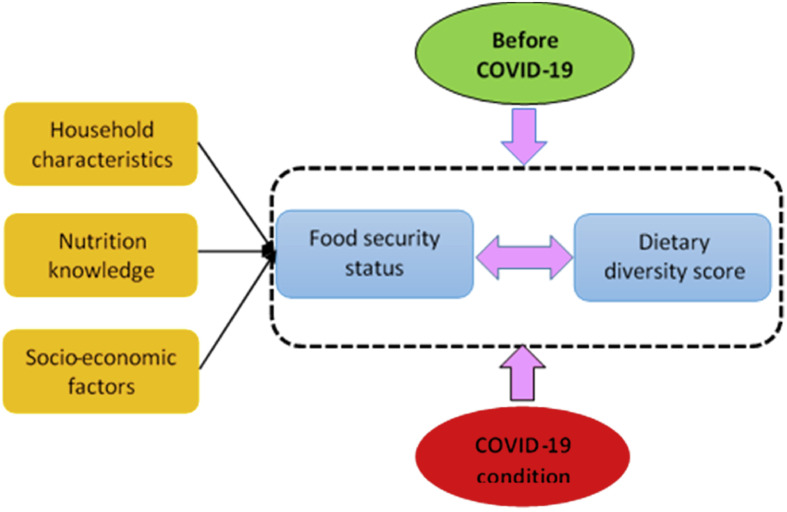
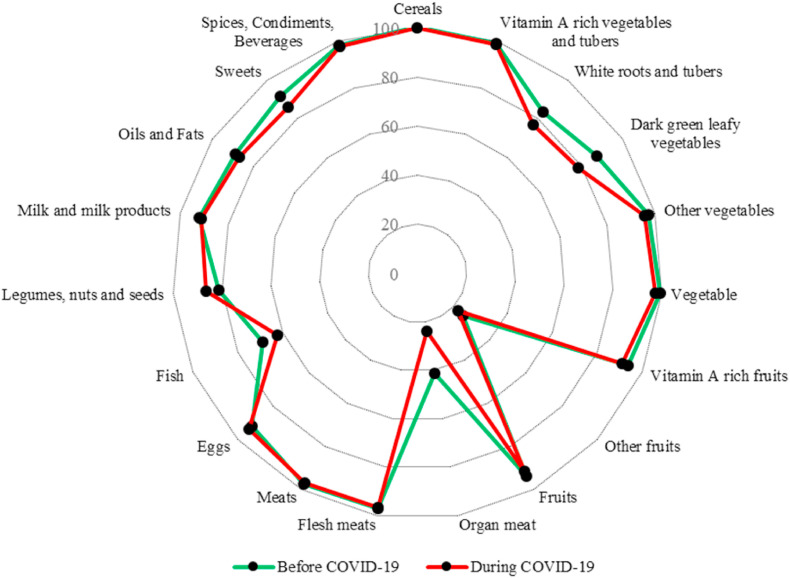
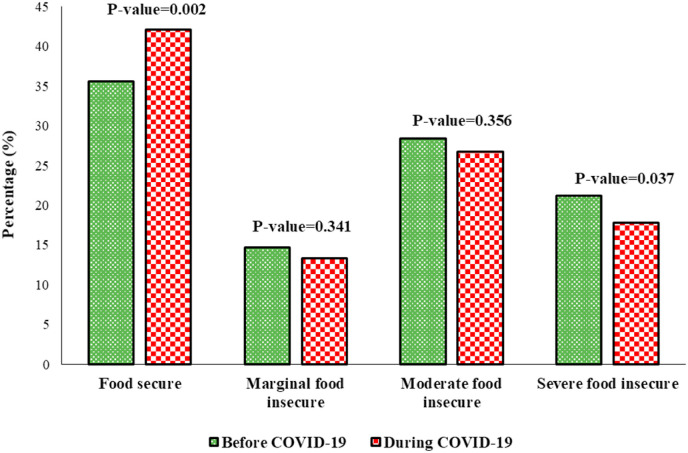
Currently, the COVID-19 outbreak is spreading fast in 185 countries and has engaged most people around the world. COVID-19 imposes severe and tragic consequences on people's health due to the high rate of spread and potentially fatal impacts. In this study, the association of socio-economic factors with food security and dietary diversity is assessed before and during the COVID-19 pandemic. Data from 299 respondents were collected by an online standard questionnaire. Household Dietary Diversity Score (HDDS) and Household Food Insecurity Access Scale (HFIAS) were calculated. A multinomial regression model was applied to determine factors associated with HDDS and HFIAS before and during COVID-19 outbreak. Food security of Iranian households improved during the initial COVID-19 pandemic period (P < 0.001). Households reduced consumption of some food groups during the COVID-19 pandemic compared to the pre-COVID-19 period. Key socio-economic factors associated with food insecurity during the COVID-19 pandemic included personal savings, household income, employment status of head of household, and nutrition knowledge of head of household. During the COVID-19 outbreak, household size, head of household's occupation, personal savings, and number of male children were significantly associated with dietary diversity. Distributing free food baskets to poor households, extending e-marketing, providing nutrition consultations, and organizing donations to support infected households may increase household dietary diversity and improve food security status during a pandemic such as COVID-19. Vulnerable populations in countries experiencing food insecurity, such as Iran, should be supported - not just by providing medical care and personal protective equipment, but also with flexible safety nets and food-based intervention programs to respond to population needs.
目前,新冠疫情正在185个国家迅速蔓延,影响了世界上的大多数人。由于传播速度快以及潜在的致命影响,新冠疫情给人们的健康带来了严重且悲惨的后果。在本研究中,评估了新冠疫情之前和期间社会经济因素与粮食安全和饮食多样性之间的关联。通过在线标准问卷收集了299名受访者的数据。计算了家庭饮食多样性得分(HDDS)和家庭粮食不安全获取量表(HFIAS)。应用多项回归模型来确定新冠疫情爆发之前和期间与HDDS和HFIAS相关的因素。在新冠疫情初期,伊朗家庭的粮食安全状况有所改善(P < 0.001)。与新冠疫情之前相比,家庭在疫情期间减少了某些食物组的消费。新冠疫情期间与粮食不安全相关的关键社会经济因素包括个人储蓄、家庭收入、户主的就业状况以及户主的营养知识。在新冠疫情爆发期间,家庭规模、户主职业、个人储蓄以及男孩数量与饮食多样性显著相关。向贫困家庭分发免费食品篮、扩大电子营销、提供营养咨询以及组织捐赠以支持受感染家庭,可能会增加家庭饮食多样性并改善新冠疫情等大流行期间的粮食安全状况。对于像伊朗这样面临粮食不安全的国家中的弱势群体,不仅应通过提供医疗护理和个人防护设备来给予支持,还应提供灵活的安全网和基于食物的干预计划,以满足民众的需求。