Department of Neurology, Oregon Health & Science University, Portland, OR 97239, USA.
Department of Electrical and Computer Engineering, Portland State University, Portland, OR 97207, USA.
Sensors (Basel). 2020 Oct 12;20(20):5769. doi: 10.3390/s20205769.
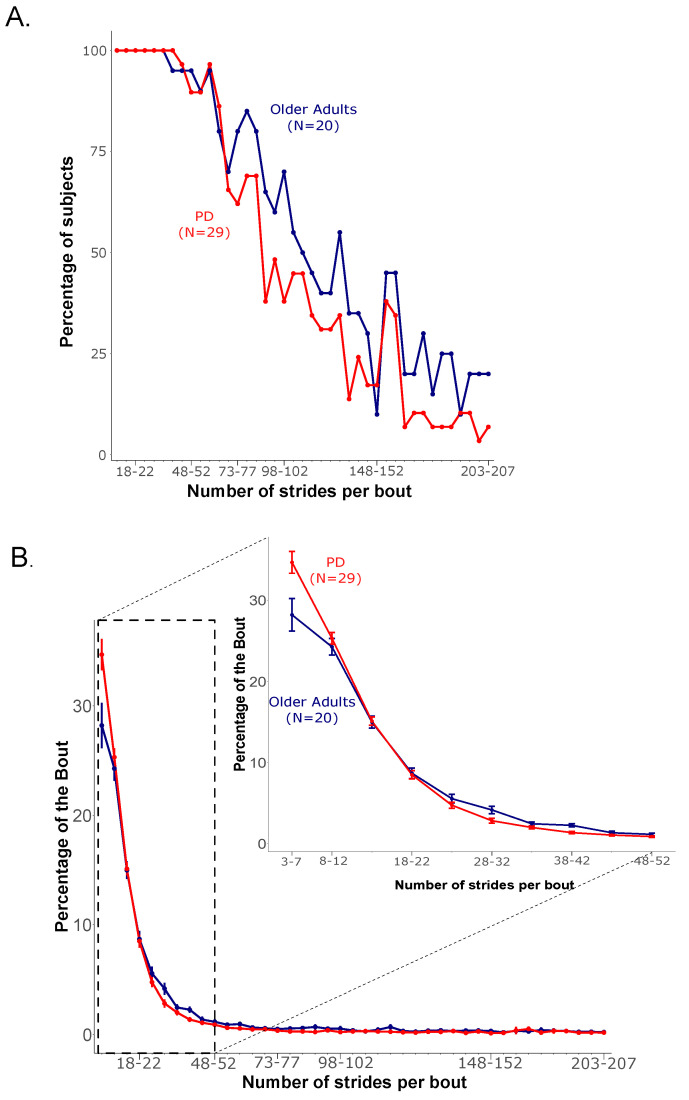
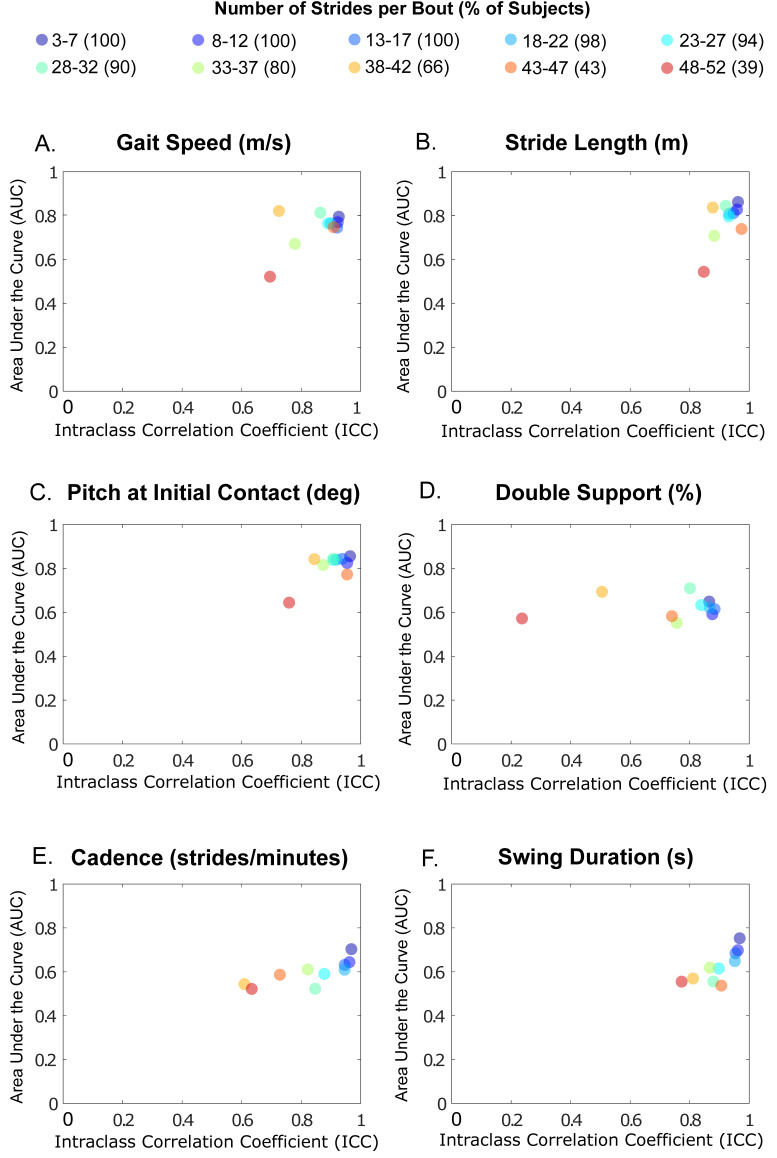
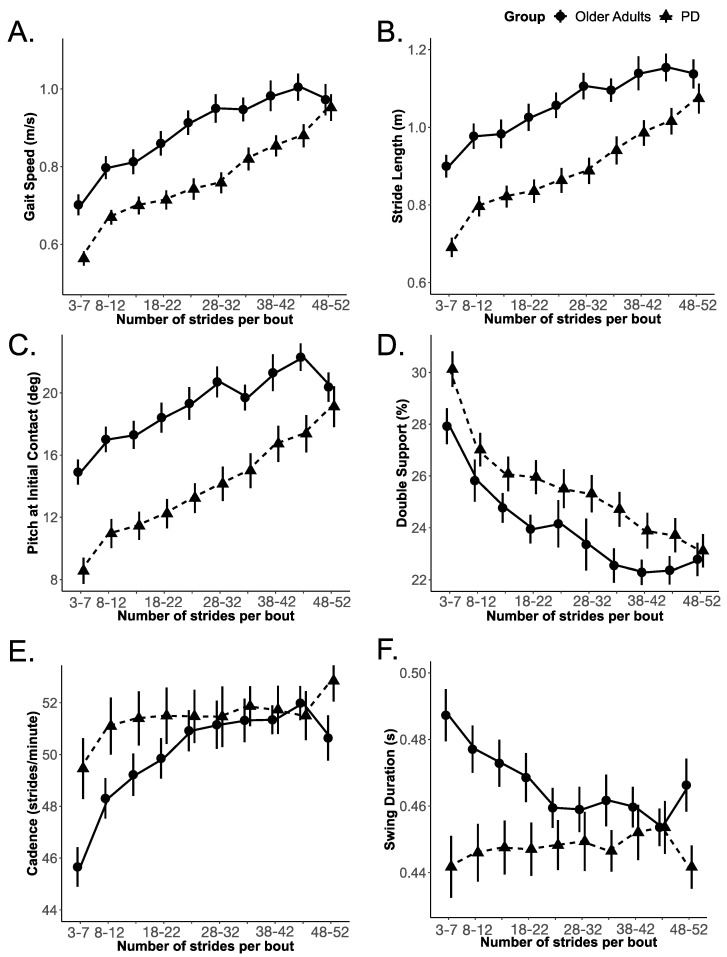
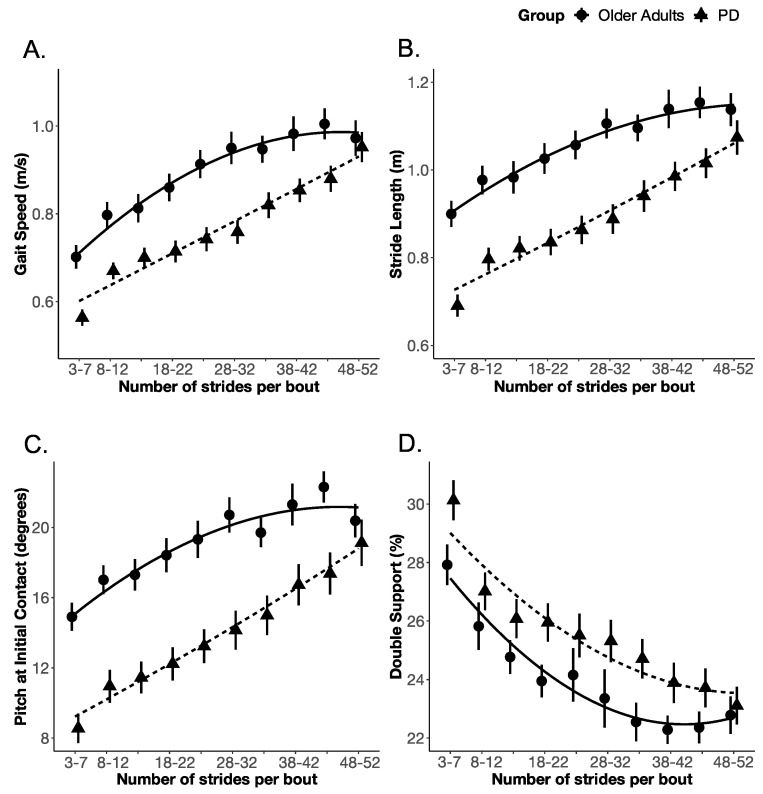
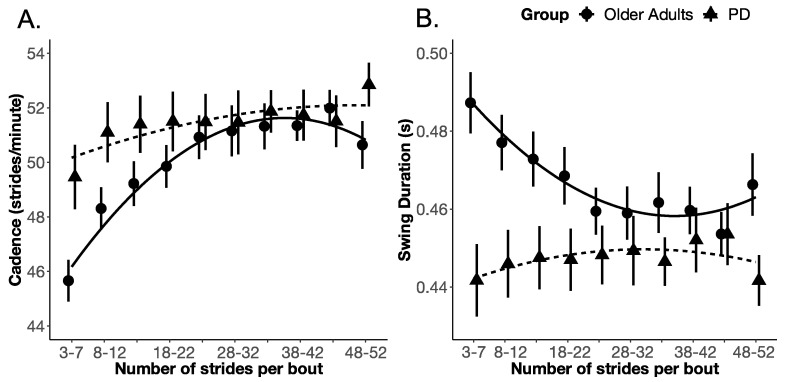
Although the use of wearable technology to characterize gait disorders in daily life is increasing, there is no consensus on which specific gait bout length should be used to characterize gait. Clinical trialists using daily life gait quality as study outcomes need to understand how gait bout length affects the sensitivity and specificity of measures to discriminate pathological gait as well as the reliability of gait measures across gait bout lengths. We investigated whether Parkinson's disease (PD) affects how gait characteristics change as bout length changes, and how gait bout length affects the reliability and discriminative ability of gait measures to identify gait impairments in people with PD compared to neurotypical Old Adults (OA). We recruited 29 people with PD and 20 neurotypical OA of similar age for this study. Subjects wore 3 inertial sensors, one on each foot and one over the lumbar spine all day, for 7 days. To investigate which gait bout lengths should be included to extract gait measures, we determined the range of gait bout lengths available across all subjects. To investigate if the effect of bout length on each gait measure is similar or not between subjects with PD and OA, we used a growth curve analysis. For reliability and discriminative ability of each gait measure as a function of gait bout length, we used the intraclass correlation coefficient (ICC) and area under the curve (AUC), respectively. Ninety percent of subjects walked with a bout length of less than 53 strides during the week, and the majority (>50%) of gait bouts consisted of less than 12 strides. Although bout length affected all gait measures, the effects depended on the specific measure and sometimes differed for PD versus OA. Specifically, people with PD did not increase/decrease cadence and swing duration with bout length in the same way as OA. ICC and AUC characteristics tended to be larger for shorter than longer gait bouts. Our findings suggest that PD interferes with the scaling of cadence and swing duration with gait bout length. Whereas control subjects gradually increased cadence and decreased swing duration as bout length increased, participants with PD started with higher than normal cadence and shorter than normal stride duration for the smallest bouts, and cadence and stride duration changed little as bout length increased, so differences between PD and OA disappeared for the longer bout lengths. Gait measures extracted from shorter bouts are more common, more reliable, and more discriminative, suggesting that shorter gait bouts should be used to extract potential digital biomarkers for people with PD.
尽管使用可穿戴技术来描述日常生活中的步态障碍的应用越来越多,但在用于描述步态的具体步态段长度方面尚未达成共识。将日常生活中的步态质量作为研究结果的临床试验人员需要了解步态段长度如何影响区分病理性步态的测量的敏感性和特异性,以及步态段长度变化对步态测量的可靠性的影响。我们研究了帕金森病(PD)是否会影响步态特征随段长度变化而变化的方式,以及步态段长度如何影响 PD 患者与神经典型老年(OA)相比,识别步态障碍的步态测量的可靠性和区分能力。我们招募了 29 名 PD 患者和 20 名年龄相似的神经典型 OA 患者参加这项研究。研究对象在一天中佩戴 3 个惯性传感器,一个在每个脚上,一个在腰椎上。为了研究应该包含哪些步态段来提取步态测量值,我们确定了所有研究对象可用的步态段长度范围。为了研究 PD 和 OA 患者之间步态段长度对每个步态测量值的影响是否相似,我们使用了生长曲线分析。为了研究每个步态段长度对步态测量的可靠性和区分能力,我们分别使用了组内相关系数(ICC)和曲线下面积(AUC)。90%的研究对象在一周内的步幅小于 53 步,并且大多数(>50%)步态段由小于 12 步组成。尽管步态段长度会影响所有步态测量值,但影响因具体测量值而异,并且有时 PD 与 OA 之间存在差异。具体来说,PD 患者的步频和摆动时间与 OA 患者的步频和摆动时间的增加/减少方式不同。对于较短的步态段,ICC 和 AUC 的特征往往更大。我们的研究结果表明,PD 会干扰步频和摆动时间随步态段长度的缩放。在对照受试者中,随着步态段长度的增加,步频逐渐增加,摆动时间逐渐减少,而 PD 患者在最小的步态段中开始时的步频高于正常水平,步幅时间短于正常水平,随着步态段长度的增加,步频和步幅时间变化不大,因此 PD 和 OA 之间的差异在较长的步态段中消失。从较短的步态段中提取的步态测量值更常见、更可靠、更具区分性,这表明应该使用较短的步态段来提取 PD 患者的潜在数字生物标志物。