Son Moon, Cho Kyung Hwa, Jeong Kwanho, Park Jongkwan
School of Urban and Environmental Engineering, Ulsan National Institute of Science and Technology, UNIST-gil 50, Ulsan 44919, Korea.
School of Civil, Environmental and Chemical Engineering, Changwon National University, Changwon, Gyeongsangnamdo 51140, Korea.
Membranes (Basel). 2020 Oct 12;10(10):280. doi: 10.3390/membranes10100280.
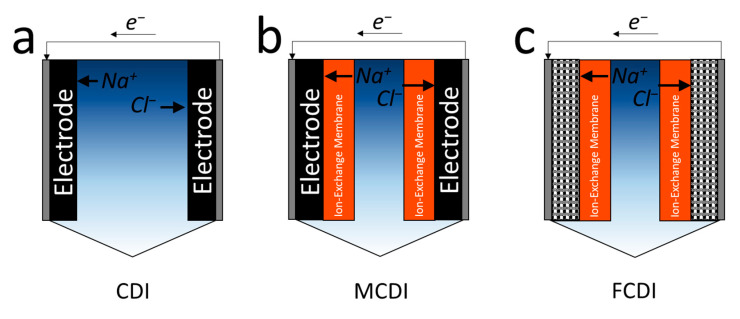
In the past few decades, membrane-based processes have become mainstream in water desalination because of their relatively high water flux, salt rejection, and reasonable operating cost over thermal-based desalination processes. The energy consumption of the membrane process has been continuously lowered (from >10 kWh m to 3 kWh m) over the past decades but remains higher than the theoretical minimum value (0.8 kWh m) for seawater desalination. Thus, the high energy consumption of membrane processes has led to the development of alternative processes, such as the electrochemical, that use relatively less energy. Decades of research have revealed that the low energy consumption of the electrochemical process is closely coupled with a relatively low extent of desalination. Recent studies indicate that electrochemical process must overcome efficiency rather than energy consumption hurdles. This short perspective aims to provide platforms to compare the energy efficiency of the representative membrane and electrochemical processes based on the working principle of each process. Future water desalination methods and the potential role of nanotechnology as an efficient tool to overcome current limitations are also discussed.
在过去几十年中,基于膜的工艺因其相对较高的水通量、脱盐率以及相较于基于热的脱盐工艺更为合理的运行成本,已成为海水淡化的主流工艺。在过去几十年里,膜工艺的能耗持续降低(从>10 kWh/m降至约3 kWh/m),但仍高于海水淡化的理论最小值(约0.8 kWh/m)。因此,膜工艺的高能耗促使了其他能耗相对较低的替代工艺的发展,比如电化学工艺。数十年的研究表明,电化学工艺的低能耗与相对较低的脱盐程度密切相关。近期研究表明,电化学工艺必须克服效率而非能耗方面的障碍。本简要观点旨在基于各工艺的工作原理,提供一个平台来比较代表性膜工艺和电化学工艺的能源效率。还讨论了未来的海水淡化方法以及纳米技术作为克服当前局限性的有效工具的潜在作用。