• 文献检索
  • 文档翻译
  • 深度研究
  • 学术资讯
  • Suppr Zotero 插件Zotero 插件
  • 邀请有礼
  • 套餐&价格
  • 历史记录
应用&插件
Suppr Zotero 插件Zotero 插件浏览器插件Mac 客户端Windows 客户端微信小程序
定价
高级版会员购买积分包购买API积分包
服务
文献检索文档翻译深度研究API 文档MCP 服务
关于我们
关于 Suppr公司介绍联系我们用户协议隐私条款
关注我们

Suppr 超能文献

核心技术专利:CN118964589B侵权必究
粤ICP备2023148730 号-1Suppr @ 2026

文献检索

告别复杂PubMed语法,用中文像聊天一样搜索,搜遍4000万医学文献。AI智能推荐,让科研检索更轻松。

立即免费搜索

文件翻译

保留排版,准确专业,支持PDF/Word/PPT等文件格式,支持 12+语言互译。

免费翻译文档

深度研究

AI帮你快速写综述,25分钟生成高质量综述,智能提取关键信息,辅助科研写作。

立即免费体验

将机器学习死亡率估计与行为提示相结合,为临床医生提供指导,以改善癌症患者的严重疾病沟通:一项 stepped-wedge 聚类随机临床试验。

Effect of Integrating Machine Learning Mortality Estimates With Behavioral Nudges to Clinicians on Serious Illness Conversations Among Patients With Cancer: A Stepped-Wedge Cluster Randomized Clinical Trial.

机构信息

Department of Population Sciences, Dana-Farber Cancer Institute, Boston, Massachusetts.

Department of Medicine, Perelman School of Medicine, University of Pennsylvania, Philadelphia.

出版信息

JAMA Oncol. 2020 Dec 1;6(12):e204759. doi: 10.1001/jamaoncol.2020.4759. Epub 2020 Dec 10.

DOI:10.1001/jamaoncol.2020.4759
PMID:33057696
原文链接:https://pmc.ncbi.nlm.nih.gov/articles/PMC7563672/
Abstract

IMPORTANCE

Serious illness conversations (SICs) are structured conversations between clinicians and patients about prognosis, treatment goals, and end-of-life preferences. Interventions that increase the rate of SICs between oncology clinicians and patients may improve goal-concordant care and patient outcomes.

OBJECTIVE

To determine the effect of a clinician-directed intervention integrating machine learning mortality predictions with behavioral nudges on motivating clinician-patient SICs.

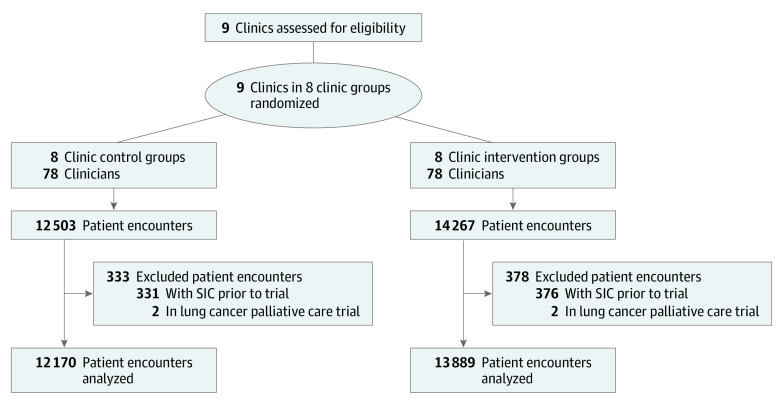
DESIGN, SETTING, AND PARTICIPANTS: This stepped-wedge cluster randomized clinical trial was conducted across 20 weeks (from June 17 to November 1, 2019) at 9 medical oncology clinics (8 subspecialty oncology and 1 general oncology clinics) within a large academic health system in Pennsylvania. Clinicians at the 2 smallest subspecialty clinics were grouped together, resulting in 8 clinic groups randomly assigned to the 4 intervention wedge periods. Included participants in the intention-to-treat analyses were 78 oncology clinicians who received SIC training and their patients (N = 14 607) who had an outpatient oncology encounter during the study period.

INTERVENTIONS

(1) Weekly emails to oncology clinicians with SIC performance feedback and peer comparisons; (2) a list of up to 6 high-risk patients (≥10% predicted risk of 180-day mortality) scheduled for the next week, estimated using a validated machine learning algorithm; and (3) opt-out text message prompts to clinicians on the patient's appointment day to consider an SIC. Clinicians in the control group received usual care consisting of weekly emails with cumulative SIC performance.

MAIN OUTCOMES AND MEASURES

Percentage of patient encounters with an SIC in the intervention group vs the usual care (control) group.

RESULTS

The sample consisted of 78 clinicians and 14 607 patients. The mean (SD) age of patients was 61.9 (14.2) years, 53.7% were female, and 70.4% were White. For all encounters, SICs were conducted among 1.3% in the control group and 4.6% in the intervention group, a significant difference (adjusted difference in percentage points, 3.3; 95% CI, 2.3-4.5; P < .001). Among 4124 high-risk patient encounters, SICs were conducted among 3.6% in the control group and 15.2% in the intervention group, a significant difference (adjusted difference in percentage points, 11.6; 95% CI, 8.2-12.5; P < .001).

CONCLUSIONS AND RELEVANCE

In this stepped-wedge cluster randomized clinical trial, an intervention that delivered machine learning mortality predictions with behavioral nudges to oncology clinicians significantly increased the rate of SICs among all patients and among patients with high mortality risk who were targeted by the intervention. Behavioral nudges combined with machine learning mortality predictions can positively influence clinician behavior and may be applied more broadly to improve care near the end of life.

TRIAL REGISTRATION

ClinicalTrials.gov Identifier: NCT03984773.

摘要

重要性

严重疾病对话(SICs)是临床医生和患者之间关于预后、治疗目标和临终偏好的结构化对话。增加肿瘤科临床医生和患者之间 SICs 发生率的干预措施可能会改善目标一致的护理和患者结局。

目的

确定一种临床医生指导的干预措施,该措施将机器学习死亡率预测与行为提示相结合,以激发临床医生与患者进行 SICs。

设计、设置和参与者:这是一项在宾夕法尼亚州的一个大型学术医疗系统内的 9 个医学肿瘤学诊所(8 个肿瘤亚专科和 1 个普通肿瘤学诊所)进行的 20 周(从 2019 年 6 月 17 日至 11 月 1 日)的分步楔形群随机临床试验。两个最小的肿瘤亚专科诊所的临床医生被分为一组,结果有 8 个诊所组被随机分配到 4 个干预楔形期。意向治疗分析包括 78 名接受 SIC 培训的肿瘤学临床医生及其患者(N=14607),他们在研究期间有门诊肿瘤学就诊。

干预措施

(1)每周向肿瘤学临床医生发送 SIC 绩效反馈和同行比较的电子邮件;(2)为下周安排最多 6 名高风险患者(≥180 天死亡率预测风险的 10%)的名单,使用经过验证的机器学习算法进行估计;(3)在患者预约日向临床医生发送退出文本消息提示,以考虑进行 SIC。对照组的临床医生接受常规护理,包括每周发送包含累积 SIC 绩效的电子邮件。

主要结果和测量

干预组与常规护理(对照组)组中患者就诊时进行 SIC 的百分比。

结果

该样本包括 78 名临床医生和 14607 名患者。患者的平均(SD)年龄为 61.9(14.2)岁,53.7%为女性,70.4%为白人。在所有就诊中,对照组中有 1.3%进行了 SIC,干预组中有 4.6%进行了 SIC,差异显著(调整后的百分比差异,3.3;95%CI,2.3-4.5;P<0.001)。在 4124 例高危患者就诊中,对照组中有 3.6%进行了 SIC,干预组中有 15.2%进行了 SIC,差异显著(调整后的百分比差异,11.6;95%CI,8.2-12.5;P<0.001)。

结论和相关性

在这项分步楔形群随机临床试验中,向肿瘤学临床医生提供机器学习死亡率预测和行为提示的干预措施显著提高了所有患者以及接受干预的高死亡率风险患者进行 SIC 的比例。行为提示与机器学习死亡率预测相结合可以积极影响临床医生的行为,并可能更广泛地应用于改善临终关怀。

试验注册

ClinicalTrials.gov 标识符:NCT03984773。

https://cdn.ncbi.nlm.nih.gov/pmc/blobs/0e6b/7563672/9ab549aa3609/jamaoncol-e204759-g001.jpg

相似文献

1
Effect of Integrating Machine Learning Mortality Estimates With Behavioral Nudges to Clinicians on Serious Illness Conversations Among Patients With Cancer: A Stepped-Wedge Cluster Randomized Clinical Trial.将机器学习死亡率估计与行为提示相结合,为临床医生提供指导,以改善癌症患者的严重疾病沟通:一项 stepped-wedge 聚类随机临床试验。
JAMA Oncol. 2020 Dec 1;6(12):e204759. doi: 10.1001/jamaoncol.2020.4759. Epub 2020 Dec 10.
2
Long-term Effect of Machine Learning-Triggered Behavioral Nudges on Serious Illness Conversations and End-of-Life Outcomes Among Patients With Cancer: A Randomized Clinical Trial.机器学习触发的行为推动对癌症患者严重疾病对话和临终结局的长期影响:一项随机临床试验。
JAMA Oncol. 2023 Mar 1;9(3):414-418. doi: 10.1001/jamaoncol.2022.6303.
3
Clinician- and Patient-Directed Communication Strategies for Patients With Cancer at High Mortality Risk: A Cluster Randomized Trial.面向高死亡风险癌症患者的临床医生和患者导向的沟通策略:一项集群随机试验。
JAMA Netw Open. 2024 Jul 1;7(7):e2418639. doi: 10.1001/jamanetworkopen.2024.18639.
4
Spending Analysis of Machine Learning-Based Communication Nudges in Oncology.肿瘤学中基于机器学习的沟通助推措施的成本分析
NEJM AI. 2024 Jun;1(6). doi: 10.1056/aioa2300228. Epub 2024 May 15.
5
Integrating machine-generated mortality estimates and behavioral nudges to promote serious illness conversations for cancer patients: Design and methods for a stepped-wedge cluster randomized controlled trial.将机器生成的死亡率估计和行为提示相结合,以促进癌症患者进行严重疾病对话的设计和方法:一项阶梯式楔形集群随机对照试验。
Contemp Clin Trials. 2020 Mar;90:105951. doi: 10.1016/j.cct.2020.105951. Epub 2020 Jan 23.
6
Behavioral economic implementation strategies to improve serious illness communication between clinicians and high-risk patients with cancer: protocol for a cluster randomized pragmatic trial.改善临床医生与癌症高危患者之间严重疾病沟通的行为经济学实施策略:一项群组随机实用试验方案。
Implement Sci. 2021 Sep 25;16(1):90. doi: 10.1186/s13012-021-01156-6.
7
Impact of Behavioral Nudges on the Quality of Serious Illness Conversations Among Patients With Cancer: Secondary Analysis of a Randomized Controlled Trial.行为推动对癌症患者严重疾病对话质量的影响:一项随机对照试验的二次分析。
JCO Oncol Pract. 2022 Apr;18(4):e495-e503. doi: 10.1200/OP.21.00024. Epub 2021 Nov 12.
8
Oncologist Perceptions of Algorithm-Based Nudges to Prompt Early Serious Illness Communication: A Qualitative Study.肿瘤学家对基于算法的提示进行早期严重疾病沟通的看法:一项定性研究。
J Palliat Med. 2022 Nov;25(11):1702-1707. doi: 10.1089/jpm.2022.0095. Epub 2022 Aug 18.
9
Oncologist phenotypes and associations with response to a machine learning-based intervention to increase advance care planning: Secondary analysis of a randomized clinical trial.肿瘤学家表型与基于机器学习的干预措施反应的关联,以增加预先护理计划:一项随机临床试验的二次分析。
PLoS One. 2022 May 27;17(5):e0267012. doi: 10.1371/journal.pone.0267012. eCollection 2022.
10
Evaluating an Intervention to Improve Communication Between Oncology Clinicians and Patients With Life-Limiting Cancer: A Cluster Randomized Clinical Trial of the Serious Illness Care Program.评估一项改善肿瘤临床医生与生命末期癌症患者沟通的干预措施:严重疾病护理计划的一项集群随机临床试验。
JAMA Oncol. 2019 Jun 1;5(6):801-809. doi: 10.1001/jamaoncol.2019.0292.

引用本文的文献

1
Artificial intelligence across the cancer care continuum.贯穿癌症护理全过程的人工智能
Cancer. 2025 Aug 15;131(16):e70050. doi: 10.1002/cncr.70050.
2
Using nudges with electronic health records systems to improve advance care planning: a systematic review.利用电子健康记录系统的助推手段改善预立医疗计划:一项系统综述
BMC Palliat Care. 2025 Jul 1;24(1):180. doi: 10.1186/s12904-025-01820-4.
3
The Use of Machine Learning for Analyzing Real-World Data in Disease Prediction and Management: Systematic Review.机器学习在疾病预测与管理中分析真实世界数据的应用:系统评价
JMIR Med Inform. 2025 Jun 19;13:e68898. doi: 10.2196/68898.
4
Bridging the Gap: From AI Success in Clinical Trials to Real-World Healthcare Implementation-A Narrative Review.弥合差距:从人工智能在临床试验中的成功到现实世界医疗保健实施——一项叙述性综述
Healthcare (Basel). 2025 Mar 22;13(7):701. doi: 10.3390/healthcare13070701.
5
Predictors and Drivers of End-of-Life Medicare Spending Among Older Adults with Solid Tumors: A Population-Based Study.实体瘤老年患者临终医疗保险支出的预测因素与驱动因素:一项基于人群的研究
Cancers (Basel). 2025 Mar 18;17(6):1016. doi: 10.3390/cancers17061016.
6
A SEMIPARAMETRIC METHOD FOR RISK PREDICTION USING INTEGRATED ELECTRONIC HEALTH RECORD DATA.一种使用综合电子健康记录数据进行风险预测的半参数方法。
Ann Appl Stat. 2024 Dec;18(4):3318-3337. doi: 10.1214/24-AOAS1938. Epub 2024 Oct 31.
7
Audit and feedback: effects on professional practice.审核与反馈:对专业实践的影响
Cochrane Database Syst Rev. 2025 Mar 25;3(3):CD000259. doi: 10.1002/14651858.CD000259.pub4.
8
Nudging Clinicians to Promote Serious Illness Communication for Critically Ill Patients: A Pragmatic Cluster Randomized Trial.引导临床医生促进重症患者的严重疾病沟通:一项实用的整群随机试验。
JAMA Intern Med. 2025 May 1;185(5):510-520. doi: 10.1001/jamainternmed.2025.0090.
9
Quality Improvement Study Using a Machine Learning Mortality Risk Prediction Model Notification System on Advance Care Planning in High-Risk Patients.使用机器学习死亡率风险预测模型通知系统对高危患者进行预先护理计划的质量改进研究。
J Brown Hosp Med. 2024 Jul 2;3(3):120907. doi: 10.56305/001c.120907. eCollection 2024.
10
Algorithm-Based Palliative Care in Patients With Cancer: A Cluster Randomized Clinical Trial.基于算法的癌症患者姑息治疗:一项整群随机临床试验
JAMA Netw Open. 2025 Feb 3;8(2):e2458576. doi: 10.1001/jamanetworkopen.2024.58576.