Malaysian Research Institute of Ageing (MyAgeing), Universiti Putra Malaysia, 43400, Serdang, Selangor Darul Ehsan, Malaysia.
Department of Community Health, Faculty of Medicine and Health Sciences, Universiti Putra Malaysia, 43400 UPM, Serdang, Selangor Darul Ehsan, Malaysia.
BMC Public Health. 2020 Oct 15;20(1):1550. doi: 10.1186/s12889-020-09587-4.
Intimate partner violence (IPV) is any behaviour within an intimate relationship that causes physical, psychological or sexual harm to those in the relationship. IPV is an important public health problem with substantial consequences on physical, mental, sexual, and reproductive health. Data on the systematic review of IPV are vital as basis for policy and program recommendations. The purpose of this systematic review was to ascertain the prevalence of IPV and its associated factors in Malaysia.
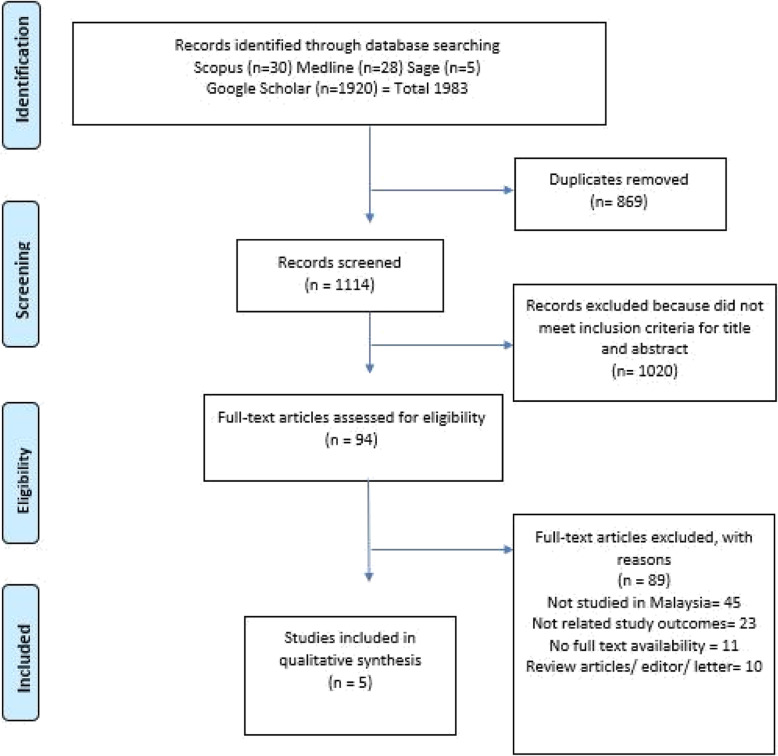
A systematic review was conducted on published research studies from four databases which included Scopus, Medline, Sage and Google Scholar using keywords of intimate partner violence OR IPV AND associated factors OR risk factors OR protective factors AND Malaysia. Articles included were either cross-sectional, cohort or case-control studies which were published between the year 2005 till present. Excluded articles were the non-Malaysian origin, irrelevant topics being studied and articles not written in English.
Out of 1983 records identified and screened, five were included for the analysis and interpretation of the data. All of the included studies were of cross-sectional design in which one of the studies was secondary data. IPV prevalence in Malaysia has a wide range between 4.94 and 35.9%. Two studies reported emotional or psychological abuse as the most common form of IPV (13% out of 22%) and (29.8%; CI = [0.27, 0.32]). Significant factors associated with IPV were lower education background, lower socio-economic status, history/ current substance abuse, exposure to prior abuse or violence, violence-condoning attitude; husbands or partners controlling behaviour, substance abuse and involvement in fights and lack of social support.
Specific IPV intervention should focus on lower socio-economic groups, high-risk institutionalised groups, the involvement of partners or husband and addressing issues of substance abuse.
亲密伴侣暴力(IPV)是指在亲密关系中对关系中的人造成身体、心理或性伤害的任何行为。IPV 是一个重要的公共卫生问题,对身体、心理、性和生殖健康都有重大影响。关于 IPV 的系统评价数据对于政策和方案建议至关重要。本系统评价的目的是确定马来西亚 IPV 的流行率及其相关因素。
使用关键词“亲密伴侣暴力”或“IPV 及相关因素”或“风险因素”或“保护因素”和“马来西亚”,对来自 Scopus、Medline、Sage 和 Google Scholar 四个数据库的已发表研究进行了系统评价。纳入的文章包括横断面、队列或病例对照研究,发表时间在 2005 年至目前。排除的文章包括非马来西亚本土、研究主题不相关和非英文发表的文章。
从 1983 条记录中确定并筛选出 5 条进行数据分析。所有纳入的研究均为横断面设计,其中一项研究为二次数据。马来西亚的 IPV 流行率范围很广,从 4.94%到 35.9%不等。两项研究报告称,情感或心理虐待是最常见的 IPV 形式(22%中的 13%)和(29.8%;CI=[0.27, 0.32])。与 IPV 相关的显著因素包括教育程度较低、社会经济地位较低、既往或当前物质滥用史、既往虐待或暴力暴露、暴力容忍态度、丈夫或伴侣控制行为、物质滥用以及参与打架和缺乏社会支持。
特定的 IPV 干预应针对社会经济地位较低的群体、高风险的机构化群体、伴侣或丈夫的参与以及解决物质滥用问题。