Li Hang, Wang Min, Zhou Hui, Lu Shan, Zhang Bo
Department of Hepatobiliary and Pancreas Surgery, China-Japan Union Hospital, Changchun, People's Republic of China.
Department of Pathology, Jilin Provincial Cancer Hospital, Changchun, People's Republic of China.
Cancer Manag Res. 2020 Sep 29;12:9339-9349. doi: 10.2147/CMAR.S261976. eCollection 2020.
Therapy for patients with liver cancer in the advanced stage remains a great challenge, and there are very few approved treatments. Although accumulated evidence demonstrates the importance of lncRNAs in liver cancer, data on the functional roles and molecular mechanisms of endogenous bornavirus-like nucleoprotein () have been rarely reported.
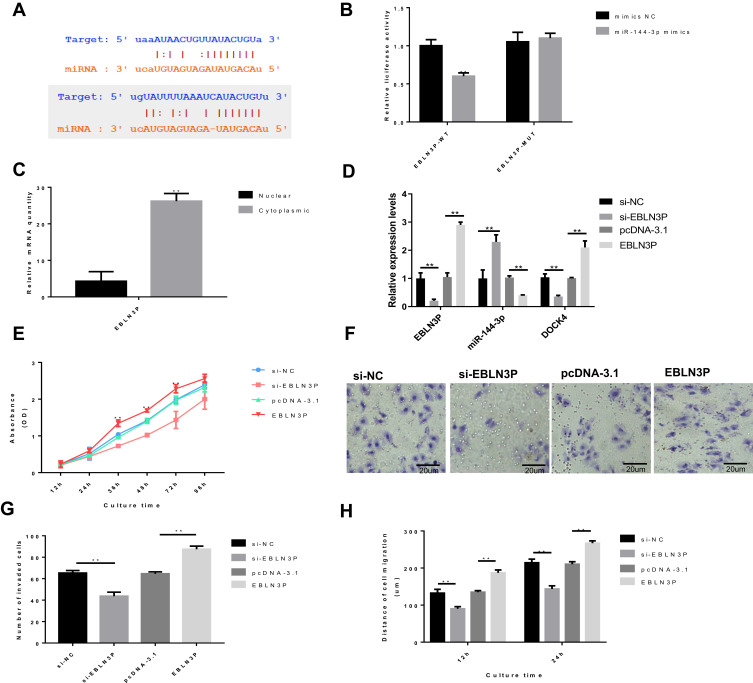
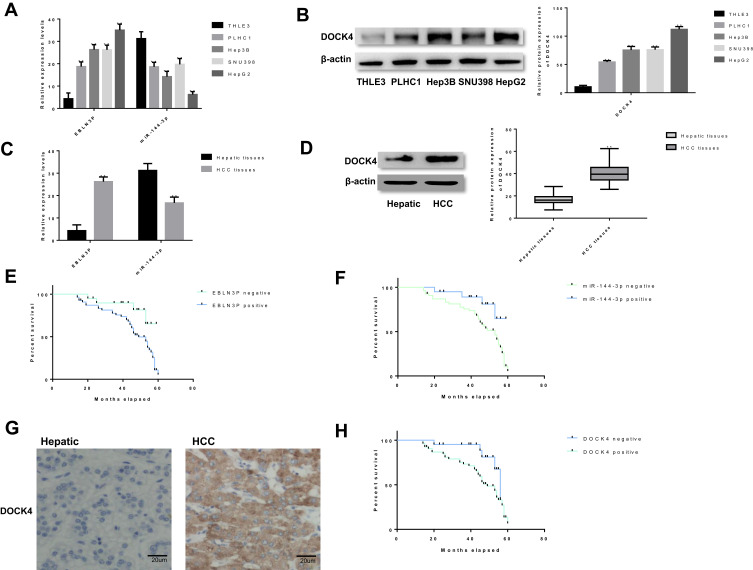
The bioinformatics prediction software ENCORI was used to predict the putative binding sites of . The regulatory roles of EBLN3P and in cell proliferation, migration and invasion ability were verified by the Cell Counting Kit-8, wound healing and Transwell assays, respectively. The interactions among , and were explored by a luciferase assay and Western blotting. The expression of and microRNA (miR)-144-3p in liver cancer tissues was quantified by reverse transcription-quantitative PCR, and the expression of dedicator of cytokinesis 4 (DOCK4) was quantified by immunohistochemical analysis.
The present results revealed that overexpression of or knockdown of promoted liver cancer cell proliferation, migration and invasion. Bioinformatics analysis and a luciferase assay demonstrated that directly interacts with to attenuate binding to the 3'-untranslated region of . Furthermore, the mechanistic investigations showing that the miR-144-3p/DOCK4 regulatory loop was activated by knockdown of miR-144-3p or overexpression of validate the roles of in promoting liver cancer cell proliferation, migration and invasion in vitro. Elevated levels of and and decreased expression were observed in both liver cancer tissues and cell lines.
The present study is the first to demonstrate that may act as a ceRNA to modulate expression by competitively sponging , leading to the regulation of liver cancer progression, which provides new insights for liver cancer diagnosis and treatment.
晚期肝癌患者的治疗仍然是一个巨大的挑战,且获批的治疗方法非常少。尽管越来越多的证据表明长链非编码RNA(lncRNAs)在肝癌中具有重要作用,但关于内源性博尔纳病毒样核蛋白(EBLN3P)的功能作用和分子机制的数据却鲜有报道。
使用生物信息学预测软件ENCORI预测EBLN3P的假定结合位点。分别通过细胞计数试剂盒-8、伤口愈合试验和Transwell试验验证EBLN3P和DOCK4对细胞增殖、迁移和侵袭能力的调节作用。通过荧光素酶试验和蛋白质免疫印迹法探究EBLN3P、DOCK4和miR-144-3p之间的相互作用。通过逆转录-定量PCR定量检测肝癌组织中EBLN3P和微小RNA(miR)-144-3p的表达,并通过免疫组织化学分析定量检测细胞分裂素4(DOCK4)的表达。
目前的结果显示,EBLN3P的过表达或DOCK4的敲低促进了肝癌细胞的增殖、迁移和侵袭。生物信息学分析和荧光素酶试验表明,EBLN3P直接与miR-144-3p相互作用,减弱了miR-144-3p与DOCK4 3'-非翻译区的结合。此外,机制研究表明,敲低miR-144-3p或过表达EBLN3P激活了miR-144-3p/DOCK4调节环,这证实了EBLN3P在体外促进肝癌细胞增殖、迁移和侵袭中的作用。在肝癌组织和细胞系中均观察到EBLN3P和miR-144-3p水平升高,DOCK4表达降低。
本研究首次证明EBLN3P可能作为一种竞争性内源RNA(ceRNA),通过竞争性结合miR-144-3p来调节DOCK4的表达,从而调控肝癌进展,这为肝癌的诊断和治疗提供了新的见解。